
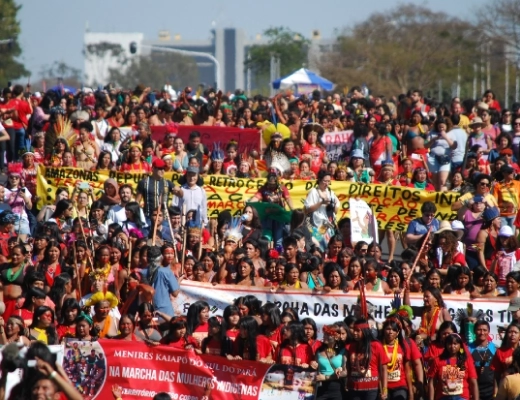






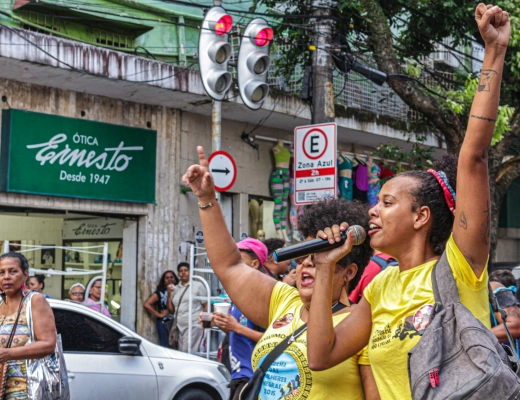

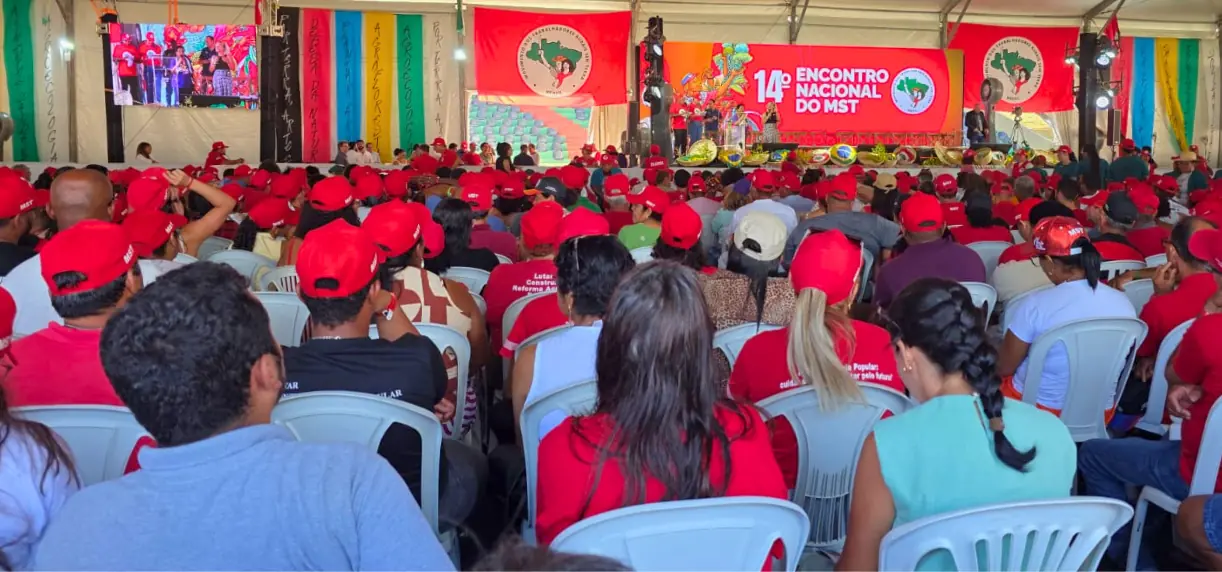
Between January 19 and 23 of 2026, the Labora Fund for Decent Work team accompanied the 14th National Gathering of the Landless Rural Workers’ Movement (MST), realized in Salvador (BA). The event gathered over 3.500 people — among delegates and national and international guests — to celebrate the 42 years of trajectory of the largest peasant movement in Latin America.
The promotion of decent conditions of work and life in the countryside is one of Labora’s priorities. In 2 years, Labora has granted over R$ 2 million (circa 400,000 USD) through 11 grants to MST, including calls for proposal, invitation letters, and complementary grants for mobilization, articulation, and social participation. Amanda Camargo, projects’ manager of Labora, reinforced the importance and joy of being able to take part in the learning journey promoted by the Gathering. “Labora is a partner of MST and strengthens the Movement in its internal organization, in its training activities in Human Rights and collective organization, and also in the development of its proposals and agendas for climate justice and a truly just ecological transition”, she complements.
The gathering promoted a balance in the actions of political training, the Movement’s internal organicity, and national and international cooperation. One of the highest points of the agenda was the approval of the Popular Agrarian Reform Program. The document establishes the MST directives for the construction of an agrarian model that prioritizes the dignity of workers and social transformation, consolidating the fight for land as a pillar of sovereignty for Brazil.
For Ísis Campos, member of the MST National Coordination and responsible for the projects’ area, the moment is of celebration and debates. According to her, “it’s a moment to celebrate, exhibit our production in fairs, showcase the positive results of the Agrarian Reform, but it’s above all a space for debates and the sharing of syntheses that we have been stacking over the latest period about our Popular Agrarian Reform Program. The Movement is also electing its new Coordination and National Board of Directors, which will be comprised of over 150 men and women from all states of Brazil”.
Currently, MST is organized in 24 states, encompassing the country’s five regions. There are over 450 thousand families that have earned the right to land through collective organization, strengthening a solidary economy and ensuring dignity for those who live and work in the countryside. In the face of so much disinformation around MST, it bears reinforcing that the Agrarian Reform is an instrument backed by the Constitution (article 184) and the Land Statute (1964), which determine that property must fulfil its social function: they must be productive, respect the environment, labor laws, and promote social well-being.
Agroecology and Food Security
For the Movement, there’s been significative advancements to the massification of agroecology. The strategy aims to expand diversified production to ensure pesticide-free food originated from family farming in the population’s table. In the field of the National Plan “Plant Trees and Produce Healthy Food”, MST has celebrated the mark of almost 50 million saplings planted, reaching half of the established goal.
Beyond the National Plan, the recent focus has been the strengthening of agro-industries. The goal is to optimize circulation, reduce losses of perishable food, and add value to the production. Nowadays, MST coordinates about 200 cooperatives and over a thousand associations through the National Union of Agrarian Reform Cooperatives and Associations of Brazil (UNICRAB). These entities structure more than 30 productive chains — such as rice, milk, coffee, and vegetables — that supply fairs and markets throughout the national territory.
Decent work and ecological transition in the countryside
The presence of Labora in the gathering reaffirms the Brazil Human Rights Fund’s commitment to the promotion of decent conditions of life and labor in the countryside. MST is one of the organizations supported by Labora in many fronts: in the national scope through the strategic support via Invitation Letters; and in the regional and state scope through projects selected in the Strengthening Informal Workers in the Fight for Rights; Just Transition and Decent Work; and Strengthening Solutions from Indigenous Peoples, Local Communities, and Workers for Climate Justice calls for proposal.
Labora’s strategic support for MST strengthens the Movement’s acting in critical territories, as demonstrated by the work of the Amazonian Latin American Agroecology Institute (IALA Amazônico) in Pará. Supported by the call for proposal for the strengthening of informal labor, the Institute acts in the Land and Freedom camp in Parauapebas, where over 5 thousand workers face the precariousness generated by large mining enterprises. The project promotes internal organization and agroecology as tools for autonomy, creating alternatives to degrading work and tackling social vulnerabilities in the Amazon region.
As for the project by the Anna Primavesi Rural Workers’ Association, also located in Pará, it focuses on strengthening the Nucleus for Cooperation of Women in Agroecology (NUCMA), headquartered in the Quintino Lira Settlement in Santa Luzia do Pará, but with impact and articulation throughout the whole state. The association promotes integrated actions for environmental restoration, the strengthening of agroecology, the valuing of female protagonism, and the guarantee of social and territorial rights.
Complementarily, MST-RR has been acting since 2005 in rural organization and now advances in a project focused on political training and just transition. The initiative in Roraima enables militants to connect the fight for rights to the climate agenda, using resources for cycles of theoretical training and land diagnosis that base the popular agrarian reform. This local effort adds up to the national actions supported by Labora through Invitation Letters, which aim to tackle the growth of violence in the countryside of the Northeast, Amazon, and Center-West regions through collective mobilization and protection of Human Rights.