







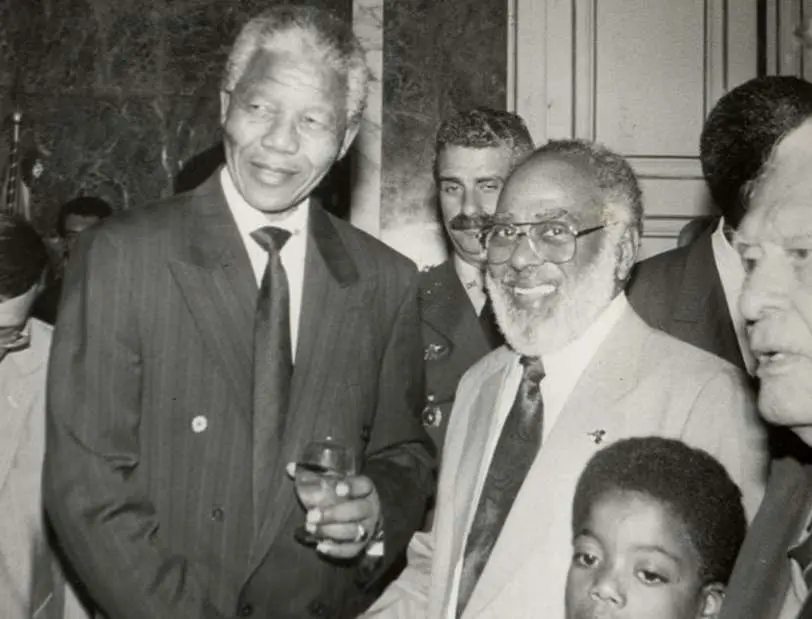
Abdias Nascimento and Nelson Mandela (Ipeafro Divulgation)
Intellectual, poet, playwright, and visual artist. Abdias Nascimento, one of the Brazil Fund’s institutors, piles up titles and professions that, though different in essence, sought the same goal: the Black population’s emancipation. An activist of Pan-Africanism – a political theory that seeks the union of African peoples and their descendants – and human rights, he was also the first Brazilian politician to propose an affirmative action law for the Black population.
For Abdias, the end of racism in the country had to go through the mobilization of civil society and the political sphere. He promoted countless actions in that line, and coordinated the Brazilian fight for racial equality with the liberation movements in Africa and the civil and human rights movements in the United States.
This internationalist gaze had domestic origins: Abdias recounted that his trajectory fighting racism began at home. One time, as a boy, he saw his mother get angry at seeing a white woman beat a Black boy. Dona Josina’s intervention in the situation was his first example of Pan-Africanist solidarity and “marked the beginning of my awareness on the reality of the Black man’s situation in Brazil”, he wrote in the book Memórias do Exílio, published in 1976.
“I didn’t learn human rights with books, nor in the time in which I studied. I learned them when I was seven or eight, from a person that didn’t know how to read or write, never went to school, and baked sweets to provide for her seven children. That person was my mother. She taught me the fight for human rights not by talking, but by acting and showing me. She fought violence, injustice, and the white people who beat Black people.”
Abdias also fought racism in the cultural field. In 1944, the playwright founded the Black Experimental Theater, the first Brazilian theater company dedicated to Black protagonism.
Upon acknowledging that racism was still present in social relations even after the end of slavery, Abdias challenged his time’s common sense. The topicality of his extensive written work, joined with the activism that marked his trajectory, makes him one of Brazil’s most important thinkers.
Abdias passed away in 2010, at the age of 97. “He was the greatest leader of our struggles, and in honor of his memory we’ll keep fighting”, claimed the philosopher Sueli Carneiro, by that time director of the Brazil Human Rights Fund.
Aside Margarida Genevois, Rose Marie Muraro and D. Pedro Casaldáliga, Abdias is one of the Brazil Human Rights Fund’s institutors.
The foundation completes 20 years in 2026. As part of the celebrations, it revisits the history and legacy of these characters that are so important to human rights in the country.
The profile below was originally published in the magazine that celebrated the Brazil Fund’s 5th anniversary, in 2011.
Human rights: an everlasting learning
“I didn’t learn human rights with books, nor in the time in which I studied. I learned them when I was seven or eight, from a person that didn’t know how to read or write, never went to school, and baked sweets to provide for her seven children. That person was my mother. She taught me the fight for human rights not by talking, but by acting and showing me. She fought violence, injustice, and the white people who beat Black people.”
Abdias Nascimento was contemporaneous to a very hard time for the Black population in the country. Born in 1914, in the town of Franca, São Paulo, he lived in a time in which the wounds of slavery were still recent. He dedicated most of his years to the fight for the end of racial discrimination. “Throughout all my life, for almost a century, this is how it went: practicing [the fight for human rights]. I’m not a writer or theorist of human rights. I don’t know how to elaborate theories; I know how to act”, he said, in the commemoration of his 92nd birthday.
His fight for racial equality began very early when he joined, in 1930, the Brazilian Black Front, considered the first Brazilian movement for civil rights. His militancy was also exerted through art. Abdias contributed expressively to the development of Afro culture and to the formation of Afro-descendant artists. Himself an artist, poet, and writer, he created the Black Experimental Theater (TEN) in 1944. The idea arose after having watched a pay in which a white actor painted his face to play a Black character. TEN was responsible for the formation of the country’s first generation of Black actors, as well as contributing to the creation of Afro-Brazilian dramatic literature.
Ahead of TEN, in 1950 Abdias organized the 1st Black Brazilian Congress and edited the Quilombo newspaper. “The Quilombo fight isn’t specifically against those that deny our rights, if not particularly to remind or make known to the Black man his own rights to life and culture”, he wrote in the first publication editorial.
Abdias was aware that the fight against racism in Brazil went through the mobilization of civil society and the political sphere. He promoted countless actions in both these fronts, such as the organization of the Black National Convention (1945/46), that proposed to the Constitutional Convention a constitutional device that would define racial discrimination as a lese-nation crime. He coordinated the Brazilian fight for racial equality to liberation movements in Africa and civil and human rights movements in the United States.
Therefore, as other human rights militants, he had the authoritarian State as an opponent. He faced two condemnations that landed him in jail. The first time, he was arrested and sentenced to prison in the Frei Caneca street Penitentiary (RJ), by the National Security Tribunal for protesting against the Estado Novo dictatorship in 1937. In 1941, he was imprisoned in Carandiru (SP), sentenced by default for resisting racist aggressions in incidents that had taken place in 1936.
In prison, he created the Convicted Theater, formed by a group of prisoners who wrote, directed, and performed dramatic plays. The military regime, in turn, was responsible for his exile. The Institutional Act n.º 5 was instituted when he was in the United States. Abdias then remained in the United States and in Nigeria for 13 years, because the police inquiries against him in Brazil would have him arrested, should he return. In that time, he produced artistic works whose themes were Black culture and resistance against slavery and racism.
Abdias returned to Brazil in 1978, when he took part in public acts and in meetings for the foundation of the Black Unified Movement against Racism and Racial Discrimination. Three years later, he founded Ipeafro (Institute of Afro-Brazilian Research and Study). With re-democratization, he pursued a political career. He was the first federal representative (RJ) to devote himself to the defense of the Afro-descendant population’s rights. During his term (1983-86), he proposed the first law bill for affirmative public policies in Brazil. He also authored the bill that typifies racism as a crime.
Between 1991 and 1992 and 1997 and 1999, he was a senator, taking over the seat as alternate for the anthropologist Darcy Ribeiro. He was also secretary of Defense and Promotion of Afro-Brazilian Populations in the state government of Rio de Janeiro (1991-94). “I have built my life in a constant state of learning, in a constant state of struggle. Firstly, for the rights of Afro-descendants, then for the entire Brazilian people, and then for all human beings. All deserve to have their rights respected”, he claimed.
In 2006, he received from president Luiz Inácio Lula da Silva the Rio Branco Order with the Comendador degree, the highest honor conferred by the Brazilian government. In 2010, he was indicated to the Nobel Peace Prize. Abdias believed that the fight against racism and for the inclusion of Afro-descendants in Brazilian society were determinants so that human rights could be fulfilled. That’s why his work left an inestimable legacy in the Black movement and also in the fight for human rights in Brazil. “To promote human rights in Brazil means to prioritize the effective social inclusion of Afro-descendants, because the racial discrimination system in Brazil, more effective than the South-African apartheid, has built a racism that powerful sectors insist in denying and solemnly ignoring, therefore impeding the search for effective solutions”. Abdias passed away in 2010, at 97 years old. “He was the greatest leader in our struggles, and in honor of his memory, we’ll keep fighting”, affirms Sueli Carneiro.