


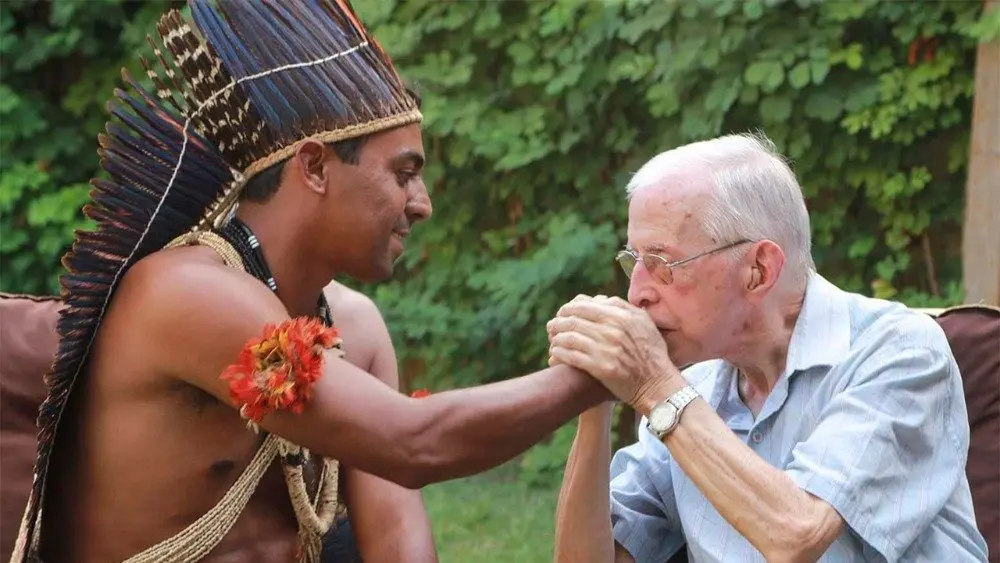
D. Pedro Casaldáliga, bishop of the poor and Indigenous peoples. (Picture: Divulgation/ Vatican News)
As soon as he was ordained bishop of São Félix do Araguaia, in 1971, D. Pedro Casaldáliga (1928-2020) published a pastoral letter in which he criticized the great latifundia and the economic development model then adopted in Brazil. His focus was, particularly, the big development projects initiated by the military dictatorship in the South-Southeast axis of the Amazon. “It wasn’t a solely theoretical pastoral letter, of religious, political, or economic considerations; it was a letter that gave the minute details of the region’s injustices”, he told the Brazil Fund in 2011.
It was also a demonstration of courage. Located on the eastern border of Mato Grosso, close to the state line with Tocantins, the region of São Félix do Araguaia lived through the rapid expansion of the agricultural frontier, done at the expanse of the Indigenous and local populations. Against that trend, Pedro (as he preferred to be called, without the “Dom”), took a stand in favor of the agrarian reform. “Governments have a debt towards the agrarian reform, and also the agricultural one. To not meet that demand means to propel millions of families on an exodus towards the city, where they will find unemployment and violence, which are lethal mostly for the youth. It’s necessary to have a possibility to live decently off of the land, to end slave labor, sub-employment, and cheap labor in the countryside”, he stated.
That acting branded him as a communist and made D. Pedro a target for death threats — something that repeated itself on many occasions throughout his almost five decades of activity. Born in Catalonia, from whence he came to Brazil at the end of the 1960s, the bishop was targeted by five lawsuits for his expulsion from Brazil during the military dictatorship. At the time, he counted with the intervention of the archbishop of São Paulo, Dom Paulo Evaristo Arns.
His commitment to the impoverished, to the landless, to Indigenous peoples and local communities, however, never wavered. Casaldáliga passed away in August 8th 2020. His body was laid in state barefoot. Upon him, a patchwork stole that came from Nicaragua and a pastoral crucifix made by Xavante Indigenous people.
Aside Margarida Genevois, Abdias Nascimento and Rose Marie Muraro, D. Pedro is one of the founders of the Brazil Human Rights Fund.
The foundation completes 20 years in 2026. As part of the celebrations, it revisits the history and legacy of these figures that are so important for human rights in the country.
The profile below was originally published in the magazine that celebrated the Brazil Fund’s 5th anniversary in 2011.
Right to land: a right for life
In the 1970s, the agricultural frontiers expanded through territories of the Center-West and North regions of the country which, up until then, were preserved areas inhabited solely by local populations. Dom Pedro Casaldáliga was a witness to that. Resident of São Félix, an amazonian municipality of Mato Grosso, from that time he sorrowfully watched the devastation that the imposed economic model caused in a good part of the Amazon. Born in Barcelona, Spain, Dom Pedro moved to Brazil in 1968, having been ordained bishop of the Catholic Church in 1971. Here, he was one of the icons of Liberation Theology.
His motto, “To possess nothing, to carry nothing, to ask for nothing, to silence before nothing, and above all, to kill nothing”, inspired and guided all his work as a religious leader and defender of the land rights of local communities.
Throughout more than four decades, he faced great and powerful ruralists, the region’s exploitative companies, and local politicians, in his fight against slave labor, environmental degradation, and land conflicts. “We have remained as a latifundia for 500 hundred years. We remain as exclusion and violence in the countryside, and land hoarding. We remain as agribusiness, masqueraded latifundia. We remain as toxicity, depredation”, he claimed in an interview to the Brazil Fund in 2011, by occasion of the Foundation’s five-year anniversary.
As one of the main activists for agrarian reform, he took active part in the founding of the Missionary Indigenist Council (1972) and of the Pastoral Land Commission (1975), created to deal with the agrarian matter and Indigenous peoples’ rights in Brazil.
Governments have a debt towards the agrarian reform, and also the agricultural one. To not meet that demand means to propel millions of families on an exodus towards the city, where they will find unemployment and violence, which are lethal mostly for the youth. It’s necessary to have a possibility to live decently off of the land, to end slave labor, sub-employment, and cheap labor in the countryside”, he stated.
The bishop’s intensive literary activity was one of the instruments of his militancy, through which he expressed his indignation against the socioeconomic system of rural Brazil. In the same year in which he was ordained bishop of São Félix do Araguaia, Dom Pedro wrote the Pastoral Letter “A Church from the Amazon in conflict with latifundia and social marginalization”.
In the text, he denounced the losses and damages caused by big farmers and large developmentalist projects, initiated by the military dictatorship in the South-Southeast axis of the Amazon. “The fact I had been ordained bishop enabled me to speak out. I intended to shout out [against] casa-grande and senzala… A few having so much, and so many being slaves. The letter was taken up by many forces on the left and from the more committed Church. We presented data, names, lawsuits. It wasn’t only a theoretical pastoral letter, of religious, political, or economic considerations; it was a letter that gave the minutest details of the region’s injustices.”
Because of his resistance to human rights violations Dom Pedro was threatened with death several times. During the military dictatorship, he was target by five lawsuits for his expulsion from Brazil. At that time, he counted with the intervention of the archbishop of São Paulo, Dom Paulo Evaristo Arns. “That very repression stimulated our responsibility for the panorama. We couldn’t dispense with talking about land, censoring the government, criticizing the police. What was evident to our awareness could turn into a shout for others that sought liberation”, he reminded.
When he talked to the Brazil Fund in 2011, D. Pedro believed that the country’s development model was still mistaken. In those years the construction of the Belo Monte hydroelectric plant on the Xingu was being discussed. Inaugurated in 2016, the power plant blocked the flow of one of the Amazon’s largest rivers, forced the displacement of the local population, and brought about social and environmental losses for the region: “All great projects, by definition, are already anti-popular and anti-economic. [They] are for the accelerated accumulation of investment capital. For the [local] people, the normal rhythm of life will be missed, while the white elephants stay around, such as the transposition of the São Francisco River and [the hydroelectric plant of] Belo Monte. It’s the obsession with the big and immediate”, he reflected.
Dom Pedro believed, however, that a new awareness would be born regarding human rights: “We talk of rights with all naturality, but in past decades it was a weird word, of few fanatics. Now we realize it’s a radically vital and essential matter. I feel that, in a certain way, human rights are still the luxury and privilege of a few, who see themselves as more human than other humans. And that, on the other hand, when the conditions for human life are too precarious, human dignity itself becomes prohibited; there are many people who live thinking only of survival”.
Even after his request for renouncing the prelature in 2003, with his successor named as bishop Leonardo Ulrich Steiner, Dom Pedro kept fighting. A writer and poet, he maintained his untiring militancy against the injustices in the countryside.