






In Miranda, a Pantanal-region municipality that is home to roughly 25,000 inhabitants, fishing is considered a traditional practice, passed down from generation to generation. The family of Nilza Bandeirazwicker, a member of APAIM, is one such example. Now 60, she recalls when she was still very young, and her father fished.
“I was born and raised on the riverbank. My father raised seven children, living exclusively from fishing,” she recalls. Like him, Nilza maintained this dynamic until changes in legislation began to directly impact the way of life of fishing communities. In July 2023, Law No. 12.197/2023, popularly known as Zero Transport, was enacted. It prohibits the fishing and transportation of 12 fish species, such as pacu, pintado, and dourado, which are among the main species caught by artisanal fishers.
Established in 2005, the Artisanal Bait Fishers Association of Miranda (APAIM) seeks to support and strengthen fishers in the region, helping guarantee the continuity of their traditional practices. However, in light of the restrictions imposed by the legislation and its impacts on artisanal fishing, the association had to reorganize and pursue alternative sources of income.
In 2024, they received support from the Brazil Fund, through the Traditional Communities Fighting for Climate Justice call for proposals, with the goal of expanding their activities. They now work with beekeeping projects centered on sustainable income generation and environmental protection.
Climate change affects life in the Pantanal
In Mato Grosso do Sul, fishing is regulated to prevent fish stocks from declining due to extreme heat and the historic drought affecting the rivers. Despite being considered a flooded plain, the Pantanal experiences seasonal wildfires. These usually occur during the dry season, between July and October.
The challenge, however, is that the impacts of human activity and climate change have led to fires exceeding expected patterns. “Here we have periods of flooding and drought. Year after year, the floods have decreased significantly. There is still some rain, but not enough. In the past, in my youth — and even until about 10 years ago — we didn’t see such large fires because the Pantanal was completely flooded and the water receded slowly. The ground still retained moisture. Now it doesn’t,” Nilza explains.
Support from the Brazil Fund arrived in 2024 at a critical moment. Shortly before, in late 2023, the territory experienced another wildfire. Nilza recalls that one as “the strongest and most terrible” to date. Amid the flames, the beekeepers, who also serve as volunteer firefighters, tried to contain it, but with limited success. Many, including Nilza, were hospitalized due to smoke inhalation.
The fire, besides harming the health of the community residents, also destroyed most of the bait hives — the main equipment used in beekeeping. “Support from the Brazil Fund was crucial. It came at a time when our boxes had been nearly wiped out and we most needed to keep working. With the first installment, we bought new boxes to replace what we lost,” she says.
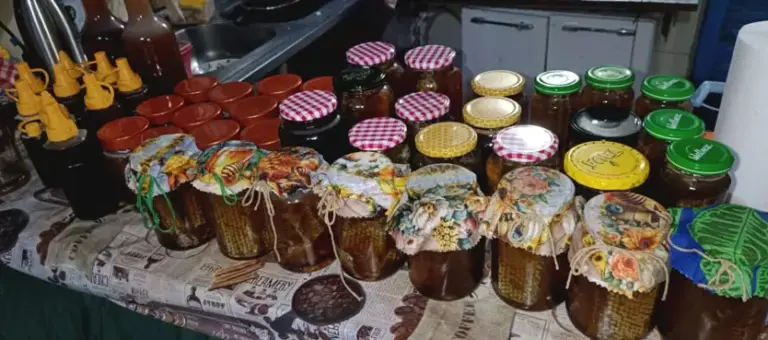
One of the results of the beekeepers’ work is honey. / Photo: APAIM
Altogether, 100 beehive boxes (nests) and 100 honey supers (where honey is stored) were acquired, with 10 units of each distributed to each beekeeper involved in the project. In a period of 6 months, Nilza produced 150 kilos of honey.

Photo: APAIM
Throughout the project, they learned new techniques that enabled them to produce additional products using beeswax. These included: propolis, mead, candles, soaps, and skincare creams.
Beekeeping has become a path to climate justice:
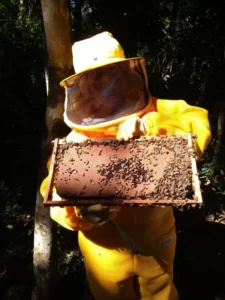
Photo: APAIM
The intense heat caused by climate change continues to affect daily activities. The hottest hours of the day, especially in the afternoon, are the most challenging for carrying out production.
To solve this problem, they created strategies. They start work at 4 am and finish at 8 am, when temperatures are still mild. If there are still tasks to be done, they only return at night, when the weather is cooler.
The transportation of bees is also done at dusk. “We transport them at night because it’s cooler, so they don’t suffer too much or die during the journey,” she explains.
Even with the shift in activities, the organization continued to be mindful of the environmental impact of its work. Bees are essential to environmental balance: without them, many fruits, crops, and plant species would not exist.
With this in mind, pollination has become essential to the food security of communities.
“We haven’t given up fishing; we’ve just broadened our scope.”
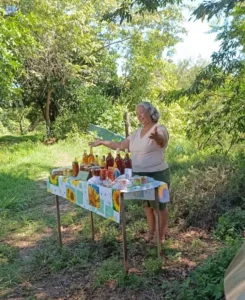
Photo: APAIM
Although fishing is no longer their most profitable activity, they continue to pursue it. With the ban on catching premium species, they have adapted, turning to lower-value fish instead. “We never intend to give up fishing. For us, it is a cultural matter, it comes from our grandparents and our parents,” Nilza reflects.