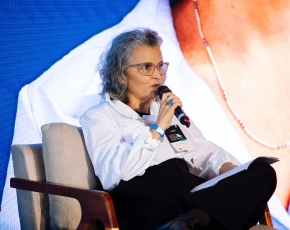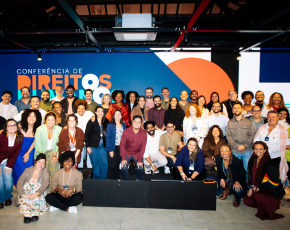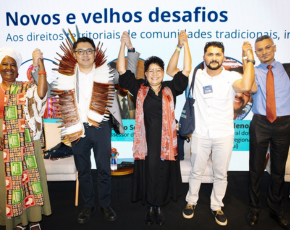




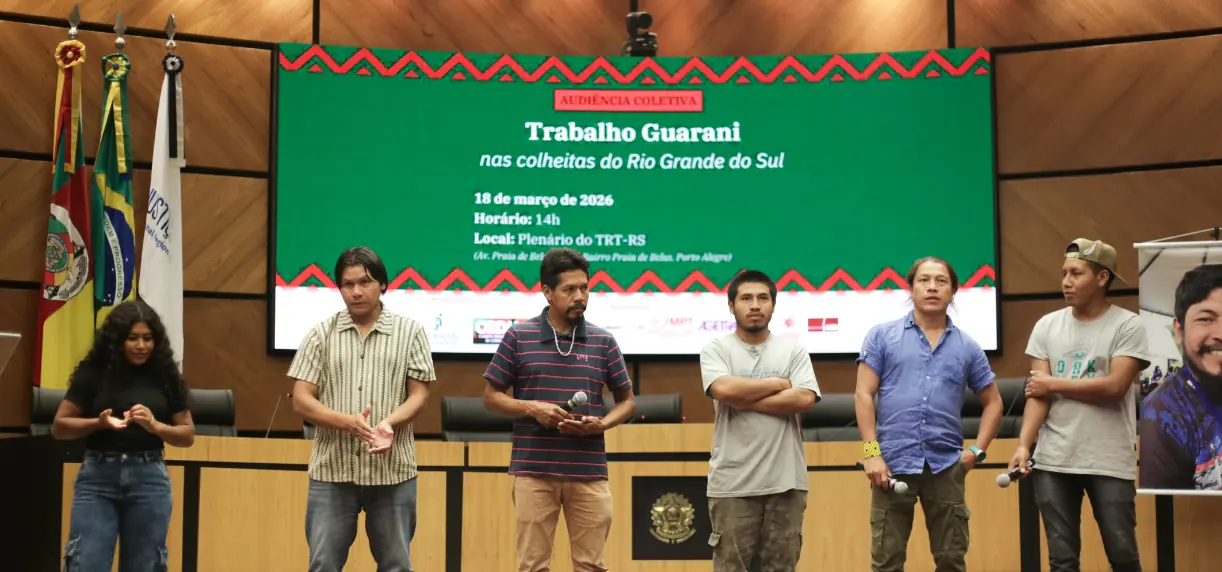
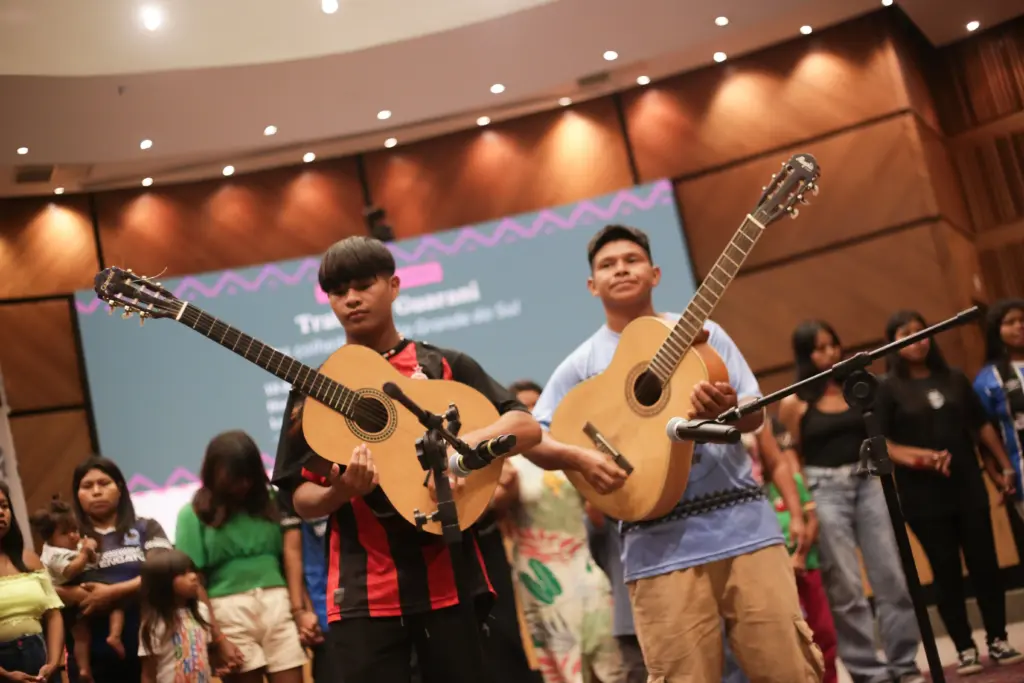
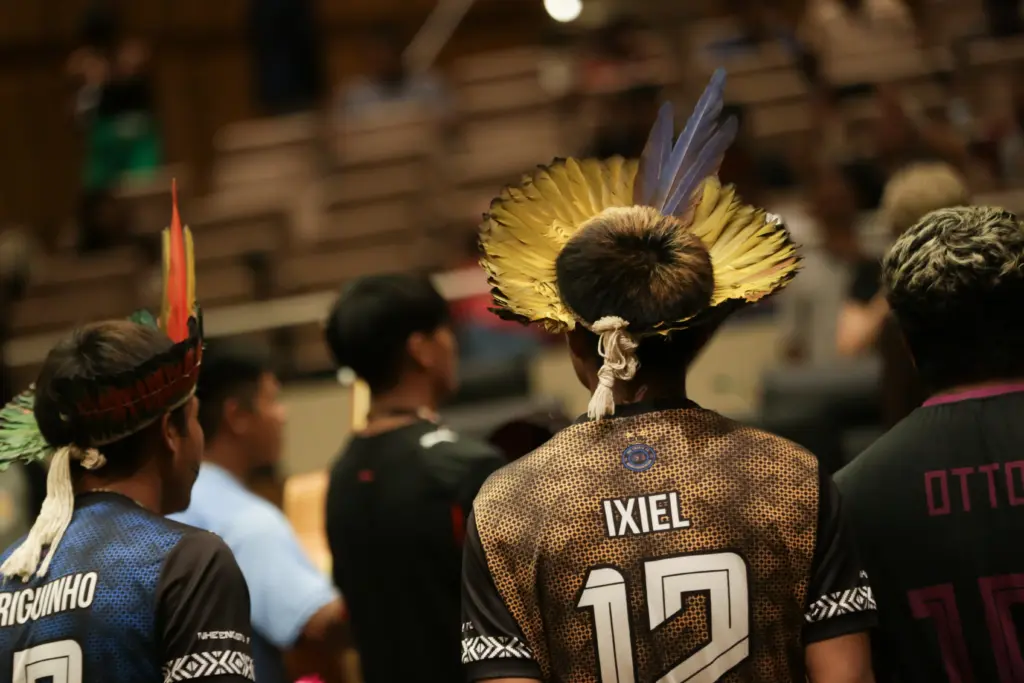
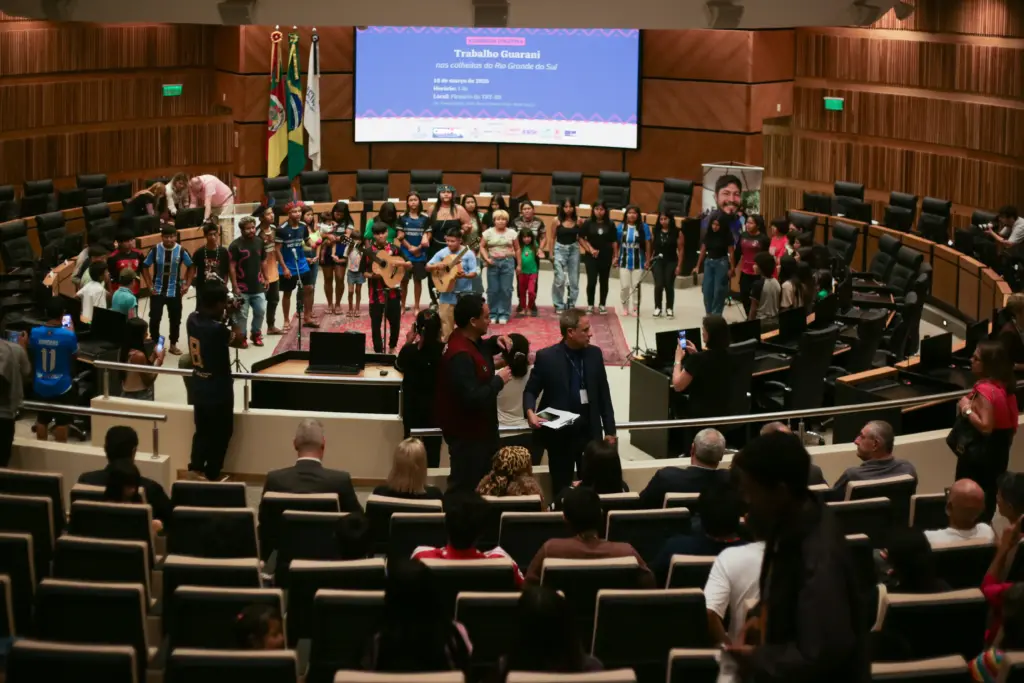
At the center of the first-floor plenary hall of the 4th Regional Labor Court (TRT-4), young Guarani chant prayers and songs while playing guitars, their colorful attire standing in contrast to the room’s sober walls. This moment marked the beginning of a collective hearing on exploitation and human rights violations faced by Guarani Indigenous workers in Rio Grande do Sul during seasonal harvests of grapes, olives, and other crops across different regions of the state. The gathering was organized by the Guarani Yvyrupa Commission and brought together representatives of the justice system, Indigenous leaders, and researchers. This was the first time Indigenous peoples were heard in this forum and actively took part in shaping a hearing around their own interests.
The hearing is part of the project “Uva Jepo’o – Expensive Wines and the Uva Po’oa Kuery (Mbyá-Guarani Grape Collectors)”, an initiative of the Guarani Awareness Association conducted with the support of Labora – Fund for Decent Work, an initiative of the Brazil Human Rights Fund. Selected by the call for proposals “Strengthening Informal Workers in the Fight for Rights 2024”, the project brings visibility to Indigenous workers of the Mbyá-Guarani ethnicity, who are frequently subjected to precarious conditions in the grape harvest in Rio Grande do Sul. Furthermore, it seeks to ensure these workers are educated about their rights while analyzing how racism intensifies inequalities in the work environment.
Exhausting working hours, unpaid wages, precarious housing, and abandonment
The accounts shared at the hearing are not isolated cases but part of a broader pattern of labor exploitation. This scenario is outlined in the report “Uva Jepo’o (Expensive Wines) and the Uva Po’oa Kuery,” presented during the hearing, coordinated by anthropologist Bruno Nascimento Huyer and developed from a project supported by Labora, with the participation of Guarani communities. According to the study, involvement in seasonal work is associated with the vulnerability of the territories, marked by limited access to land, pressure on traditional areas, and the absence of public policies.
According to data from Emater/RS-Ascar, there are 62 Guarani villages spread across 36 municipalities in the state, totaling around 4,000 people. Huyer’s report indicates that these communities live under a range of land tenure situations, including public areas, private lands, unregularized territories, and roadside encampments, and that, in most cases, the available land does not ensure subsistence within their own territories. As a result, seasonal farm work becomes one of the few income alternatives for families.
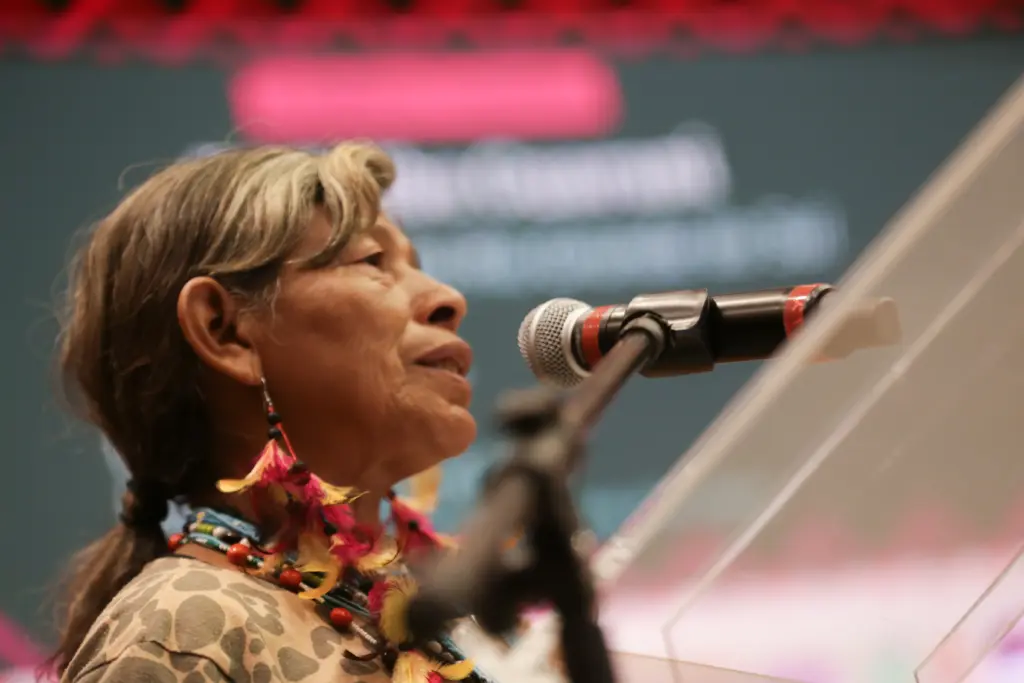
For these communities, traveling for seasonal work deeply affects their social organization. As men go off to work in the harvests, women stay in the territories, sustaining community life amid prolonged absences and uncertainty over when — or if — their relatives will return. “We maintain our village while the men leave,” highlighted Patrícia Ferreira, a leader of the Guarani Yvyrupa Commission and coordinator of the Uva Jepo’o Project of the Guarani Awareness Association. She also pointed out that precarious labor conditions had long been normalized in the communities. “We realized how much this had been overlooked, but initiatives like this hearing help bring it into focus more quickly,” she remarked.
Credits: Isabelle Rieger/Brazil Human Rights Fund Archive.
Credits: Isabelle Rieger/Brazil Human Rights Fund Archive.
Credits: Isabelle Rieger/Brazil Human Rights Fund Archive.
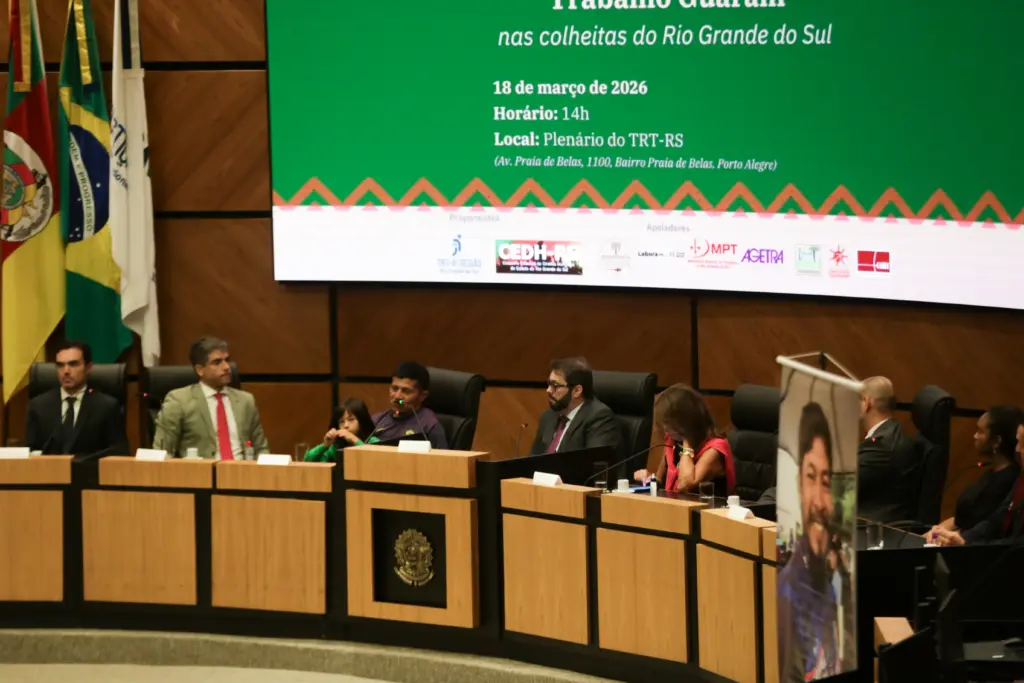
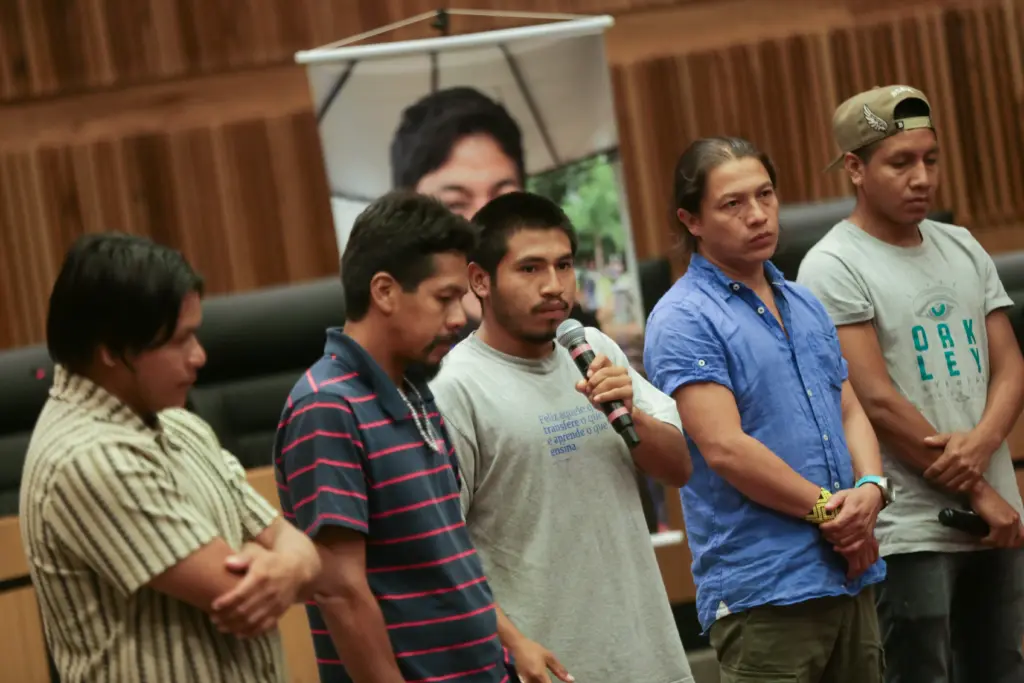
Patrícia is the sister of Aldo Kuaray Mirim, a leader of the Tekoa Ko’enju community in São Miguel das Missões, who was a pioneer in denouncing the violations faced by Guarani workers during harvests and in coordinating the project supported by Labora. In his village, the limited size of the territory makes it impossible for families to sustain themselves solely through farming and the sale of handicrafts, leading part of the community to travel to work in local wineries during the grape harvest. Throughout the hearing, a portrait of Aldo was displayed in the plenary hall in his memory.
The testimonies presented throughout the hearing included accounts of excessive working hours, unpaid wages, and precarious housing, classified as conditions analogous to slavery under Article 149 of the Penal Code. Aldo Benítez Mariano, an 18-year-old Guarani youth and one of the five who spoke in the chamber, reported: “We go to help our family, but end up being exploited.” He was part of the group of young people who shared their experiences working in the harvests.
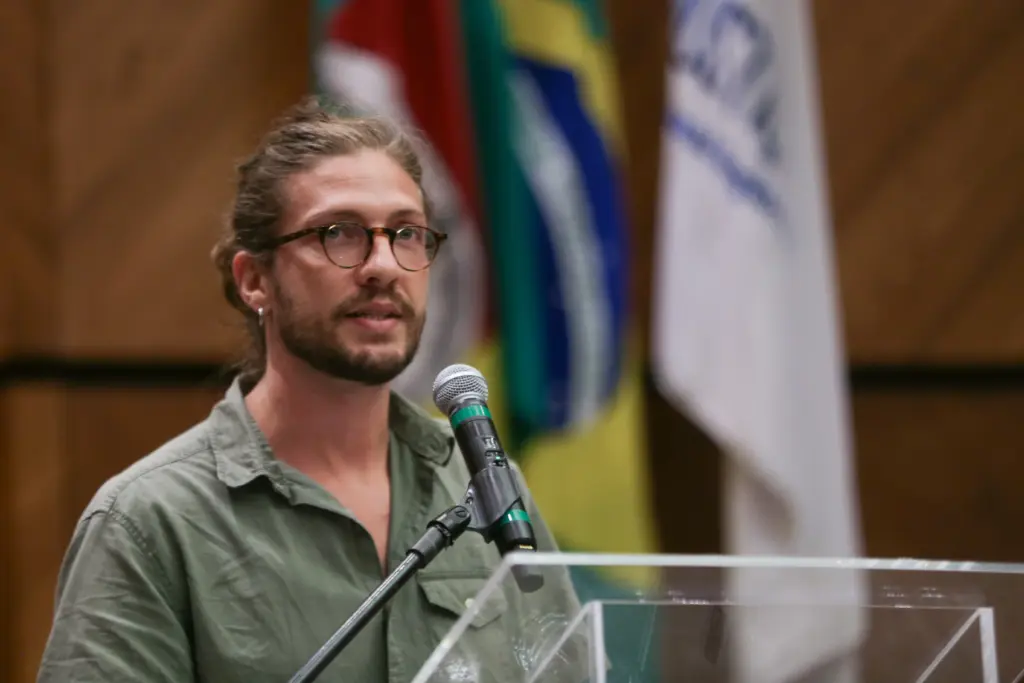
“Would you accept that your children were treated this way?” asked the representative of the Guarani Yvyrupa Commission, Helio Gimenes Fernandes. “For us, we are still in the era of slavery.” In his statement, he also recalled that Indigenous peoples are the original inhabitants of the country. The comment came after workers described being abandoned along highways at the end of the harvest season, often without receiving their agreed-upon wages.
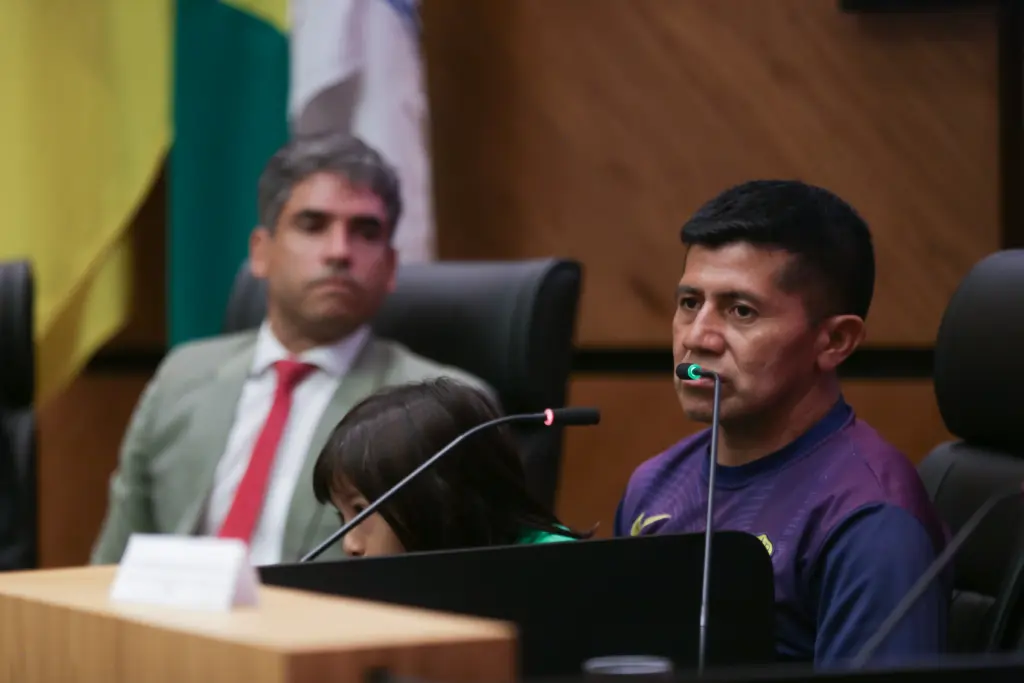
Hélio Gimenes during testimony. Credits: Isabelle Rieger/Brazil Human Rights Fund Archive.
The leaders also drew attention to the impacts of these conditions on the health and well-being of the communities, especially among young people. According to testimonies presented at the hearing, prolonged absence from the villages, exploitation, and abuse during the harvest season have lasting effects that go beyond the work period, affecting both community life and the workers’ mental health.
In Brazil, there is still little research on Indigenous mental health. This is one of the main conclusions of researchers affiliated with the Federal University of Mato Grosso do Sul, in an article that also indicates that psychological suffering among Indigenous peoples is related to factors such as loss of territory, land disputes, and the erosion of cultural practices. The study further highlights that these conditions, combined with socioeconomic inequalities and the lack of effective public policies, aggravate mental health problems. The need for research on the topic to combat the scarcity of data also appears in another article by a researcher affiliated with the University of Brasília.
However, when the focus is broadened to labor analogous to slavery as a whole, the impacts on mental health are better documented. In a dissertation presented in the Graduate Program in Environmental Health and Occupational Health at the Federal University of Uberlândia (UFU), researcher Loína de Souza Vitorino points out that, even after workers leave precarious conditions, many face difficulties in reintegration, carry psychological scars, and remain exposed to a cycle of vulnerability that can lead them back to exploitation.
The consequences of labor exploitation also have a different bias depending on gender. Among the Indigenous workers who spoke at the hearing, a young Guarani woman reported suffering harassment while working in the kitchen of a farm during the harvest. Her name was not disclosed. In Portuguese, she said that her boss would enter her room and touch her body. “Even though I woke up at four in the morning to go to the kitchen and prepare breakfast, he didn’t respect me. He wanted to flirt with me all the time,” she reported.
At this point in the narrative, the speaker was interrupted. From then on, the testimony proceeded in Guarani. The initial translation was done by Ariel Ortega, who was following the testimonies and acting as a translator between Guarani and Portuguese. As the young woman spoke, the chamber remained silent, interrupted only by occasional soft laughter. In Guarani, she was able to continue with her story. She spoke about the times when her boss entered her room, about her underwear that disappeared, about the repetition of these acts of violence throughout the workdays. At one point, someone in the audience translated part of the account for the audience in Portuguese: “he was touching her butt.”
A study supported by Labora shows that seasonal Indigenous work occurs in at least 36 villages in the state
These testimonies are supported by data compiled in a recent research presented at the hearing. The report “Uva Jepo’o (Expensive Wines) and the Uva Po’oa Kuery” indicates that Indigenous workers are present in at least 36 villages in the state.
The research shows that Guarani participation in seasonal work is directly related to the deterioration of their territories and the lack of public policies, which restrict subsistence options in the villages and drive entire communities into forms of labor characterized by informality, labor intermediaries, and repeated rights violations, including situations that may constitute labor analogous to slavery. According to the survey, 98.93% of Guarani communities have social programs as their main source of income, while 38.71% resort to seasonal work, such as grape and apple harvests.
Another Guarani worker, Ariel Ortega, from Tekoa Ko’enju, in São Miguel das Missões, also reported experiences during the harvests. According to him, while in some smaller properties there are more respectful relationships, in other situations, especially when the work is mediated, precarious conditions prevail.
Ariel described cases in which workers have to bear the costs of food, lodging, and even internet access, in addition to receiving less than initially promised. “When we get there, it’s a different price, and what was agreed upon isn’t fulfilled,” he stated. He also mentioned exposure to pesticides without adequate protection and recurring illnesses among workers, often without access to healthcare. According to the leader, holding the public hearing and conducting the research contribute to giving visibility to these violations and expanding access to information about rights, since these conditions have long been normalized.
According to prosecutor Franciele D’Ambros, regional coordinator of the National Coordination Office for the Eradication of Slave Labor and Combating Human Trafficking (Conaete) of the MPT-RS (Public Labor Prosecutor’s Office of Rio Grande do Sul), changes in the harvest calendar are another factor shaping the dynamics of seasonal work in the state. Crops such as grapes and apples, which traditionally occurred in more spaced-out periods, have begun to coincide more frequently. According to her, the shift is related to climate changes observed in Rio Grande do Sul, which shorten production cycles and concentrate the demand for labor into a single period. In 2024, Rio Grande do Sul was hit by floods that devastated approximately 90% of its municipalities. According to the Ministry of Indigenous Peoples, more than 16,000 Indigenous people were affected in at least 84 communities, representing about one-third of the Indigenous population in the state.
Credits: Isabelle Rieger/Brazil Human Rights Fund Archive.
Credits: Isabelle Rieger/Brazil Human Rights Fund Archive.
Credits: Isabelle Rieger/Brazil Human Rights Fund Archive.
Credits: Isabelle Rieger/Brazil Human Rights Fund Archive.
This situation is likely to heighten pressure on workers, deepening their vulnerability and enabling the activity of labor intermediaries in already precarious settings. The practice is similar to the so-called “pejotização”, in which workers are hired as independent contractors rather than employees, without access to labor rights. D’Ambros argues that the use of intermediaries, common in sectors like agriculture, tends to undermine labor guarantees and hinder accountability for violations.
“Labor intermediation contracts, such as those used in harvest work, not only weaken labor rights but also act as a shield against accountability for subjecting people to conditions analogous to slavery”, D’Ambros notes. The prosecutor, who works in Caxias do Sul, also points out that the scenario is aggravated by the structural limitations of the agency in the region, which has only three prosecutors to meet the demand of the entire Serra region.
Representatives of the justice system also commented on the reports presented at the hearing. The president of the TRT-4 (Regional Labor Court of the 4th Region), Judge Alexandre Corrêa da Cruz, said that seasonal work has come to constitute a pattern of exploitation and violation of rights. “The accounts point to violations of human dignity, in defiance of the Constitution.” The president of the CEDH-RS (State Council for Human Rights of Rio Grande do Sul), Julio Picon Alt, reinforced the need for swift responses to the complaints. “The State must provide an immediate response to these violations,” he stated.
For Indigenous leaders, this situation reflects an ongoing history of violations. “We work without rights and without protection,” said the coordinator of the Guarani People’s Articulation Council, Eloir Oliveira, while demanding concrete actions from the State.
The reports are consistent with recent cases of work analogous to slavery in the state, including the rescue of over 200 workers from wineries in Serra Gaúcha in 2023. On the occasion, the workers were found in degrading conditions, facing grueling working hours, confiscation of documents, debts imposed by intermediaries, and accounts of physical and psychological abuse.
As a follow-up to the hearing, the need for coordination among agencies such as the Ministry of Labor, the Public Defender’s Office, and the Federal Police was pointed out, along with the development of targeted public policies to guarantee decent working conditions and the right of Indigenous peoples to their territories.