


The Xerente female brigade
The Akwê Xerente people, who lives in the Tocantins cerrado, is accustomed to fire. It takes part in the biome renovation cycles: in the drought period, it can occur naturally, after the fall of a lightning bolt. It burns the trees of thick barks and deep roots, which flourish again after the flames die down.
In later years, however, this dynamic has changed. As the planet’s temperatures rise, as a reflection of the climate crisis, the dry period gets longer and the drought gets more severe. The fire, formerly useful to the vegetation’s renewal, has become destructive. To natural burnings are added arsons and accidental fires, provoked by human action.
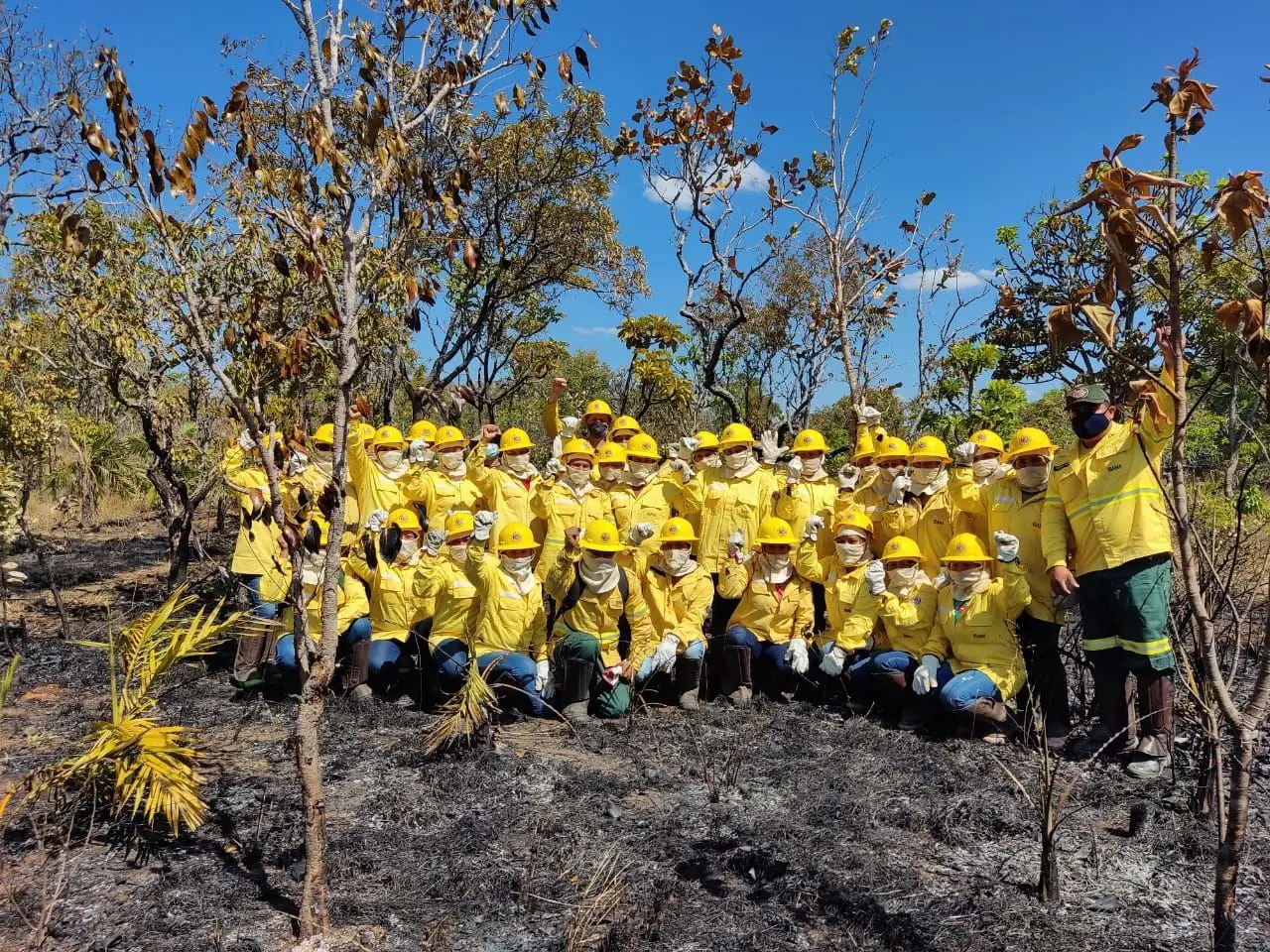
To protect the land where they have lived for generations, the xerente had to adapt to the new context. In 2014, they created a specialized indigenous firefighting brigade. Tied to Ibama, the Association of Akwê Xerente Firefighters for the Prevention and Control of Burnings and Fight Against Forest Fires (ABIX) quickly rooted its reputation as one of the most well-prepared in the country. In 2019, this work branched out in the creation of an exclusively female brigade, the first in Tocantins.
Now, all this mobilization led by the Xerente is registered in photos, videos, and social media posts. Since 2025, Abix has conducted the Sacred Fire: Communication and Indigenous knowledge in the prevention and tackling of fires in the Cerrado project.
Undertaken with support from the Brazil Human Rights Fund, the project works to train Indigenous communicators capable of registering and divulging the fire management practices conducted by the Xerente. “We want to show we’re capable of creating solutions and contributing to the minimization of climate change’s impacts. We want to divulge what we do and the important work we do for humanity and the planet”, says the association, attended by the Raízes and Labora 2025 calls for proposals.
The team formed by Sacred Fire also produces educational material, aimed toward teaching about the advancement of the climate crisis.
At the endpoint, the Indigenous brigade and the team of communicators share a goal: each in its own manner, they work to protect the Xerente territory and preserve their knowledge and traditions. Two dimensions – land and culture – indissociable for the Indigenous peoples.
Support to land management
Since it was created in 2006 the Brazil Human Rights Fund has supported initiatives such as that of the Xerente in Tocantins. Throughout 20 years the institution has destined over R$12 million (circa 2,4 million USD) to projects and organizations dedicated to protecting and promoting the rights of Indigenous peoples.
Largely, the supported actions are aimed towards the valuing of these peoples’ cultures, or to the demarcation and protection of their traditional territories.
There are around 1,7 million self-declared Indigenous people living in Brazil today. They are representatives of 305 peoples, speakers of at least 166 languages. The 1988 Constitution enshrines that they all hold native rights over the territories they traditionally occupy. And that it’s the Brazilian State’s duty to demarcate and protect these lands.
Between what the Letter says and what occurs in reality, however, there is a gap. Of the over 1300 traditional territories identified by the Missionary Indigenist Council (CIMI), only around 50% have been demarcated in the last 38 years.
This sluggishness from the State leaves the Indigenous lands vulnerable to the actions of illegal invaders, gold-diggers, and woodcutters. A problem that still harms, though in a lesser scale, the already demarcated Indigenous Lands, in cases in which the State’s protection proves insufficient. This scenario of insecurity reduces the Indigenous people’s autonomy over their own lands, which compromises their material and cultural survival.
The grants offered by the Fund, through calls for proposals or on an emergency basis, enable the Indigenous organizations to improve their land management capabilities.
This was the wish of the Xavante Indigenous people from the Tsa’Amri Wawé Village, in the Parabubure Indigenous land, when they enrolled to the Indigenous Peoples Fighting for Climate Justice 2024 call for proposal.
A little over 500 km away from Cuiabá, in Mato Grosso, the Parabubure Indigenous land comprises a polygon of 224 thousand hectares surrounded by soy fields in one of the most deforested regions of the Brazilian Amazon.
With support from the Brazil Fund, the Tsa’Amri Wawé Village has been growing, since 2024, an agroforest: a system in which native species grow intermingled with edible crops.
In the Xavante agroforest are planted the yam, taioba (arrowleaf elephant ears), baru trees, mangaba, cagaita, buriti palms, araticum (custard-apples), genipap, gabiroba, sucuuba, bacaba, tucum and jatobá-do-cerrado. “Enough food to feed the whole village”, relates the anthropologist Watsi Betânia, one of the project’s idealizers. The work is spearheaded by the Revolutionary Environment Association — AMAR, an organization formed by the very own Indigenous people.
The wish to implant an agroforest in the territory occurred to Betânia by chance, during one of her trips to Acre. In the state, she found out about similar projects, conducted by other peoples, such as the Huni Kuin. In the Colônia 27 Indigenous Land, the Huni Kuin – also with support from the Brazil Fund – have been growing an agroforest that has returned to woods 100 hectares of formerly degraded pasture.
“These experiences have shown us that the agroforest may be a first step in the construction of an Indigenous land management plan”, says Betânia. An Indigenous land management plan is a document that registers these peoples’ way of life, and the way in which they intend to manage their lands as a means to ensuring their communities’ well-being and survival.
To begin work in the agroforest, Betânia recounts that the community needed to first revisit ancestral knowledge. To understand which native species to grow and in which moments. “That involved the entire village. All age ranges”.
The process nurtured, within the community, the interest for planning and registering how to preserve their territory. “The agroforest made the relatives understand the importance of the territorial and environmental plan to ensure our food sovereignty. It made us see the importance of thinking, for instance, about the management of hydric resources”.
Beyond funding the initiative, the Brazil Fund has offered technical support to the project. “The Fund’s advisors have helped us put our ideas down in writing”, says Betânia. “But they didn’t tell us what to do. They didn’t impose a project. The Brazil Fund trusted our capacity to point out solutions”.
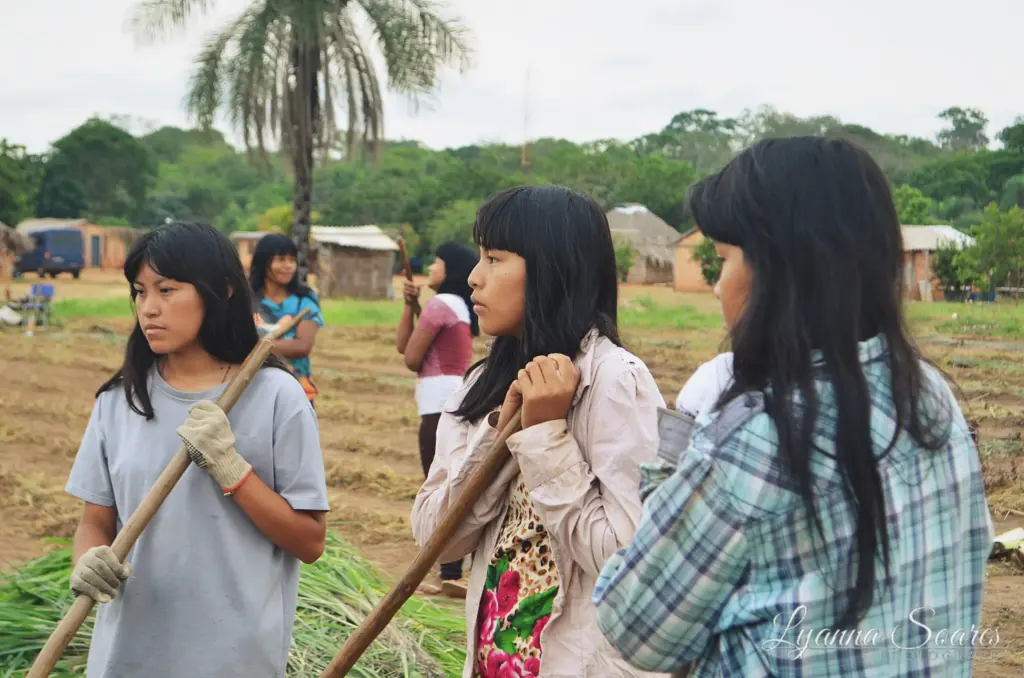
In the Xavante Agroforest, enough food is grown for an entire village (Picture: Lyanna Soares/Acervo AMAR)
Trust-based relations
The partnerships established by the Brazil Fund with the supported organizations abide by the following rule: they are based on trust. The institution understands that the organizations, acting in their territories, detain the knowledge required to point out solutions to the problems they face.
In the case of Indigenous organizations, this bond of trust is backed on data. Nowadays, the Indigenous lands are the ones that preserve the most native vegetation in the country, according to a survey by MapBiomas.
In an increasingly warm planet, preserved forests acts as carbon sinks – they sequester carbon dioxide from the atmosphere, something essential to fight the climate crisis.
It was exactly to support Indigenous peoples and local communities that the Brazil Fund launched, in November 2023, Raízes: an initiative aimed towards Climate Justice.
“The Brazil Fund has a consolidated trajectory in the support to Indigenous peoples and local communities”, says Thainá Mamede, projects’ manager of the Brazil Fund and the one responsible for Raízes. “In structuring a specific line to that end, the Fund has sought to focus efforts and deepen its acting. It’s a way to highlight the urgency of the climate agenda, and to underline these groups’ importance in the overcoming of the climate emergency. These are populations that, historically, have already been developing fundamental practices of preservation, land protection, and sustainable production articulated to their ways of life, contributing in a concrete manner to climate equilibrium and to the maintenance of biodiversity’.
Since 2024, Raízes has destined over R$2,9 million (circa 600,000 USD) to Indigenous-themed projects. Abix and the Xavante agroforest, of which we have spoken in this article, are among the contemplated initiatives.
In the universe of philanthropy, Raízes has yet an ambition in no way small: to showcase to possible backers the urgency of supporting initiatives managed by Indigenous peoples. It is estimated that, globally, only 17% of the available funding for the environmental and climate agenda get to Indigenous communities. The Brazil Fund understands it is essential to redistribute these resources.