



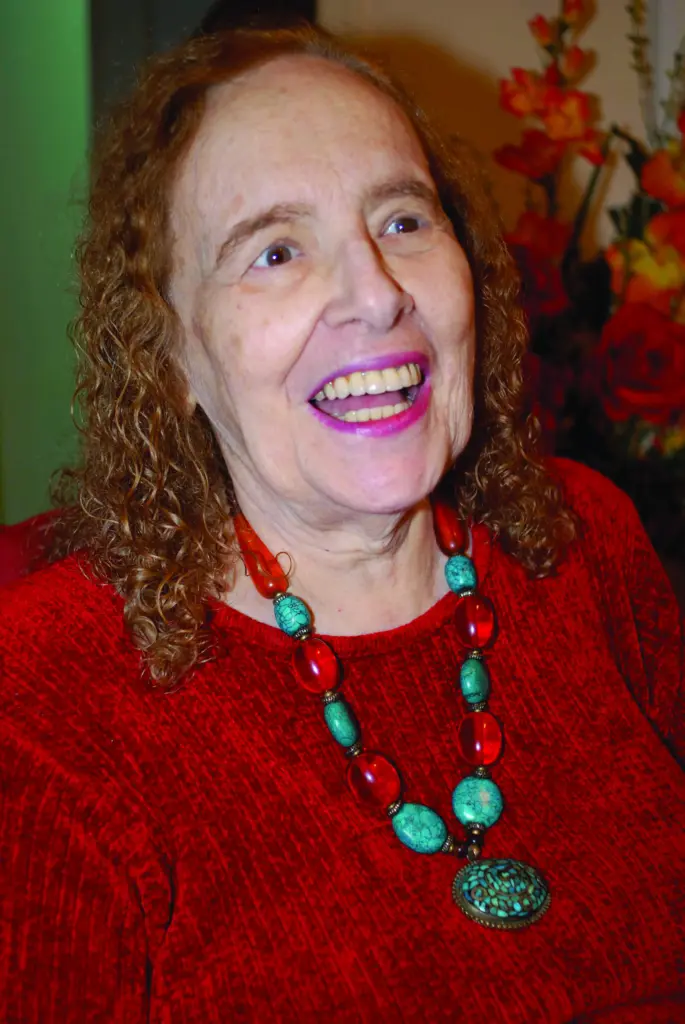
Feminist writer and institutor of the Brazil Fund, Rose Marie Muraro in 2011
It was a nun who taught Rose Marie Muraro – an emblematic figure in the activism for rights in the country and one of the Brazil Human Rights Fund’s institutors – what feminism was. It happened in the beginning of the 1960s: right out of an oppressive marriage, Muraro had gotten closer to the leftmost wings of the Catholic Church. That’s when she met a certain Mother Cristina, a nun from São Paulo who gifted her a copy of “The Feminine Mystique”.
The book had been published shortly before by the American Betty Friedan, and narrated the processes by which capitalist society tries to relegate women to the roles of mothers and wives. “I saw myself portrayed there”, said Muraro.
She recounts that curious passage during one of the interviews for the documentary “Uma mulher impossível”. (seen here, from the 11:23 minute mark). The movie, released in 2015 by filmmaker Marcia Derraik, tells the story of Muraro by the activist’s perspective.
Considered an “inflammatory” public intellectual in her time (she herself claimed to want to “set fire to the world”), Muraro used her voice and her proximity to progressive sectors of the Catholic Church to confound the military regime, to defend gender equality and the sexual liberation of women.
“The subject of women was a subject without importance for the military and society at large. People didn’t know about the existence of feminism”, she says at a certain point in the documentary.
She took charge of changing that scenario. With the belief that the books would set fire to the world, Muraro brought Friedan to lecture in Brazil still in the early 1970s. Sometime later, already in the 1990s, she founded Rosa dos Ventos, the country’s first feminist publishing house. In-between moments, she wrote over 30 books, founded a women’s organization dedicated to diffusing feminist ideas and articulating them to the fight for social justice. “Feminists defend men too”, she explained. “Because the entrance of women in the job market was taken advantage of to drastically lower the salaries of men and women. Those who came out on top were the system, and feminists know that”.
The work earned her the title of “patron of feminism in Brazil”. The honor is enshrined in law – it was granted to her by the National Congress in 2005.
Having passed away in 2014, Muraro is, alongside D. Pedro Casaldáliga, Abdias Nascimento and Margarida Genevois, one of the Brazil Human Rights Fund’s institutors. She is also the figure honored in the General Call for Proposal 2026 – Strengthening rights and birthing a new world.
The foundation completes 20 years in 2026. As part of the celebrations, the Fund revisits the history and legacy of its institutors.
The profile below was originally published in the magazine that celebrated the Brazil Fund’s 5th anniversary in 2011.
Celebrations for the Foundation’s two decades of work will take place throughout the entire year of 2026. Follow us to keep up with the news!
***
The transgressive feminism of Rose Marie Muraro
The violence of a sexist world takes place not only physically, but also in more subtle manners, rooted in the simplest habits, in the most routine discourses, and in the most dominant conceptions.
In the face of that, Rose Marie Muraro, 81, knew that this violence couldn’t be beaten by force. But the ideas and the possibility of expressing and spreading them were a way through which women could break away with discriminatory logic and domination, both cruelly considered natural.
As a writer and editor, Rose Marie gave voice to the bold positions and progressive ideas about themes related to the matter of gender.
Her literary production was dedicated to women’s rights: “I went to work with “the woman” because I thought from her things would get better. If you change her condition, you change that of her children, and consequently, that of the chain of generations”, she says.
In the 1960s, as the editorial director of Editora Vozes, she collaborated to the mobilization of two important social movements in Brazil, that of female emancipation and that of Liberation Theology with Leonardo Boff.
Throughout the last 40 years, she wrote over 30 books, many considered polemic in the time in which they were published, such as “Sexualidade da Mulher Brasileira Corpo e Classe Social no Brasil”, from 1983. “Automação e o Futuro do Homem” (1966), and “Libertação Sexual da Mulher” (1975), which were censored by the military for being considered pornographic.
For her intellectual contributions and militancy, she’s considered an icon of the feminist movement in the country. Her acting was remarkable during the 1970s; her revolutionary and liberating discourse was one of the means of resistance against the military regime.
In 1986, after the publication of “A Erótica Cristã”, she was expelled from the publishing house as a retaliation from the conservative sectors of the Catholic Church.
She recently received the Teotônio Vilela prize from the Federal Senate, in commemoration of the 20 years of amnesty in Brazil. The mistaken perception of women as a fragile sex soon dispels itself for those who know this brave and outgoing woman. “When I started to work, in the 1970s, I was alone, exposing myself to the military. I was crazy, not afraid of anything”, she recalls the violent times of repression.
Rose Marie remembers it was forbidden to gather, but that didn’t stop the mobilization and foundation of one of the country’s first feminist organizations. In 1975, with women from the Communist Party of São Paulo, she founded the São Paulo Women Development Center, dedicated to organizing and mobilizing women from the middle class and young liberal professionals, so that they diffused the feminist debate among popular classes. “We developed a struggle with political projects, of going to favelas and all, but that wasn’t funded. We did interviews, we knew the needs of women, worked for the decriminalization of abortion, did marches”, she recounts.
Involvement with human rights was part of practically her entire life. Her first action was with Dom Helder Câmara, at 15 years old. At that time, she joined one of the Catholic Student Action groups, wherein she got intensely involved with social movements.
Another surprising detail of her trajectory is the fact she was born almost fully blind and recovered vision only at 66 years old. When she saw herself for the first time in the mirror, she said: “I know now that I’m a very beautiful woman”.
Nowadays, Rose Marie evaluates that the feminist movement is big in the entire world, including in Brazil, and that it had important victories, such as the decriminalization of abortion in a few countries. However, she claims there is still much to be done, so that the asymmetry of gender is balanced out.
To her, one of the ways of ensuring that women have access to their rights is through their empowerment, earned through economic autonomy.
Her contribution to the actualization of human rights was acknowledged many times. She was elected nine times “Woman of the Year”. In 1990 and 1999, she received from the magazine Desfile the title of Woman of the Century. In 2003, she was named councilor of the National Council of Women’s Rights, and in 2006 she was named Patron of Brazilian Feminism.