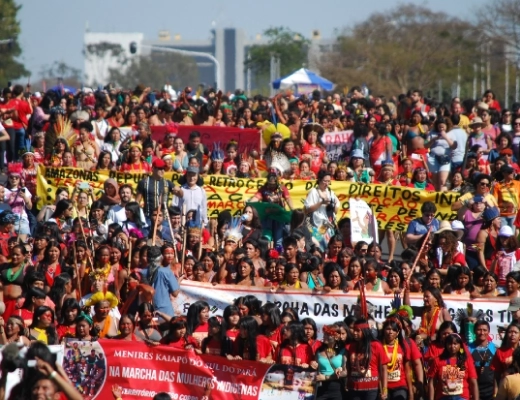



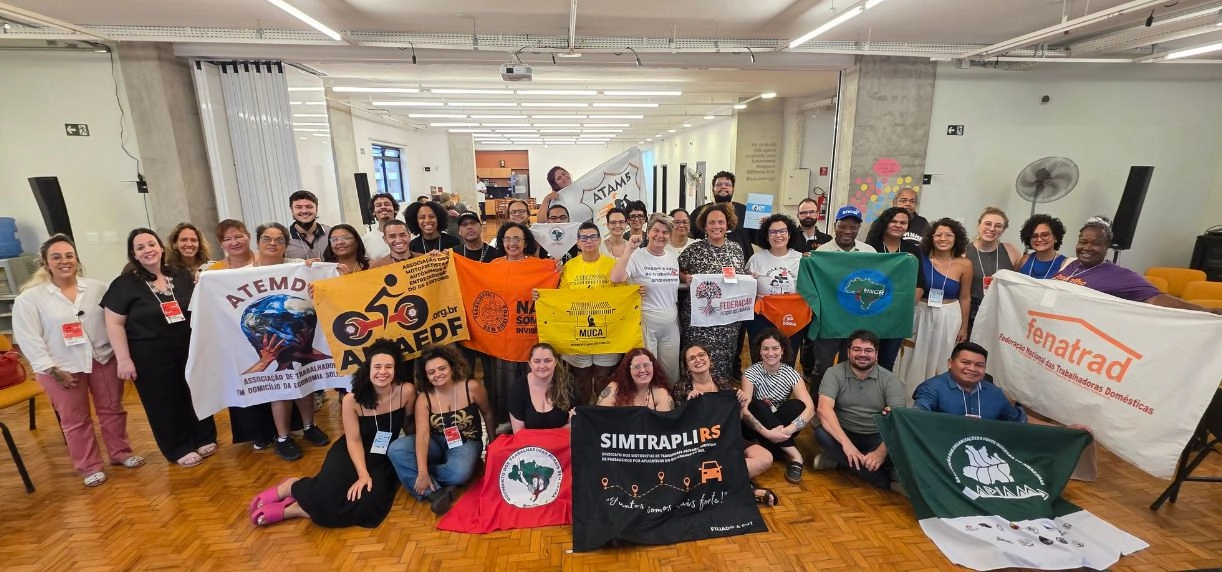
On March 25 and 26, Labora — Fund for Decent Work, in partnership with FORGE (Funders Organized for Rights in the Global Economy), held a meeting in São Paulo with leaders from 37 organizations. The event brought together representatives from social movements, trade unions, and workers from the agricultural, care, fishing, digital platform, and informal trade sectors, aiming to share experiences and coordinate strategies for transnational campaigns.
While transnational campaigns have gained momentum in recent years—particularly in the automotive and digital platform sectors, driven by network-based organizing—such initiatives remain under-explored in other areas of labor rights advocacy. The journey was part of a six-month period involving interviews, focus groups, and a literature review.
Amanda Camargo, project coordinator at Labora, highlighted the scarcity of resources dedicated to strengthening the struggle for decent work, both nationally and globally. “We are here to learn from the organizations and to map out alternatives and proposals. We also rely on the support of funding organizations interested in strengthening this cause and collaborating with us on this journey,” she stated.
The event concluded with a direct dialogue between philanthropy representatives and social organizations, building upon the issues raised during the sessions. Representatives from Labora, FORGE, Laudes Foundation, Avina Foundation, and Tide Setubal Foundation discussed topics such as funding criteria and timelines, monitoring, accountability, international engagement, and support for small funds. The commitment of funding entities to active listening was evident, recognizing that socio-economic transformation—which is intrinsically linked to the world of work—is only possible through support that respects the autonomy of all stakeholders involved.
According to Maeve Galvin, Program Director at FORGE ( Democracy at Work Fund), the initiative is fundamental for identifying new areas of intervention. “We are studying new forms of worker power and researching opportunities for transnational campaigns, aiming to create programs where groups can unite across borders in the struggle for rights,” she emphasized.
The meeting was held at the Casa Carlito Maia Auditorium in the Campos Elíseos district (SP). Catering was provided by Brazil’s Landless Workers’ Movement (MST) of São Paulo, featuring agroecological products sourced from Popular Agrarian Reform initiatives.
Sectoral Strategies and Challenges of Grassroots Movements
During the meeting, participants mapped sectoral barriers within an international context, identified coordination strategies, and formulated proposals to guide philanthropic action in the decent work ecosystem. To deepen the debate, participants were divided into thematic subgroups to collectively construct sectoral maps reflecting the specific challenges of each category.
- Technology and Digital Resistance: Workers from digital platforms and apps prioritized international algorithmic resistance. The group highlighted the urgency of strengthening class unity to counter the fragmentation characteristic of this labor model.
- Formalization and the Right to the City: Waste pickers and street vendors addressed the need for formalization and recognition of the right to the city, advocating for engagement with the International Labour Organization (ILO).
- Gender Justice and the Care Economy: The care work segment focused on overcoming invisibility and achieving gender justice, framing care as essential, society-structuring work.
- Territory and Environmental Protection: The “waters and forests” category reaffirmed the defense of “life-territories,” focusing on combating environmental racism and preserving the economies of Indigenous and traditional communities.
- Rural Resistance Against Corporations: Lastly, the agricultural sector presented itself as a front of resistance against corporate expansion, articulating advocacy strategies to protect their lands.
International Campaigns, Climate, and Decent Work: Preliminary Findings in London
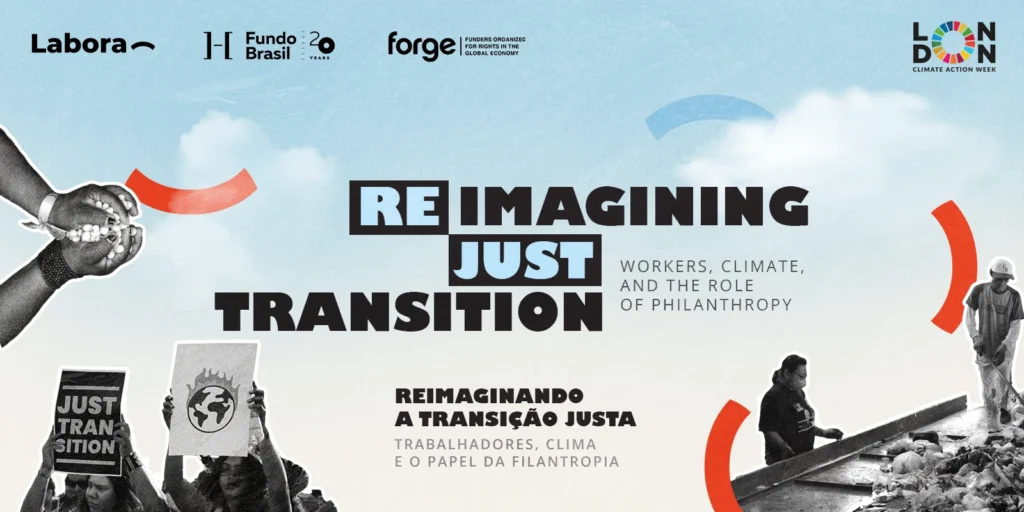
During London Climate Action Week 2026, Labora and FORGE will host the panel “Reimagining the Just Transition: Workers, Climate, and the Role of Philanthropy,” focusing on the realities of workers in the Global South. The event will present preliminary research results from the Learning Journey which, in addition to identifying gaps in transnational organizing, investigated the impacts of extreme weather—such as heat stress, droughts, and floods—on professional livelihoods.
The panel will feature representatives from the International Alliance of Waste Pickers, Via Campesina, and The National Confederation of Rural Wage Earners (CONTAR), bringing together voices directly facing the climate crisis in both rural and urban centers.
Beyond diagnosing damages caused by large-scale energy transition projects in vulnerable territories, the discussion aims to challenge the philanthropy sector to move beyond fragmented approaches. The goal is to foster coordinated international solidarity strategies that provide political and financial support for worker-led responses, ensuring the transition to a green economy is socially just and globally integrated.
Event Details:
- Date: June 24, starting at 10:00 AM (London time).
- Location: United Voices of the World Union Auditorium (144 Cambridge Heath Rd, Bethnal Green, London E1 5QJ, UK).
Note: The event is in-person and subject to capacity. Registrate now.