




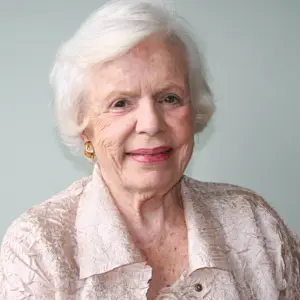
Margarida Genevois, institutor of the Brazil Fund
In the many interviews she gave throughout her 103 years of life, completed this March 10th, Margarida Genevois — one of the Brazil Fund’s institutors — always said she was very shy. The claim surprises those who know the boldness of her acting in defense of human rights.
In the 1970s, during one of the most virulent periods of the Military Dictatorship, the sociologist Margarida took part in the Commission of Justice and Peace of São Paulo. Created by initiative of Cardinal D. Paulo Evaristo Arns, the institution offered legal assistance to people persecuted by dictatorships: the Brazilian one and also that of other Latin-American countries.
It was up to Margarida to welcome the people persecuted by repression, to gather information and forward them to where they could get help. The Commission of Justice and Peace protected the persecuted and their relatives though the legal sphere and also offered sheltering. It was no easy task. Many lawyers refused to defend political prisoners of victims of persecution. Doctors refused treatment. “Those who accepted were heroes. They risked their lives, their careers”, said Margarida to the Brazil Fund in 2016.
Her acting didn’t stop there. A speaker of French (the language in which she was taught to read, that of her husband), Margarida went around Europe in search of resources to fund the Commission’s activities. She took, in her luggage, news of Brazil that the dictatorship went to great lengths to cover up. “Through the Church, we sent news abroad, which helped avoid a lot of arbitrariness, because they denounced the lies they tried to spread”, told Margarida years ago, during a seminar at USP (University of São Paulo) College of Law.
This fierce acting was even considered, by people of her own family, as atypical of a woman with social origins such as hers. Carioca, Margarida was born to a family of Rio de Janeiro’s uppermost echelons (she descends from the founders of the city of Rio de Janeiro, she told one time in an interview with Museu da Pessoa). Her husband, a French engineer that worked for the Rhodia company, feared his wife’s militancy might bring problems to her and their children. “My keen vision in the sense of social justice was considered – by him and my mother – a terrible influence on my daughters. The eldest one got involved in the student movement and was arrested”, she remembered, in the same interview.
Those fears didn’t stop her from continuing acting against the state of exception. Neither from, years later, putting herself between gold-diggers and farmers to avoid an armed conflict in the region of Araguaia. The story is told in the Sul 21 magazine based on the biography written by journalist Camilo Vanucchi. At that time, Margarida said she didn’t feel fear, only indignation. Decades later, she admitted: “I’ve never felt so much fear in my life”
The trajectory, long-lived and audacious, earned Margarida the title of Lady of Human Rights in Brazil. Aside D. Pedro Casaldáliga, Abdias Nascimento and Rose Marie Muraro, Margarida is one of the Brazil Human Rights Fund’s institutors.
The foundation completes 20 years in 2026. As part of the celebrations, the Fund revisits the history and legacy of these figures that are so important to human rights in the country.
The profile below was originally published in the magazine that celebrated the Brazil Fund’s 5th anniversary in 2011.
Margarida Genevois: justice and education as paths toward human rights
Margarida fought against rights violations during the military dictatorship in Brazil, defending political prisoners and fighting for re-democratization
One of the most critical moments for human rights in Brazil was certainly the military dictatorship period that started soon after the coup of 1964 and lasted over two decades. From then on, citizens had rights – mainly political ones – restricted; many fell in clandestinity for their activities and positions contrary to the government, which started repressing opposition with brutality. The time was also marked by the increase of social inequalities. Part of the population was prevented from claiming their rights and seemed doomed to resign itself to the social and economic destitution to which it was subject because of repression and lack of knowledge of these rights.
For Margarida Genevois, one of the Brazil Fund’s institutors, it’s important that people have a clear notion of dignity to then understand their rights and duties in society. It was in the context of an authoritarian regime that her activism for human rights intensified. As the government toughened up and exposed opponents to a series of violations and a condition of fear and vulnerability, Margarida got more and more involved in the defense of citizens’ rights, such as those of victims of political persecution.
Her acting took place mainly when she moved to São Paulo in 1967 and started taking part in the Commission of Peace and Justice of the São Paulo Diocese, wherein she advocated for 25 years. Alongside Dom Paulo Evaristo Arns, she fought for the defense of political prisoners, against the government’s arbitrary prisons and for the return of the Rule of Law to the country. She also sheltered political refugees, mainly those who ran from the dictatorships in Chile, Argentina and Uruguai; to those people she provided legal protection whenever possible.
Margarida also took part in the search for missing people during the regime and reported those disappearances and tortures to international organizations. She played an important role in the process that culminated in the amnesty of political opponents and return of the exiles. Throughout her trajectory, she took a stand against the law of national security and death penalty.
After the re-democratization of Brazil Margarida continued to protest injustice, in defense of the unemployed, the landless, and against the torture and mistreatment of youths imprisoned in institutions of the socio-educational system.
Before the military dictatorship, Margarida had already faced off against social injustices. Born to one of the richest families of Rio de Janeiro, she met the harsh reality of the families who lived in the countryside when she moved to the surroundings of the city of Campinas, in São Paulo, soon after her wedding. Therein, she realized that social welfare by itself wouldn’t be enough to tackle a structural problem.
She started her work in the São Francisco Farm, which belonged to the Rhodia industry, where her husband worked. Margarida was moved into acting upon seeing the workers’ poverty and lack of resources. In that farm, where a community of 2,5 thousand people lived, she undertook programs of support to malnourished children and guidance to women on natal care.
Alongside the region’s women, she managed the creation of daycares, a childcare post, and a mother’s club for the workers in the place where she lived, as well as founding the Female Newspaper, directed to the community’s women.
The result of that was the decrease in infant mortality in Campinas. “If in a society people don’t understand they have rights, things don’t move forward. It’s the fight for rights that propels the social fight”, she says.
Ever since, Margarida has been actively involved with the defense of human rights, especially those of the most vulnerable social groups. “My entire life I have worked with human rights. Human rights are an enthralling fight. It’s a microbe that, when it gets us, there’s no vaccine, no treatment, you spend the rest of your life motivated and in love with it.”
In the latest years, Margarida devoted herself to promoting human rights education. “After many kinds of work, I came to the conclusion that the most useful thing to do is human rights education”, she claims. She clarifies that the education in which she believes is not restricted to formal education, but it refers mainly to the transmission of values. “Those who think, for instance, that human rights are a thing for criminals, are ill-informed. And ill-informed people don’t know how to look around”, she evaluates.
For her, it’s important that the reclaiming of rights is solidary: “If you have rights, others have them too, because they are like you in dignity, there is no superior being. That’s why one must fight for their rights, but also for those of others. Rights are interlinked”, she says.