




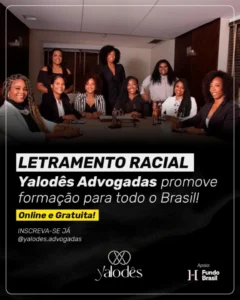
Nowadays, the Network’s board of directors is comprised of 9 women. Picture: Yalodês Black Lawyers’ Network (divulgation banner for the course)
“The first step of racial literacy is to acknowledge structural racism”. Thus says Luíza Mandela, doctoral student in education, during a lecture of the first module of the course developed by the Yalodês Black Lawyers’ Network. In a context in which every day cases of racism are reported, the training arises as a way to raise awareness in all publics.
During July 8th, 15 and 22 of 2025, Black lawyers of the Yalodês Network broadcasted through Youtube three modules of a training that covers everything from the scenario of racism in Brazil to the means of tackling it.
Throughout the lessons, data that illustrates how racism operates in different spheres was presented. Among it, it was highlighted that only 22% of Black people are protagonists in soap operas and campaigns, even though they comprise the majority of the population, and the fact that almost 70% of the prison population is comprised of Black youths.
The course was one of the results of the project funded by the Brazil Human Rights Fund through the Tackling Racism from the Basis – 2024 call for proposal.
With 100% free access, the lessons were open to people of different trajectories, areas of acting, and regions of the country, promoting a plural space of learning and exchange. “We Black people don’t have to talk about racism and racial matters only for us. It’s necessary to expand this discussion. The course was open to whoever wanted to participate and was done online, so it had national reach. The idea is to democratize the access to education”, relays Caliane Nunes, president of the Yalodês Black Lawyers’ Network. Those who enrolled and concluded the modules received a certification.
The recordings remain available for public access in the organization’s official channel.
It’s not enough to not be racist, one has to be anti-racist
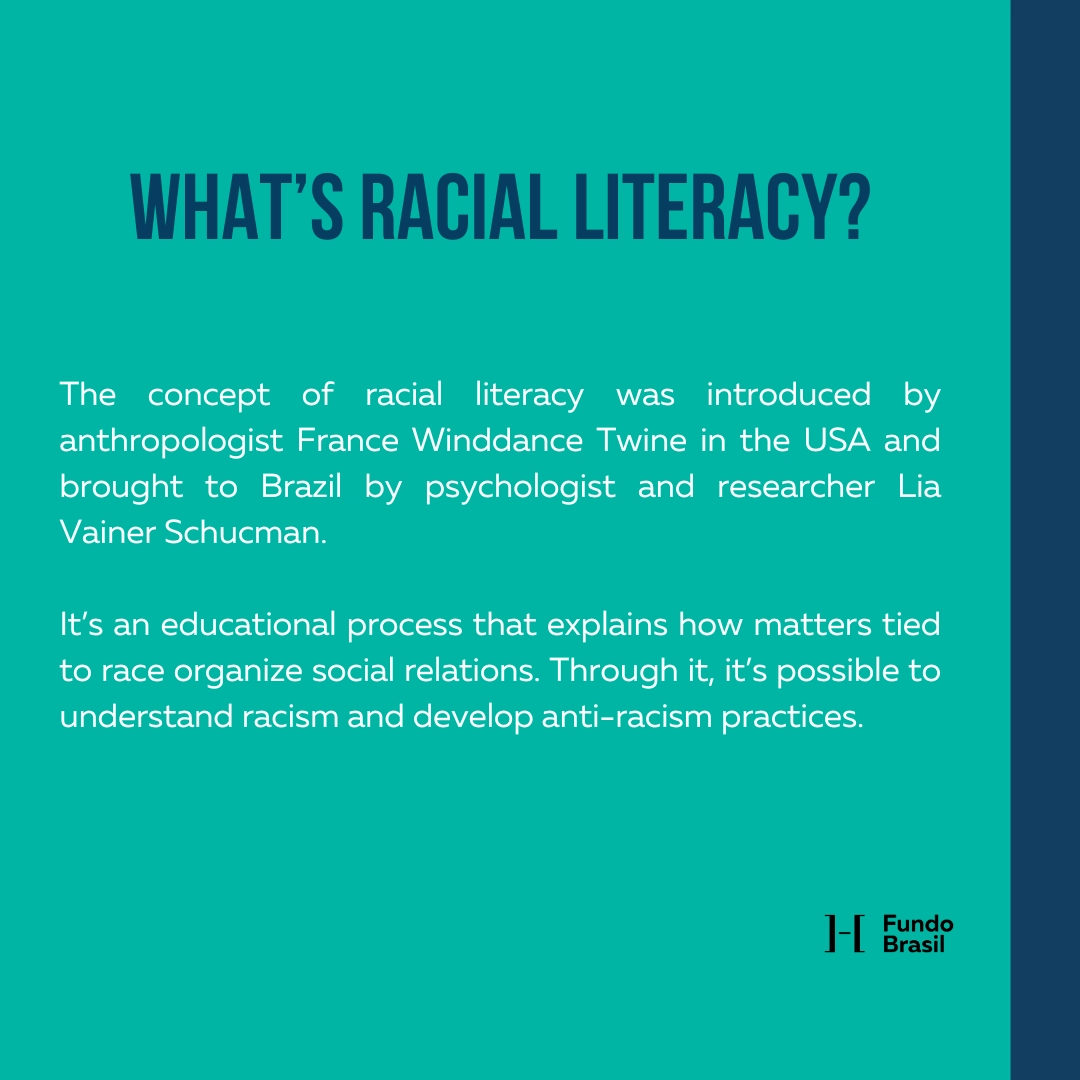 Caliane’s first contact with the subject was when she studied for university entrance exams, during her passage through the Steve Biko Cultural Beneficent Institute popular preparatory course. The organization is aimed towards the training of Black students in the access to universities. “When I studied there, there was a subject called ‘Civil Rights and Black Awareness (CCN)’. The literacy course was really inspired by that idea”.
In that same time, Caliane did the entrance exam for History and, sometime later, transferred to law. “Nowadays, in the field of Law, I share that knowledge. The racial discussion matured with time, and it’s important to update those things”.
Beyond the inspiration from the pre-entrance exam subject, the idea came from the understanding that, though over 20 years have passed since she frequented the Institute, Brazilian society still lacks a commitment to understand and tackle racism. “The course arises to plant a seed of the anti-racist fight. So that all people can realize their role in society and how to act”.
To structure the course, she had support from the pedagogical coordinator Manuela Barbosa, whom she met during her journey in the Steve Biko Institute. Together, they planned the classes with a division in three modules, so that spectators gained a conceptual basis and could have access to the goings on of the racial discussion.
As for the guests, there was a careful search to define participants. “There’s a lot of good people who talk about the subject, but we decided to prioritize members of the board of directors”, she justifies. The choice resulted in a group of three Black speakers, highlighting the presence of the women who comprise the Yalodês Network.
Yalodês is knowledge and collective well-being
The Yalodês Black Lawyers Network was created in October 19th 2023 from the perception of Black lawyers coming from public schools in the face of a judicial system that has historically excluded them. According to the research “Justice in Numbers 2024” by the National Justice Council (CNJ), 14,3% of magistrates are Black. With regards to Black women, the number is halved: it is estimated that, in total, they are only 7% in the magistrature.
It was with statistical data such as that in mind that they united, with the goal of promoting social transformation through the fight for equal rights and the elimination of structural racism.
The name Yalodês has Yoruba origins and means “woman who leads and represents other women”. Caliane explains that “beyond the idea of taking up protagonism within the justice system, the goal is to strengthen one another. The great motto is ‘one rises and pulls the other up’”.
In the first months, the Black Lawyers’ Network was comprised of 30 Black women, acting in legal consultancy, awareness about racial and gender equality, and political advocacy. Nowadays, strengthened after the grant and with a little over 2 years of formation, the organization counts with 200 women from the legal world. Among them lawyers, jurists, students, and teachers, spread all over Brazil.
Beyond the trainings and lectures, one of the organization’s staples are free legal consultancies. These are joint efforts that aim to answer possible questions about many legal processes, such as access to INSS and Social Security.
The partnerships happened with associations of residents and women’s groups that work with the racial agenda. The gatherings work in the following manner: the Network sets up a date, the lawyers go to the arranged location, and the interested people take demands so they can be oriented.
The target public of the legal consultancy are Black and low-income people, who don’t usually have access to this type of assistance. The initial expectation was that during the project about 60 consultancies would be conducted, but that goal was surpassed. In total, 110 free legal consultancies were offered, directly benefitting over 500 people.
Support from the Brazil Fund enabled institutional consolidation
The Tackling Racism from the Basis call for proposal has as a goal to institutionally strengthen groups comprised of Black activists, and to enable the activities proposed by organizations that seek the defense of the Black population’s rights and strive for racial justice.
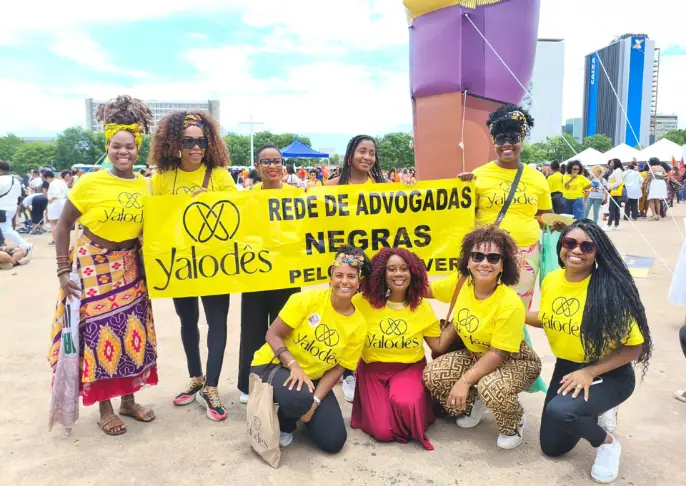
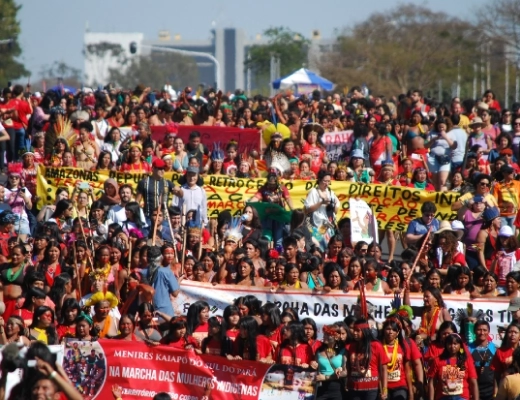
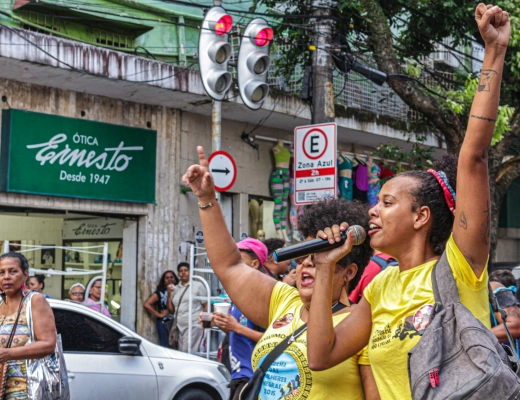
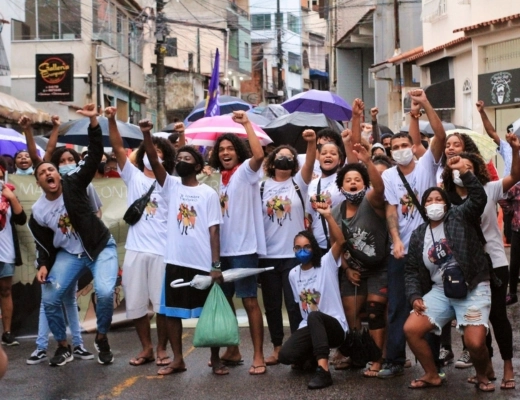
Members of the Yalodês Network during the Black Women’s March. Picture: Yalodês Black Women’s Network
“The ‘Roots of Equality’ was our first project approved after construction of the CNPJ. From it, we provided free legal consultancies to the Black population and the racial literacy course. It was with those resources that we could strengthen the Network. It was a magnificent experience”, rememorates the president of the Black Lawyers’ Network.
In November 2025, the Yalodês Network was one of the 49 organizations supported by the Brazil Fund that were present in the Black Women’s March for Reparations and Well-Living. “The March’s support was really great, very good to have participated. The March was a political act that expanded people’s vision. There are members of Yalodês who went there and had never been inside a plane before, had never left Salvador”, she remembers.
The experiences, including during the Black Women’s March, helped consolidate the perception that the racial debate needs to get into even more specific spaces. Upon looking at the course’s future, Caliane thinks the objective now is to expand the training. “The Youtube format was cool, since it can reach all of society, but if the racial discussion is necessary for society as a whole, the idea is to take that knowledge to several areas. For instance: racial literacy for teachers, companies, communicators…”.