







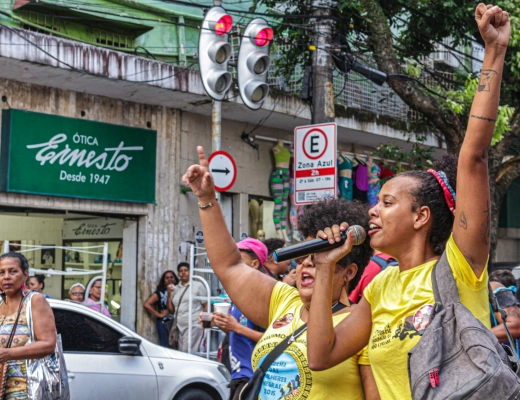

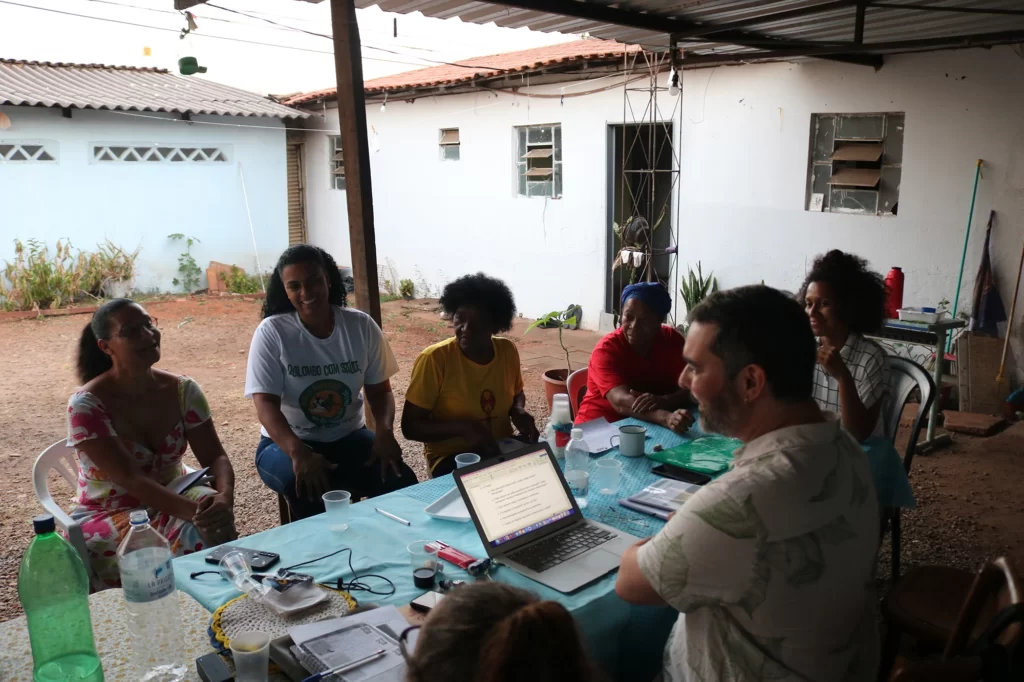
Black women from the Malunga Group during monitoring conducted by Brazil Fund. Photo: Airan Albino/Brazil Fund Archive
ESG stands for Environmental, Social, and Governance. The term refers to a set of criteria used to assess how a company operates in relation to the environment, social issues, and its own governance structure. Beyond financial performance, these practices seek to determine whether business activities are aligned with positive impacts on society and the planet.
In recent years, interest in ESG has grown among companies seeking to meet the expectations of consumers, investors, and their own employees. In other words, companies are responding to a society that is increasingly attentive to the consistency between corporate practices and public positions on a planet shaken by social crises, the climate crisis, and concrete threats to democracy. Research indicates that companies with structured policies across these three areas tend to navigate crises more effectively, attract investment, and remain relevant in the market.
Companies that adopt ESG practices can benefit from a stronger reputation, easier access to capital, greater employee engagement, and even reduced legal risks. This requires real change: reviewing production processes to reduce environmental impacts, addressing structural inequalities in hiring, ensuring that affected communities are genuinely heard, and making corporate boards more diverse and transparent are some basic steps. It is not simple, but it is necessary, and it is a trend that is here to stay.
The Malunga Group is an organization working in Brazil’s Central-West region to strengthen the leadership and expand the rights of Black women, with support from the Brazil Human Rights Fund. The group recently held a course on democracy that culminated in the launch of the Black Women’s Network of the Central-West region, with the aim of expanding the impact of this debate and its activities. Initiatives like this strengthen the leadership of historically excluded populations. They also show how social responsibility can drive solutions to collective problems, with the potential to be scaled up and benefit a broad segment of the population.
Learn more about the connection between ESG and human rights
Implementing ESG requires investment, time, and commitment. The returns, however, are tangible and cannot be measured solely in terms of reputation or profit. By including grants to human rights projects as part of their social commitment, among other initiatives, companies recognize that sustainability requires addressing inequalities and strengthening those who face rights violations every day. For Brazil Fund, supporting these initiatives means recognizing that there can be no social or climate justice without the direct action of those who defend rights.
ESG is not simply a corporate strategy. It is an expression of collective commitment to the changes required for a sustainable and just future.