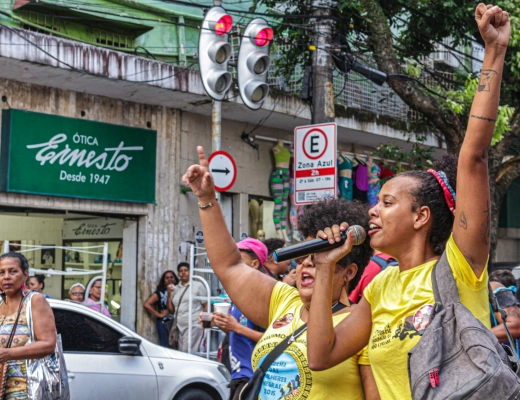
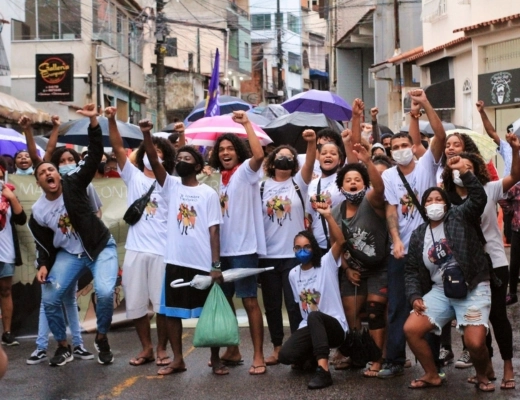
 Taking an intersectional approach, Raízes supports initiatives that recognize how gender, race, and territory shape inequalities and disproportionately affect traditional communities, quilombola communities, and indigenous peoples. By directing resources to territories, it helps strengthen the autonomy of these communities, advance climate justice in Brazil, and build on solutions already developed within the territories — solutions that connect ways of life, conservation, and efforts to tackle inequality.
The crisis we face today is socioclimatic. The predatory exploitation of biomes, the expansion of deforestation, wildfires, and the destruction of territories walk side by side to deepening social inequalities. In Brazil, these dynamics are compounded by overlapping territorial pressures, including the expansion of large-scale projects, the advance of extractive frontiers, and the erosion of social and environmental policies.
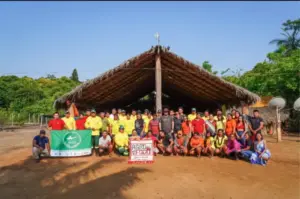 Land use driven by monoculture and extensive livestock farming is one of the major sources of greenhouse gas emissions, undermining the ability of people to remain in rural and forest areas. These processes are not merely environmental; above all,
they constitute human rights violations that threaten ways of life, food systems, and traditional knowledge.
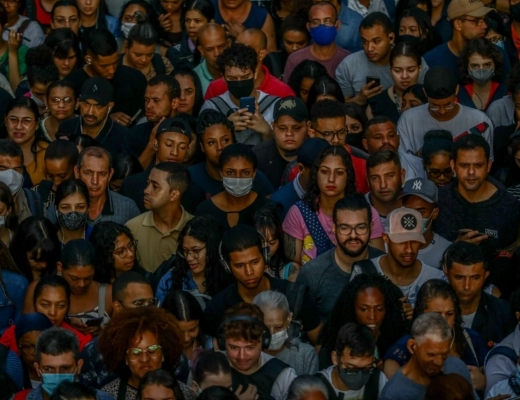
The impacts of the climate crisis are not felt equally. They fall disproportionately on Indigenous peoples, traditional communities, and people living in urban peripheries. Although these groups have contributed little to global warming, they experience its effects more severely such as increasingly frequent extreme weather events.
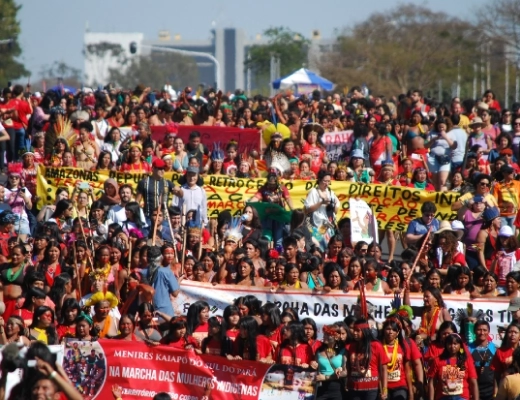
At the same time, these groups are leading the way in developing solutions: They defend their territories, resist threats, and build concrete pathways toward sustainability and collective well-being on a daily basis.
This understanding guides the work of the Brazil Human Rights Fund. We strengthen movements working to advance social and climate justice and contribute to a just transition.
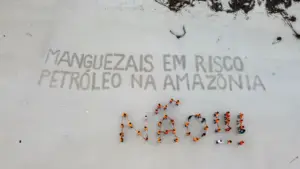 Over the years, we have built an approach that channels resources and technical support directly to people and organizations working in their territories. This means ensuring that grassroots collectives, organizations, and movements, including those in remote areas, can access funding simply, quickly, and transparently, while receiving technical support to strengthen their institutions. We also act swiftly in response to emergencies such as wildfires, floods, and other extreme events.
Our model is based on active listening and the participation of leaders, activists, and experts in decision-making processes. Their firsthand experience in their territories and in struggles for rights helps define priorities and pathways, strengthening both the legitimacy and diversity of the support we provide.
For the Brazil Fund, climate justice is inseparable from the right to territory, self-determination, a healthy environment, decent work, collective good living, and the preservation of local knowledge and practices. Raízes is part of this broader approach.
Launched in November 2023, Raízes – Indigenous Peoples and Local Communities Fund for Climate Justice is a funding program that deepens and expands the Brazil Fund’s commitment to mobilizing resources and strengthening the leadership of these peoples in addressing the climate crisis. It supports both local action and participation in advocacy and decision-making spaces.
Raízes provides strategic financial support to initiatives working to defend territorial rights, protect forests and natural resources, strengthen sustainable economies, develop leaders, and build political alliances. Its work is guided by an intersectional approach that recognizes how race and gender affect access to rights and territorial autonomy.
At the same time, the program has rapid-response mechanisms to address emergencies, supporting communities affected by extreme climate events or threats to their territories and leaders.
Raízes was created as a strategy for strengthening those on the front lines of territorial protection and the development of solutions for both the present and the future. By supporting these initiatives, the Brazil Fund contributes to advancing concrete pathways toward climate justice in Brazil.
The Brazil Fund works to strengthen and expand social justice philanthropy through advocacy networks.
Comuá Pelo Clima (Comuá For the Climate) is an initiative created by the Comuá Network, of which the Brazil Fund is a member. It seeks to strengthen the political positioning and collective, coordinated action of organizations within this network of independent local and territorial funds. The initiative supports the development of strategies, narratives, and knowledge production in the field of climate philanthropy, helping advance these agendas. Its member organizations bring expertise in resource management and project monitoring and evaluation.
The Brazil Fund is a signatory to the Brazilian Philanthropy Commitment on Climate Change, as part of the #PhilanthropyForClimate movement, and remains actively engaged in relevant national and international forums on social justice philanthropy and climate justice.
The definition of traditional communities in Brazil encompasses dozens of culturally distinct groups with their own forms of social organization and deep, respectful relationships with their territories and natural resources.
Under Decree No. 6,040/2007, Article 3, §1, Traditional Peoples and Communities (TPCs) are defined as “culturally differentiated groups that recognize themselves as such, have their own forms of social organization, occupy and use territories and natural resources as a condition for their cultural, social, religious, ancestral, and economic reproduction, using knowledge, innovations, and practices generated and transmitted by tradition.”
In Brazil, Traditional Peoples and Communities comprise 28 distinct segments that represent a significant share of the population and occupy a substantial portion of the national territory. They are officially recognized under Decree No. 6,040, enacted in February 2007, and represented by the National Council of Traditional Peoples and Communities. They are present across all of Brazil’s biomes — the Amazon, Caatinga, Cerrado, Atlantic Forest, Pampas, Pantanal, and the Coastal-Marine System.
Indigenous peoples and quilombola communities, meanwhile, have their rights and status recognized under Article 231 of the Federal Constitution and Article 68 of the Transitional Constitutional Provisions Act. Other groups continue to fight for legal recognition of their territories.
These peoples and communities play a vital role in protecting forests, regulating the climate, conserving biodiversity, and sustaining life. The Brazilian government officially recognizes the following segments: “andiroba collectors, sempre-vivas flower gatherers, traditional healers, caboclos, caiçaras, mangaba collectors, catingueiros, cipozeiros, fundo e fecho de pasto communities, quilombola communities, extractivists, coastal and marine extractivists, faxinalenses, geraizeiros, island communities, morroquianos, Pantanal communities, artisanal fishers, Pomeranian communities, Roma peoples, terreiro communities and peoples of African religious traditions, Indigenous peoples, babaçu coconut breakers, raizeiros, retireiros do araguaia, riverine communities, vazanteiros, and veredeiros.”
The communities that have historically contributed the least to the climate crisis are often those most affected by its impacts, as their survival depends directly on their territories. At the same time, their ways of life make a significant contribution to conserving ecosystems and biomes. Ensuring that their voices are at the center of climate policies and strategies is therefore essential.
Evidence shows that an effective response to climate change must begin by listening to and directly supporting the peoples and communities that have long inhabited and cared for their territories in ways that respect the environment and collective well-being. According to a report by the Intergovernmental Panel on Climate Change (IPCC), more than 40% of the world’s population is already highly vulnerable to climate change. In the Global South, this vulnerability is even more pronounced, compounded by interconnected historical factors such as social inequality, land injustice, environmental racism, among others.
The IPCC report also emphasizes that cooperation and inclusive decision-making with local communities and Indigenous peoples, together with recognition of their inherent rights, are essential to protecting forests and other ecosystems. Its most recent report that the path toward mitigation and adaptation, reducing emissions, and securing a sustainable future requires cooperation and inclusive decision-making with Indigenous peoples and Traditional Peoples and Communities, as well as recognition of Indigenous peoples’ inherent rights, including their right to their traditional territories.
While climate finance has made some progress through the creation of national and international funds and financing arrangements involving governments, the private sector, philanthropy, and other actors, the resources available remain far from sufficient. This shortfall is particularly acute for community-based organizations, movements, and leaders, who face significant barriers to accessing funding. Resources must be directed toward climate mitigation and adaptation efforts, particularly responses to extreme weather events, locally led adaptation initiatives, and emergency support. These efforts must be expanded and better structured to strengthen the communities on the front lines of the climate crisis.
The Indigenous Peoples and Local Communities Forest Tenure Pledge Annual Report 2021–2022, presented at COP26, states that only 7% of global climate finance is being directed toward direct support for Indigenous peoples and Traditional Peoples and Communities.
A significant share of resources to climate finance has been channeled through governments and public funds. However, philanthropy can be less bureaucratic and more efficient, enabling resources to reach Indigenous peoples and Traditional Peoples and Communities quickly and flexibly.
One of the core purposes of the Brazil Human Rights Fund is to defend rights and support the building of a just, inclusive, and sustainable country rooted in community knowledge and practices.
The historic struggles of Indigenous peoples and Traditional Peoples and Communities to preserve their territories and ways of life are, fundamentally, struggles for climate justice. Securing their basic rights directly results in more forests remaining standing, greater preservation of rivers and other bodies of water, and the ability of people to remain in their territories with a dignified and sustainable way of life, while generating fewer carbon emissions, as extensively demonstrated by a wide range of studies.
We understand it is essential to recognize the productive activities carried out by Indigenous peoples and Traditional Peoples and Communities as forms of work, and to ensure that the perspectives of these groups — who are at the forefront of biome conservation and climate resilience practices — inform workers’ debates on proposals for a just energy transition that strengthens climate resilience.
Exclusive calls for Indigenous peoples, quilombola communities, riverine communities, fishers, babaçu coconut breakers, caiçaras, fundo e fecho de pasto communities, extractivists, coastal and marine extractivists, communities of African religious traditions, and other recognized Traditional Peoples and Communities.
SOS Raízes is a rapid-response mechanism of the Brazil Fund focused on protecting human rights defenders as a result of their work defending their peoples, territories, and ways of life. It provides particular support to Indigenous and Traditional Peoples and Communities leaders facing risk and/or serious threats, as well as emergency support to address climate emergencies of varying scales.
It takes an integrated approach to protecting people, ways of life, and territories, recognizing the direct connection between human rights defense, environmental preservation, and territorial integrity.
Support may be activated both to protect people at risk — including cases involving attacks, criminalization, and threats against human rights defenders and their communities — and to respond to socioclimatic and territorial emergencies such as extreme weather events, severe wildfires, floods, and extreme droughts that seriously affect territories and ways of life.
It is an agile, flexible, and direct mechanism designed to provide immediate support for safety and protection and to ensure the continuity of resistance and adaptation strategies in the territories.
For requests related to the protection of human rights defenders, applications for support should be sent to [email protected]. Information on eligibility criteria is available at: https://www.fundobrasil.org.br/nosso-trabalho/apoio-a-sociedade-civil/apoio-emergencial/.
For requests and information related to emergencies resulting from extreme weather events— including floods, droughts, and fires — please contact [email protected] for appropriate guidance and referral.