



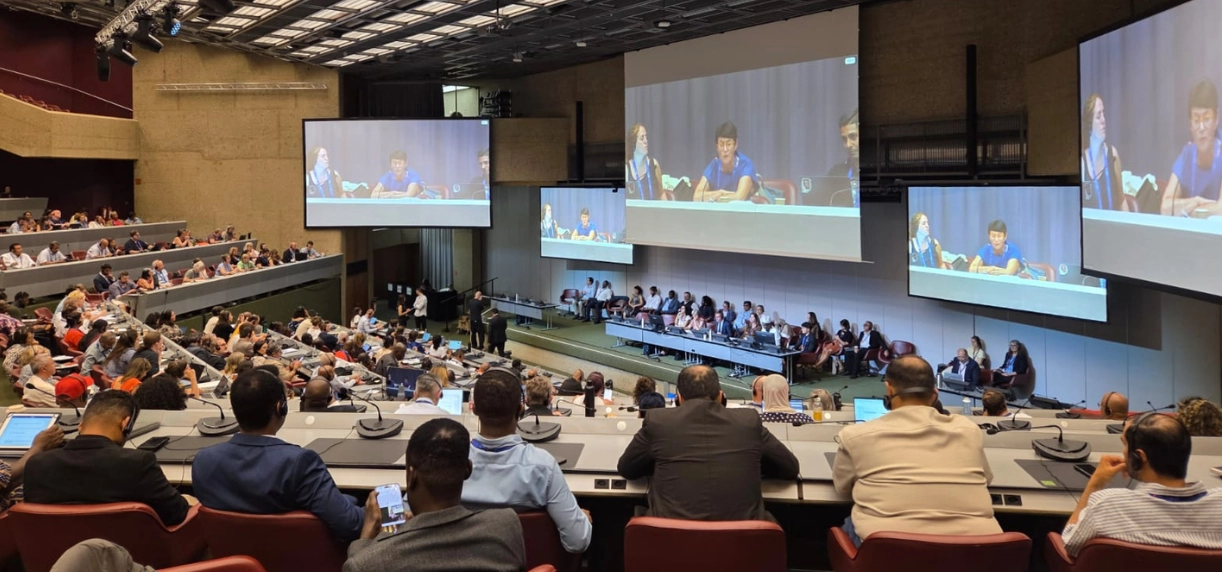
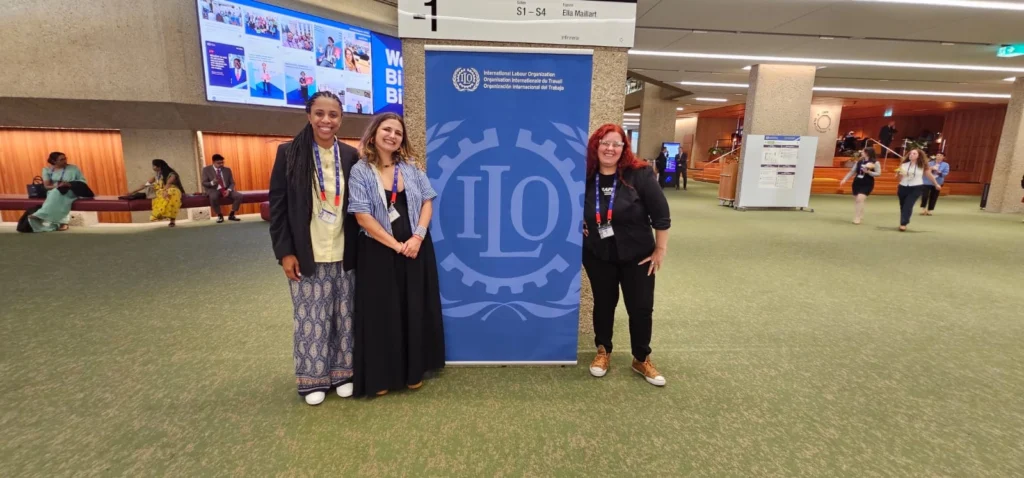
 The coordination team of Labora – Fund for Decent Work attended the 114th International Labour Conference (ILC) in Geneva, Switzerland. The event brought together representatives of governments, employers, and workers from the 187 member states of the International Labour Organization (ILO).
This was the first ILO conference in which we actively participated as Labora. Our presence there made perfect sense, given that strengthening the fight for digital platform workers’ rights has been part of our work since our inception.
Over its three years of operation, Labora has allocated more than BRL 33.3 million in grants, including BRL 700,000 specifically directed to organizations representing platform workers. Alongside financial support, we organize spaces for dialogue, mobilization, and collaboration among civil society organizations, academia, and philanthropy. We seek to stimulate debates that can chart pathways for advocacy, joining forces around a shared vision of decent work for each category of worker, grounded in social protections and respect for the territorial specificities of contemporary Brazil.
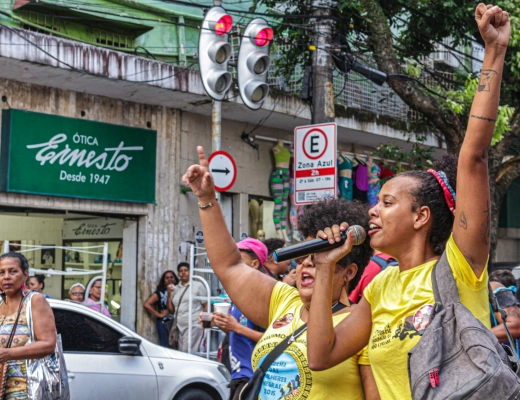
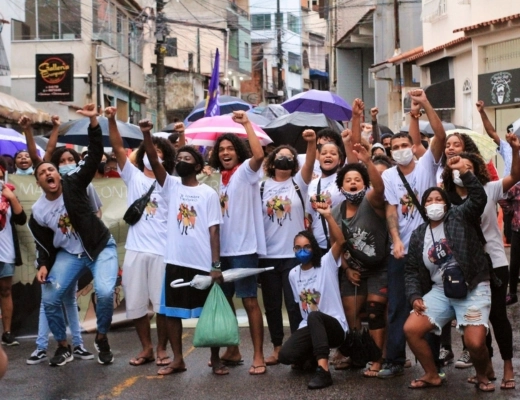
The experience of organizations supported by Labora shows that digital platforms follow a similar global logic: they establish themselves in countries beyond the reach of local labor legislation and continue operating until governments step in to regulate these major monopolies. It is therefore a major accomplishment to see that the mobilization led by movements, collectives, and the trade unions has resulted in an international convention with the potential to affect nearly 400 million people worldwide — and a significant and growing number of workers in Brazil.
Convention No. 193: The First Global Milestone for Platform Workers
As for Convention No. 193, we consider it a historic milestone. It represents the first global set of rules to protect platform workers. Its greatest achievement is the international recognition that digital platform workers cannot be left in a legal limbo or deprived of social protection. It sets unprecedented global standards for trade union rights, minimum pay, and workplace safety. On the other hand, critical questions remain unresolved, particularly the harmonization of rules concerning the nature of the employment relationship, as the practical implementation and enforcement of these minimum standards will depend largely on the balance of power and the specific legislation of each country that ratifies the Convention.
An international convention does not come about easily. Its adoption required countless hours of complex debate during the Conference and, above all, strong groundwork to build alliances based on the collective organization of the working class. Companies did not agree to develop the text through tripartite dialogue out of generosity, nor did governments actively engage in the process by chance: the Convention is the direct result of workers’ struggle, organization, and advocacy on a global scale.
Once ratified by Brazil, the Convention will naturally be adapted to address our specific circumstances. Nevertheless, the proposal championed by workers achieved two major victories: recognition of platform workers as workers, rather than merely as individual entrepreneurs, and the requirement that these minimum standards and social protections apply to every worker, regardless of the nature of their employment relationship.
Seeing this achievement become a reality inspires us to look to the future of work with the conviction that it is indeed possible to establish firm standards for guaranteeing rights, even under the most complex circumstances. Ultimately, social reality prevails, and collective mobilization creates the solutions needed to ensure decent conditions for every category of worker.
It is worth emphasizing that the organizations supported by Labora that took part in the ILO’s social dialogue in Geneva are seeking to expand their participation in international spaces. They have recognized that their presence and action in these spaces not only transform their own local realities but also contribute significantly to strengthening the working class worldwide.
Our experience alongside our partners has shown us that fair regulation starts with popular mobilization. For workers to continue participating in these spaces on an equal footing, they need the material resources to sustain their struggle for decent work. Against this backdrop, Labora’s support for these organizations is even more critical to collectively building pathways toward a fairer, more equitable, and more inclusive future of work in Brazil.