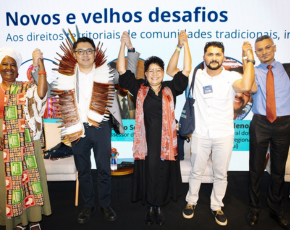





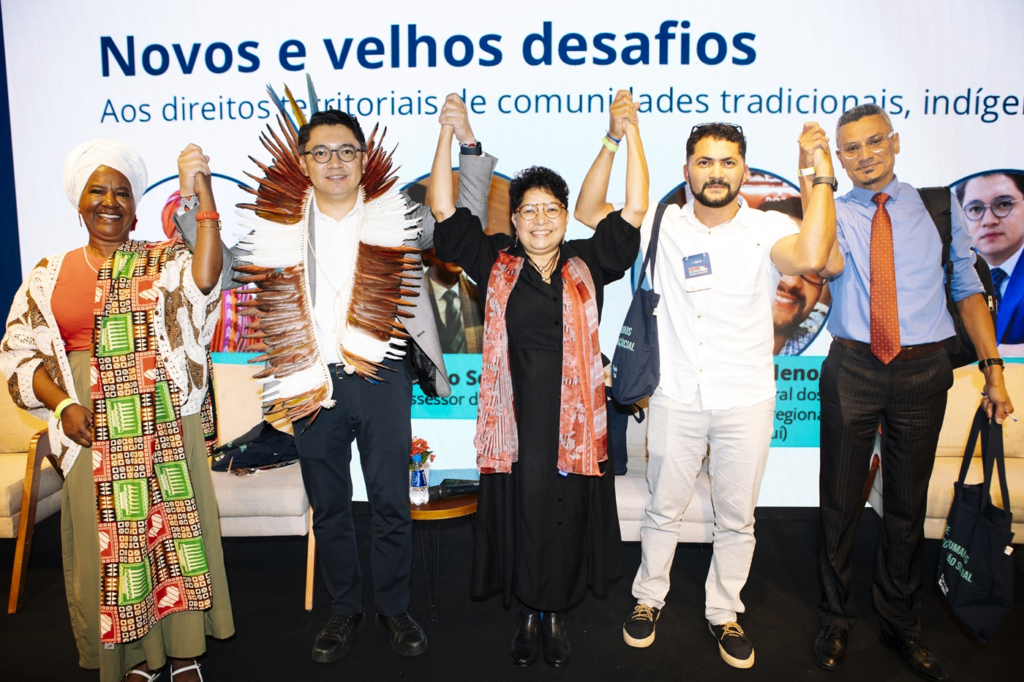
Makota Kidoiale, Eloy Terena, Kátia Brasil, Danilo Serejo and Luciano Galeno | Picture: Rebeca Figueiredo
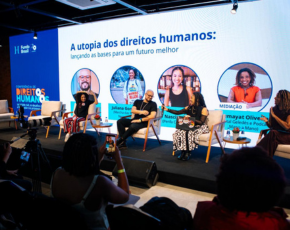
The expansion of energy, mining, and infrastructure projects has put in dispute territories occupied by Indigenous peoples, quilombolas, and other local communities. In the last day of the Human Rights Conference – Civil Society, Brazil’s Challenges, Philanthropy, and the Next 20 Years, the theme was discussed in the “New and old challenges to the guarantee of land rights to Indigenous peoples, local communities, and quilombolas” roundtable. The event was organized by Fundo Brasil.
With mediation from Kátia Brasil, executive-editor of Amazônia Real, the roundtable gathered representatives from different local communities. Those who took part were Eloy Terena, Minister of Indigenous Peoples; Makota Kidoiale, quilombola leader of Kilombo Manzo Ngunzo Kalango; Luciano Galeno, member of the Pastoral Fisher Council; and Danilo Serejo, advisor of the Movement of Those Affected by the Alcântara Space Base (MABE).
Right at the start of the debate, Eloy recalled the Brazil Fund’s trajectory alongside the Indigenous movement: “today I’m here in my position as a minister, but since my time as a lawyer, I have received support from the organization”. At the time, the minister referred to the foundation of the Nucleus for Popular Legal Defense and Assistance (Najup), in Mato Grosso do Sul, which offers legal assistance to Indigenous and local communities in the state, acting in defense of those peoples’ rights.
The recollection went beyond this pre-existing relationship, and also brought forward the principles defended by Eloy: “before being a minister, I am of the fight, of the Indigenous peoples’ movement”. To him, the juridicization of social demands isn’t the main problem, but the political dispute. He explained: “at some point, the seat [of minister] will go on, governments will go on, and us [Indigenous and local peoples] will get back to fighting”.
Many of the results of this fight arrived a few decades ago. Only in 1988, with the promulgation of the Federal Constitution – which is yet to complete 40 years – the rights of Indigenous peoples were institutionally recognized. The following year, in Convention nº 169 of the International Labor Organization (ILO), the importance of traditional lands was acknowledged, in addition to the legal guarantee of the preservation of those populations’ values and beliefs.
Nowadays, however, the autonomy and security of local populations have been suffering threats. Not for nothing, the minister defended that the fight and organization of these groups need to be strengthened and follow the increase on political-economic interests in Indigenous territories. Eloy also remembered the advancements in Indigenous communication and highlighted how the discussion regarding Marco Temporal went from an agenda restricted to Indigenous peoples and reached other members of the public debate.
Different worldviews
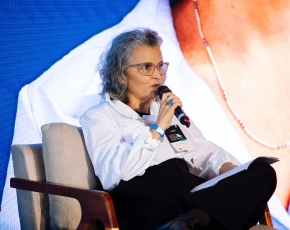
Makota, for her part, highlighted the historical permanence of quilombola communities and those populations’ relationship with the land. “Of the six quilombos in Belo Horizonte, two are proven to exist for over 250 years. Belo Horizonte is only 128 years old. The city is, therefore, an organization that invaded the quilombola communities”, she reflected.
From that analysis and defense, the quilombola leader reinforced the importance of collective identity among the members of local populations. According to her, this manner of organization contrasts heavily with the individualism present in the way that not only the Brazilian State, but also other countries and societies, take as an organizational system nowadays.
Differences such as that, for instance, cause cultural shock between Indigenous and non-Indigenous peoples, that is, those that are traditionally known as “white”. That occurs because “Brazil has been constituted from European concepts, so African culture causes a sense of uncanniness, it doesn’t dialogue with temples, orders, and individual readings” more common in the Brazilian population’s daily life.
In the same line, Luciano complemented how that shock between the Euro-Christian vision and the cosmovision of local peoples occurs. “We see nature as a part of being, and they (Euro-Christians) see it as a commodity”. Such a behavior that, for him, leads to a series of intersections with current agendas of the public debate, such as those related to the energy transition.
Upon seeing nature as a mere commodity, an inexhaustible product and, above all, priced out for different buyers, the discussion loses its value. That’s because elements such as the wind, Sun, and water – so valued by Indigenous peoples – start being treated as resources available to economic exploitation.
Capital in dispute
He also highlights that, upon occupying territories desired by great economic enterprises, local communities get into conflict with the State’s modus operandi. And that public organs also oftentimes don’t take concrete actions that avoid the advancement of violations of rights such as the territorial autonomy of Indigenous and quilombola movements.
“The State, as a colonizing structure, ignores the violation of rights”, since, as a political, legal, and administrative organization, it also has interests. It just so happens that, most cases, these interests are still aligned to the ambition of companies, which leads to the incentivization – even indirect – of the construction of wind-energy parks, real-estate enterprises, and mining, all of those in detriment of the physical and immaterial well-being of Indigenous populations.
An example of violation of local peoples’ rights in favor of capitalist activities cited by the speakers was the installation of the Alcântara Space Center (CEA) on the coast of Maranhão. For Danilo, the arguments used to justify the project involved matters of “national sovereignty” and “exploration of space technology”, but left aside the recognition and historical guarantees largely assured to local populations.
It just so happens that, beside the CEA, there live quilombola communities. One of them, the community of Canelatiua, is where Danilo was born and raised. And for that reason, he could share reports about the impacts provoked by the installation in the site. “A series of impacts of economic, social, and cultural order were caused for the families and communities that were compulsorily transferred in the 1980s”, a time in which the Brazilian government was still governed by the military.
At the time, 52 thousand hectares of land were expropriated, meanwhile only 8.963 hectares were occupied effectively. It was only in 1999, however, that quilombola communities managed to organize the “Alcântara: the Space Base and Social Impasses” seminar, presented to the Public Prosecutor’s Office with the intent of debating and denouncing the socioenvironmental impacts and human rights violations faced by the communities.
*Maju Pinheiro, member of Journalism Junior of the School for Communications and Art of the University of São Paulo, under supervision of journalist Mônica C. Ribeiro.