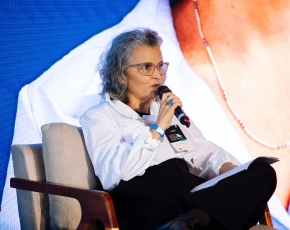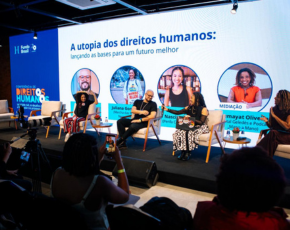




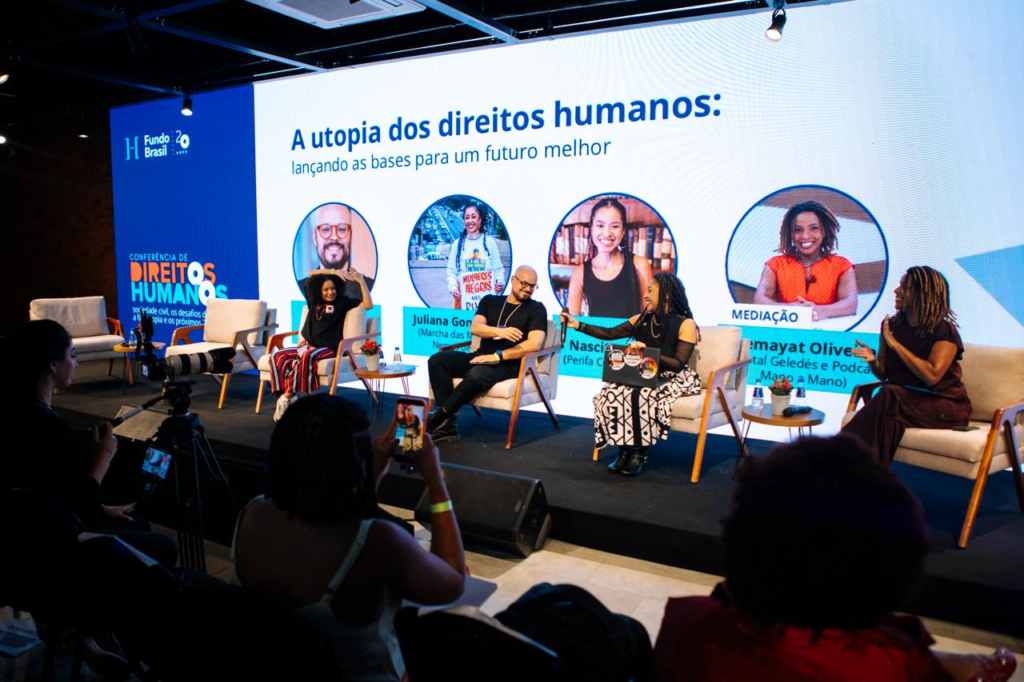
Thuane Nascimento, Lucas Petroni, Juliana Gonçalves, and Semayat Oliveira | Photo: Rebeca Figueiredo
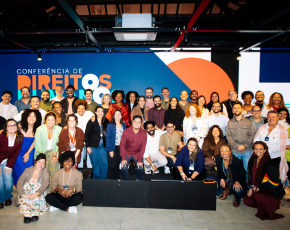
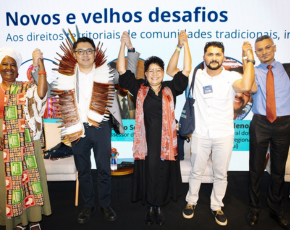
Brazilian democracy has advanced, albeit with many contradictions. If we want to have a more just future, we need to start discussing ways to strengthen democracy in the face of the rise of authoritarian forces. The closing plenary session of the Human Rights Conference – Civil Society, Brazil’s Challenges, Philanthropy, and the Next 20 Years, organized by Fundo Brasil, addressed The Utopia of Human Rights: Laying the Foundations for a Better Future. Speakers included Lucas Petroni, a scientist, philosopher, and professor at the São Paulo School of Economics of the Getúlio Vargas Foundation (FGV); Thuane Nascimento, executive director of PerifaConnection and cofounder of Observatório das Baixadas; and Juliana Gonçalves, a journalist, activist, researcher, and cofounder of the Black Women’s March. The session was moderated by journalist Semayat Oliveira, cohost of the Mano a Mano podcast.
The Advances and Limitations of Democracy
“What can we do as a society, here and now, with the resources and projects we have underway, to dismantle or prevent authoritarian forces or projects from organizing and destabilizing Brazilian democracy?” This was the question that guided Lucas Petroni’s initial address at the plenary session.
He explained that this question guided a multidisciplinary research project that involved about 15 researchers from different areas of Brazilian political life. Based on their work, each group proposed a list of potential and feasible reforms for Brazil in 2026. Lucas summarized the results in four theses, the first of which focuses on an assessment of the Brazilian democratic experience over the past 40 years. The analysis compares the Brazilian reality in 1988 with present-day Brazil and identifies progress in different areas. “Despite all the problems that we know, today we have a much more dignified, humane, and decent society than in 88,” he stated.
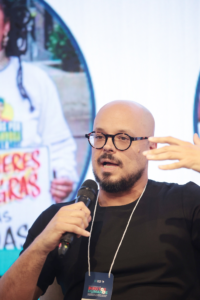
Lucas Petroni | Photo: Rebeca Figueiredo
Lucas drew attention to the increase in per capita family income and the decrease in poverty. However, he also highlighted three problems that still persist in Brazilian democracy: income concentration, social violence, and the transformation of authoritarian forces.
For him, income concentration is “a characteristic of post-colonial democracies.” Social violence, however, has not improved and may have worsened, affecting both social agents and groups, as well as interpersonal violence and state violence.
With regard to the role of authoritarian forces, he said that these agents moved away from a “vigilantist” model and began to apply these forces with an “insurrectionist” pattern, aimed at destabilizing the existing order and seizing power. In this context, Lucas established a difference between extremism and radicalism: while the former seeks to destroy democratic foundations, the latter can represent a legitimate form of political organization in the face of injustice. “In this sense, radicalism could be very good, and could even be our duty in the face of injustice.”
In his definition, extremist groups are antidemocratic and want to end equality, or the differences that exist among people. “It is characteristic of extremism to try to end the negotiation of differences,” which threatens political life in Brazil in various ways, since “an environment saturated with extremism makes people afraid of expressing themselves publicly.”
Thuane Nascimento added to the discussion by talking about a kind of “safeguard” attributed to youth in the face of the rise of authoritarianism. According to her, the present time demands our defense of democratic achievements, but without transforming that defense into the indiscriminate preservation of everything that exists. “When we talk about defending democracy, we have democratic institutions that are extremely important, but we also have a democracy that is experienced on the ground, in each territory,” she stated. For her, we must find a balance between what should be protected and what needs to be transformed.
At the beginning of her address, Juliana Gonçalves remembered the recent loss of activist Zélia Amador de Deus, who passed away this September at the age of 76. She highlighted Zélia’s important role in paving the way for the Black movement and emphasized that “Zélia spent her life defending the idea of well-living.”
When addressing current political challenges, Juliana emphasized the importance of looking to the future and stated that she believes “the greatest threat to capitalism is capitalism itself.” According to her, the far right is constantly looking for scapegoats among socially vulnerable groups to blame during difficult times. “Whose fault is it that life is difficult? Should we blame Black people, women, immigrants, the poor?,” she asked.
Juliana also drew attention to the feeling of hopelessness found among the population and its political consequences. For her, sustaining democracy does not end with the elections. While acknowledging the importance of the electoral process, she pointed out that “people are capable of using a democratic instrument to vote for antidemocratic proposals.” She highlighted the far right’s ability to transform fear and frustration into political identity. For her, simply pointing out the problems is not enough to solve them: “It’s a dispute that doesn’t revolve around facts; it’s a dispute about belonging, identity, and fear.”
Black Movement, Well-Living, and Collective Construction
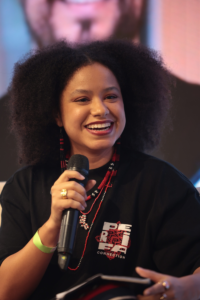
Thuane Nascimento | Photo: Rebeca Figueiredo
Thuane highlighted the need for change in some institutions that were originally created to serve the elite and that, today, are becoming increasingly accessible to the peripheral population. She stressed the importance of the Black movement in this shift in thinking: “All the engagement of Black people in society mainly revolves around higher education, access to education, and the public construction of affirmative action policies. The Black movement decided to look at an institution that had not been serving Brazilian reality and say: ‘We will change this story’.”
This also applies to mental asylums, which, until a few years ago, were seen as a reality impossible to change. “Until someone looked at them and said: ‘This has to stop, this is torture’,” she added. Today, the anti-asylum movement has gained more visibility, contributing to the advancement of policies that promote care in freedom.
Juliana highlighted the importance of building connections, trust, and a sense of belonging. For her, a policy based on affection should be one of the pathways toward a new era. She also believes that one of the roles of human rights for the next 20 years is to recover basic education, build communities, and resume dialogue—agendas historically demanded by Black movements. “Trust is a very important value for generating time and hope,” she stated.
According to her, there has been a great deal of political development in recent years, in which Black women are asserting a new type of well-living. “They are not just saying that they want to live; they are talking about how they want to live.” According to Juliana, with this demand, they are also contesting the very idea of the State, enabling a debate about what kind of State is desired and what its political, social, and economic organization should be.
Juliana also pointed out that the debate on democracy must include discussions about a rigorous, transparent, accountable, and democratic regulation of big techs. This could be done by funding Black, community, and marginalized media, building on the understanding that “local journalism and the communication produced here are not accessories—they are essential for us to fight misinformation and treat this world in decline.”
Is It Possible to Reconnect with the Collective Dream?
At the end of the panel, Semayat Oliveira asked the panelists how to fight the sense of hopelessness they described before. “How can we perhaps reconnect with a utopia, the dream of being collective?”

Semayat Oliveira | Photo: Rebeca Figueiredo
Lucas believes that some people’s aversion to utopia may stem from certain models aimed at flawed projects. However, he said that many of these projects, despite claiming to be utopian, never had an intimate relationship with the idea of democracy and difference. “Today’s utopia is tomorrow’s common sense,” he added. For him, the problem lies in an excess of individualistic utopias and the “lack of an idea to transform society democratically.” He further reinforced the need for a broad perspective on consolidating utopias, and added that he saw collectivity as the only way to achieve stable coalitions that fight for a common interest.
He recalled that the very idea of Brazil living in a democracy was utopian until the end of the 20th century, and compared Brazil’s inequality rate to that of Middle Eastern countries, which feature patriarchal systems and slavery. “We have to look at Brazilian democracy not as something that is difficult and doesn’t work, but almost as a sociological miracle,” he adds.
Thuane continued the discussion by asking what is needed to transform a utopia into reality, and cited the recent debate about ending the 6×1 work schedule. For her, more than discussing these issues on a case-by-case basis, a consistent political agenda is required to transform utopia into common sense in the long run. Although public figures help to bring visibility to a cause, she pointed out that it is the social movements that actually fight to make it a reality.
In this regard, Thuane talked again about insecurity, elaborating on the idea that people that oppose ending the 6×1 work schedule are not necessarily against workers having two days off: they fear that Brazil could be negatively affected by the reduction in working hours. For her, the way to address this line of thinking is to reinforce the feeling of belonging and security for the population.
She ended by emphasizing that the left needs to fight for its own ideology, and not just follow causes that have been imposed on it. “We may lose, but we’ll be working and coming together for something we want.”
The plenary session drew close to its end with Juliana’s remarks about the movement that transformed well-living into an everyday political practice. For her, the fight to end the 6×1 work schedule is a great example of this perspective, which looks collectively at society and decides to fight for the cause of workers who deserve decent time off.
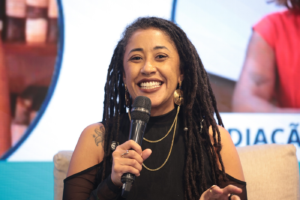 She added that we must build a sense of community within society, and that this is the only way to secure our rights. She argued that people are driven by their own passions, and that addressing these personal interests is the path to collectivity. “That’s why some progressive left-wing discourses become very boring—they keep talking about what we don’t want, and not about what we do want,” she added.
Semayat added that it is important to accept opposing viewpoints and engage in dialogue without the pretense of being right all the time. Finally, she proposed a quick activity, where she asked the speakers what their utopias were.
Semayat started by saying that the utopia that motivates her is freedom for Black people to live. Next, Juliana explained that her utopia is to be free, without fear, and her dream is a more representative parliament. Lucas said his motivation is imagining that everyone would consider it worthwhile to live in a democracy. Thuane concluded in a lighthearted manner, stating that her utopia includes agrarian reform, the demarcation of Indigenous lands, and urban reform in the peripheries.