



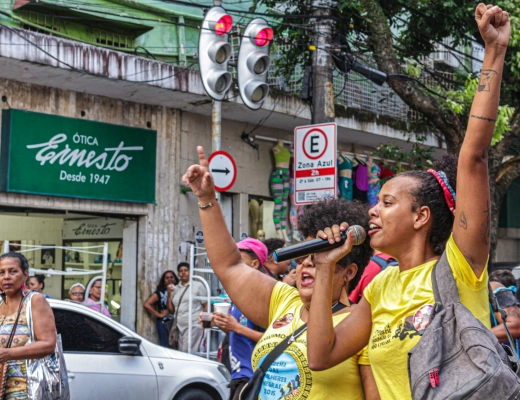
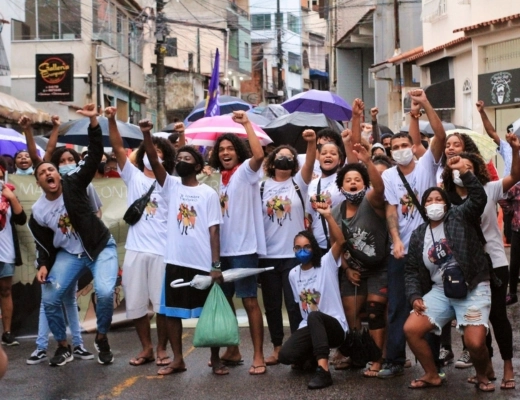
The Labora Fund for Decent Work organized, throughout April and May 2026, a Training Journey about the 114th International Labor Conference, offered especially for digital platform drivers and delivery workers.
Realized in partnership with the Interunion Department of Statistics and Socioeconomic Studies (DIEESE), Women in Informal Employment: Globalizing and Organizing (WIEGO), Unified Workers’ Central (CUT), and Solidarity Center, the journey resulted in a document with the collective demands of app-based drivers and delivery workers which will serve as a reference for the representatives who will take part in the Conference.
The International Labor Conference is an annual event mediated by the International Labor Organization (ILO). In 2026, it will center its debates around agendas of decent work in the platform economy, gender equality, and the relationship between formal and informal labor.
The trainings were proposed as a space of appropriation and collective construction of knowledge about the Conference and its goals, tools, methodologies, and recent demands, in no way substituting official discussion spaces. The document will, however, serve as a reference for the representatives who will be in the Conference, ensuring a more democratic and representative participation for the organizations that will not be present for the debates.
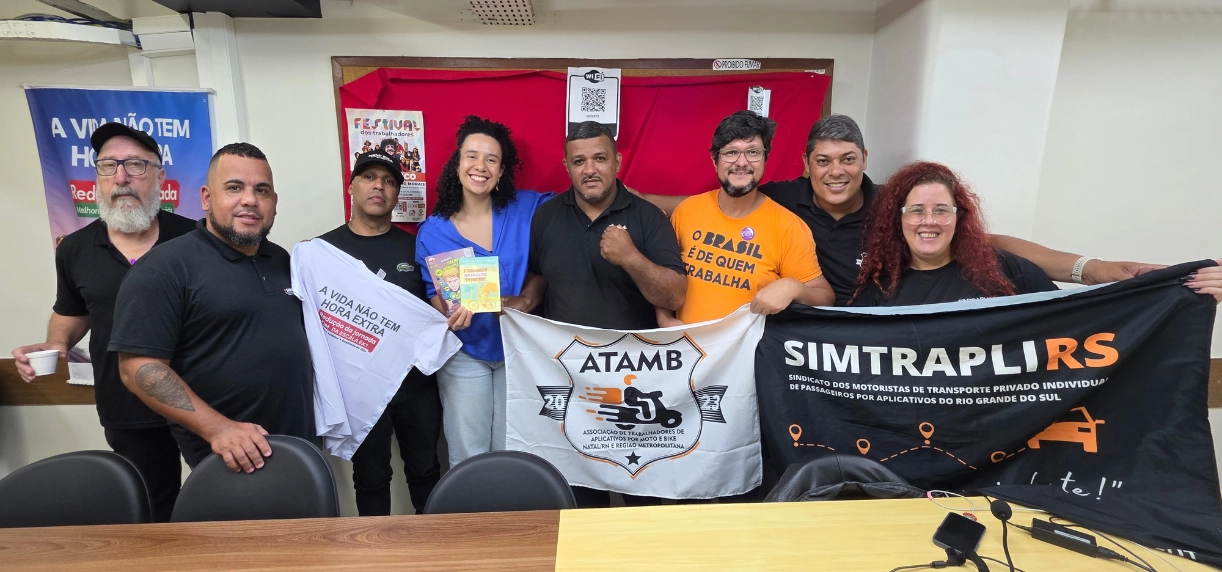
One of those appointed by the Union Centrals to bring the demands of Brazilian platformed workers to the UN halls is Carina Trindade, president of the App-Based Individual Passenger Transport Drivers’ Union of Rio Grande do Sul (SIMTRAPLI/RS), an organization supported by Labora, which has firmed the collective commitment of trying to reflect these demands in that space’s negotiation agendas, taking into consideration the participation limitations that the Conference imposes.
For Carina, the Conference configures as another fighting instrument for the working class. “It’s important to follow the debate because, whatever is decided in this year’s ILO will get into the question of regulation in a global level, and in Brazil it won’t be different, wherein we’ll be able to demand from our rulers the implementation of the regulations”, she claimed.
The proposals that will be defended in Geneva get into complex points of the platform economy, such as the establishment of a minimal pay based in distance traveled and local living costs, the end of arbitrary blockings by algorithms with no right to defense by the workers, and access to social security (including the discussion around special retirement due to the danger of a routine in the streets). The document also proposes debates about the specific protection of women against harassment and incentives to the professional and technical training of workers, including topics about the impact of climate change in their work routines.
Have taken part in the trainings, debates, and construction of collective demands to be considered during the International Labor Conference:
- National Alliance of App Delivery Workers (ANEA)
- Association of Motorbike and Bicycle App Delivery Workers from the State of Pará
- Association of Motorbike Delivery Workers of João Pessoa
- Association of Motoboys, Motogirls and Delivery Workers of Juiz de Fora (AMMEJUF)
- Association of App Workers by Motorcycle and Bicycle of the Metropolitan Region of Natal/RN (ATAMB)
- Movement Association of Delivery Workers of Rio de Janeiro
- União Maior Motoboys Association (AUMM)
- Association of Motoboys and App Drivers of Rondônia
- Association of Autonomous Motorbike App Delivery Workers (AMAE/DF)
- Association of App Delivery Professionals of Maceió (APEAM)
- Association of App Workers of the State of Rio de Janeiro (ATARJ)
- Association of App Workers of the State of Rio de Janeiro (ATA/RJ)
- Movement of Workers Without Rights (MTSD)
- Union of Drivers that Use Apps in the State of Minas Gerais ● App-Based Individual Passenger Transport Drivers’ Union of Rio Grande do Sul (SIMTRAPLI/RS)
- App Drivers’ Union in SC (SIMASC)
- Delivery Workers’ Voice Rio de Janeiro
The ILO Conference has already been responsible for influencing important historical advancements to Brazilian workers. In 2018, for instance, Brazil was the 25th country to adhere to Convention 189, the first international treaty that established minimal global standards to ensure decent work, fundamental rights, protection against abuse, and fair pay to the category of domestic workers.
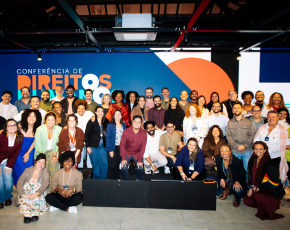
The last meeting of the Training Journey took place in CUT’s headquarters, in Porto Alegre, as well as part of the Labora Exchange Program’s schedule, an initiative that aims to offer in-person technical visitations between the supported organizations and, therefore, to build spaces for learning, exchange of good institutional practices, articulation, and strengthening of networks. The exchanges are conducted throughout two days and organized in a sectoral manner, so as to gather supported organizations in each category: digital platform workers, care economy workers, farmers, LGBTQIAPN+ workers, among other priority support groups to Labora.