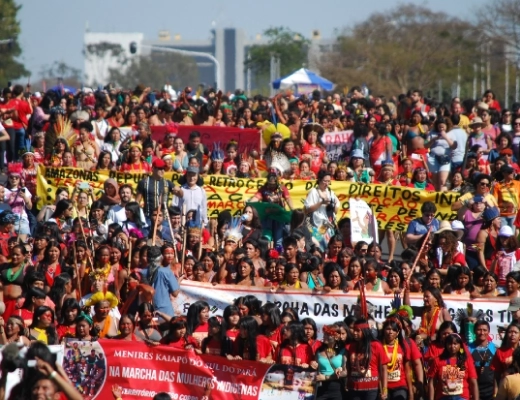




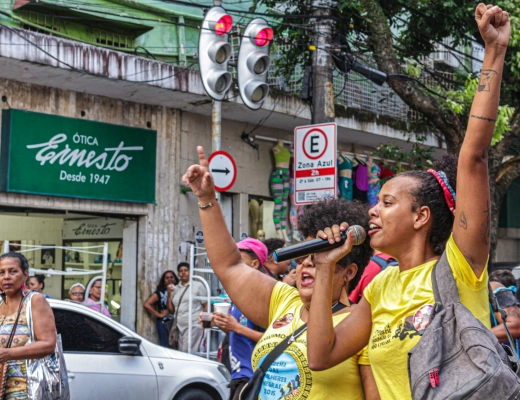
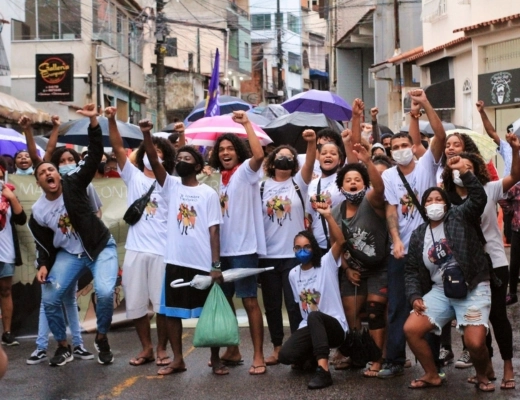
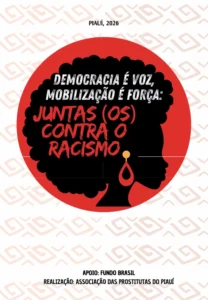
The color red was chosen on purpose, as a resource to draw the public’s attention. / Credits: APROSPI
“Peço licença ao público / A quem vou me reportar / Falarei do racismo / De forma bem popular / Por isso usarei o cordel / Para a mensagem passar”. ¹
Thus begins the cordel “Democracy is voice, Mobilization is strength: Together against racism”, released by the Association of Prostitutes of Piauí (APROSPI). The publication turns one of the most traditional expressions of northeastern popular culture into an instrument for awareness and tackling racism.
The initiative was developed with support from the Brazil Fund, through the Tackling Racism from the Basis 2025 call for proposal, and was born from the need to make the debate about racism more accessible and closer to the reality of sex workers.
In verse and rhyme, the cordel carries the discussion beyond the training activities realized by the association, reaching different publics through a simple and popular language.
The idea arose during the roundtable conversations promoted by APROSPI. The discussions revealed that many associates, including those who had taken part in the organization for years, still had a hard time recognizing situations of racism and understanding how structural prejudice crossed their lives.
Developing a project with the Brazil Fund enabled the further expansion of this perception. “I came to understand what racism was from the roundtable conversations. Such that in our meetings, we discovered almost unanimously that all of us had already suffered this prejudice”, recalls Celia.
A survey done by the very associates of APROSPI points out that Black sex workers are those who most suffer discrimination and, above all, are in the worst situations of vulnerability. As well as the racial prejudice, Celia also highlights that, due to their work, they are often seen with stigma, which worsens rights violations and hinders the access to opportunities and services.
In the project’s report, they describe how this reality manifests in daily life: “beyond facing the stigma of discrimination against prostitution, every day they face racism, which presents itself as lower pay, low clientele, precarious work spaces, mistreatment/discriminatory treatment, institutional, social, and individual violence”.
Speaking of racism involves both the collective and individual
When they idealized the booklet, they desiret to build more than a booklet that people “take out of politeness”. They wanted to do something different, that earned the public’s attention, so they truly read it. The choice for a cordel came up in that context, as a form of bringing the content closer to a more accessible and popular language.
As none of the members had experience with the cordel format, they sought help near the Association. They talked to a homeless man who used to stay in the square near the headquarters and recite cordéis. From that meeting, he contributed with his knowledge about the structure and form of which the verses should be constituted.
Throughout the production, they also had to learn how to recite the text, which must be read musically. Celia is very proud of the final result: “the coolest part is that I’s just like us, it has our character. We had full freedom to do it as we thought would be best”, she says. “The Brazil Fund gave us legitimacy to speak and learn what we didn’t know”.
Chang
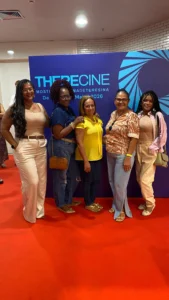
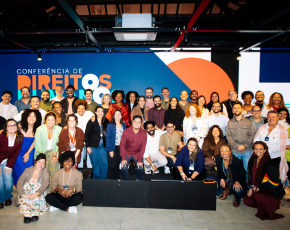
Associates of the Association of Prostitutes of Piaui during event. / Picture: APROSPI
e only happens with popular mobilization
Celia displays a lot of happiness upon knowing that the people who read it sought to understand more about the subject. The Association was even invited by educational and healthcare units to talk about the subject. “They brought us to speak in universities. So we could speak of the cordel ourselves, to read our own book. We felt more important speaking of the evil that plagues us”, she says.
With the delivery of the magazines, it is estimated that 1.000 people got the cordel. According to the association’s survey, another 3.000 were indirectly impacted through family, community, and social ties.
Now APROSPI expresses the desire to expand this public and make available an online version of the booklet. “We want to make an e-book. We’re waiting for other opportunities to do it, because it has a cost and we need people who can head that work”, she says.
It’s almost 18 years on the fight for rights
The Association of Prostitutes of Piauí arose in 10/10/2008 through a general assembly, with the goal of reclaiming rights, as well as the destigmatization and inclusion of sex workers to the job market.
They undertook activities that intersect gender, race, and class, and – through events, gatherings, and training workshops with the communities –, aim to spread awareness about individual, social, and institutional violences, such as racism.
Among the main actions of the Association are the promotion of the debate and construction of public policies. They also work alongside public organs in order to ensure better living conditions for sex workers, especially Black women and those in situations of greater vulnerability.
In 2024 and 2025 they were supported by the ‘Tackling Racism from the Basis’ call for proposal, which seeks to strengthen organizations, collectives, and movements led by Black activists. With the grant, as well as the realization of an anti-racist cordel, they developed workshops covering the rights of the Black population and mental health, with the participation of community leaders, sex workers, youths, and Black and peripheral women.