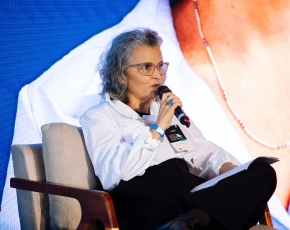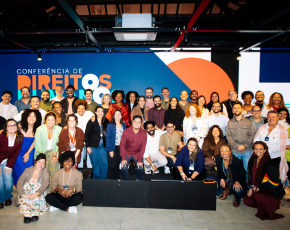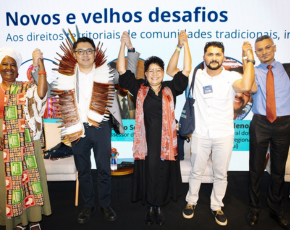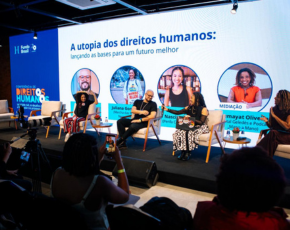



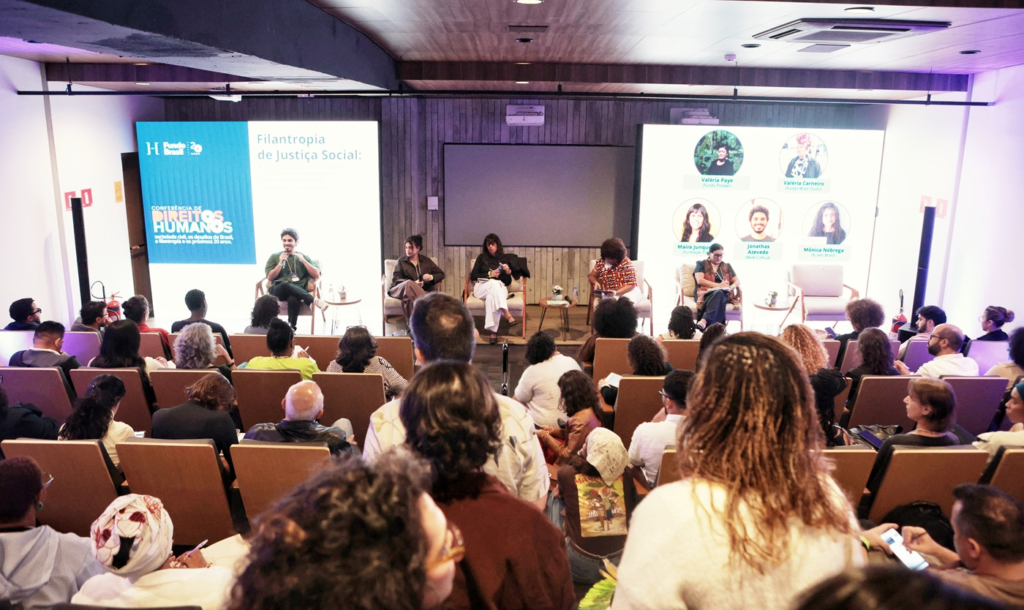
Jonathas Azevedo, Mônica Nóbrega, Maíra Junqueira, Valéria Carneiro, and Valéria Paye | Photo: Rebeca Figueiredo
“Local philanthropy is a funding option that has been improving in Brazil and throughout the Global South,” said Mônica Nóbrega at a panel discussion on The Importance of Local, Community, and Independent Funds for Strengthening Organized Civil Society. The lecture took place on Thursday 10 September at the Human Rights Conference – Civil Society, Brazil’s Challenges, Philanthropy, and the Next 20 Years and addressed the relevance and history of independent philanthropic organizations. The event was organized by Fundo Brasil.
The session included Jonathas Azevedo, executive director of the Comuá Network, Maíra Junqueira, director of the Ford Foundation in Brazil, Valéria Paye, executive director of the Podáali Brazilian Amazon Indigenous Fund, and Valéria Carneiro, coordinator of the Mizizi Dudu Quilombola Fund. Journalist Mônica Nóbrega, communications coordinator for the Brazil Fund, acted as mediator.
Through data and personal accounts, the speakers talked about the strength of local funds and the challenges they face, especially in the Global South. The discussion also addressed different forms of community action and support relationships between movements and large institutions.
Collectivity and Collaboration
According to Jonathas Azevedo, local funds are defined by their autonomous organization, independent of large entities or renowned actors. He explained that these organizations are based on local communities and on the regional demands they face. During the panel discussion, the speakers highlighted the importance of mobilization among collectives and funds when organizing grants and requests.
Valéria Carneiro explained that land regularization and the recognition of quilombola territories, central themes of the Mizizi Dudu Fund’s work, are only possible through direct contact with the communities living in those areas. According to her, an organization can only adequately serve a group by listening to its demands and understanding its form of occupation.
Valéria Paye pointed out that her initiative simply follows what the Indigenous movement does, keeping in touch with its history and other relevant entities. “We are only part of the solution, in an ecosystem of identification created among similar individuals,” she explained. The relationship between funds with similar agendas was also highlighted in the discussions. According to the speakers, collaboration among local philanthropies is essential for these organizations to remain self-sustaining.
Valéria Paye, who is also an Indigenous activist, explained that the Podáali fund is part of the Brazilian Amazon Indigenous Organization Network (COIAB), which works to facilitate direct communication between diverse movements in the Amazon region. Founded in 1998, COIAB currently coordinates nine different funds working on Indigenous issues.
The Comuá Network and the Ford Foundation are other entities that mobilize and gather funds in collaborative structures. Jonathas Azevedo explained that, for the Comuá Network, the relationship with other entities forms a “mycelium,” meaning that “it’s a network that is often made invisible, but that sustains its field and is committed to transformation.” Maíra Junqueira also highlighted the collective aspect: “We seek to strengthen democracy, and civil society and its organizations are the pillars of that.”
Rigidity and the Global South
According to the US Council on Foundations, only 13 percent of the grants provided by US philanthropic organizations are directed to the Global South. This finding was presented by Mônica Nóbrega, highlighting the lack of connection between international organizations and the causes of countries that are not central to global geopolitics.
According to Maíra Junqueira, part of the reason why local funds, especially Brazilian ones, are kept away from international funds is the lack of trust on both sides. She explained that philanthropy builds on recognition and responsibility among those involved, and that the distance between large organizations and regional entities often generates distrust about their capabilities. According to her, international funds avoid those that are little known, while local funds are wary of receiving resources for causes unrelated to their own.
Valéria Paye added that, in addition to the limited interaction between foreign institutions and local causes, large organizations also create barriers to supporting independent funds. She explained that the application processes are often “too rigid,” with very specific and exclusionary requirements. As an example, she cited the Green Climate Fund (GCF), the largest global philanthropic climate action fund, which tried to include the Podáali Fund in its program, but with such restrictive requirements that Podáali could never meet them.
She went on to say that she seeks to “provoke the field” by presenting demands that are specific to her community, without restricting herself to formal requests: “Large institutions also need to review their processes and documents. It’s not just us that have to adapt.” She argued that there should be dialogue and an agreement between both sides, without the expectation that only small funds should give in.
Jonathas Azevedo explained that the barriers to philanthropy are often intentional, linked to prejudice and systems entrenched in inequality. “It has never been about lack of money,” he stated. He then added that the Comuá Network’s motto is “making the impossible happen,” and one of its main priorities is facilitating access to funding.
*Nina M. Bozic, member of Jornalismo Júnior at the School of Communications and Arts of the University of São Paulo (USP), under the supervision of journalist Mônica C. Ribeiro.