


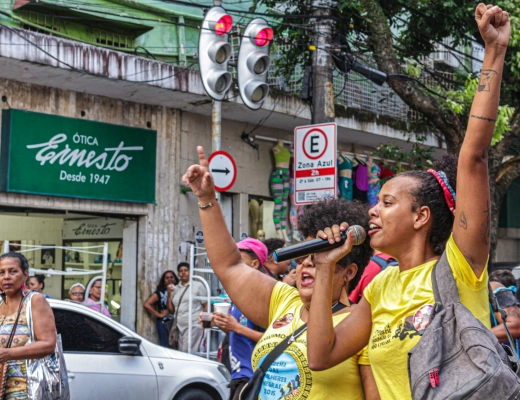
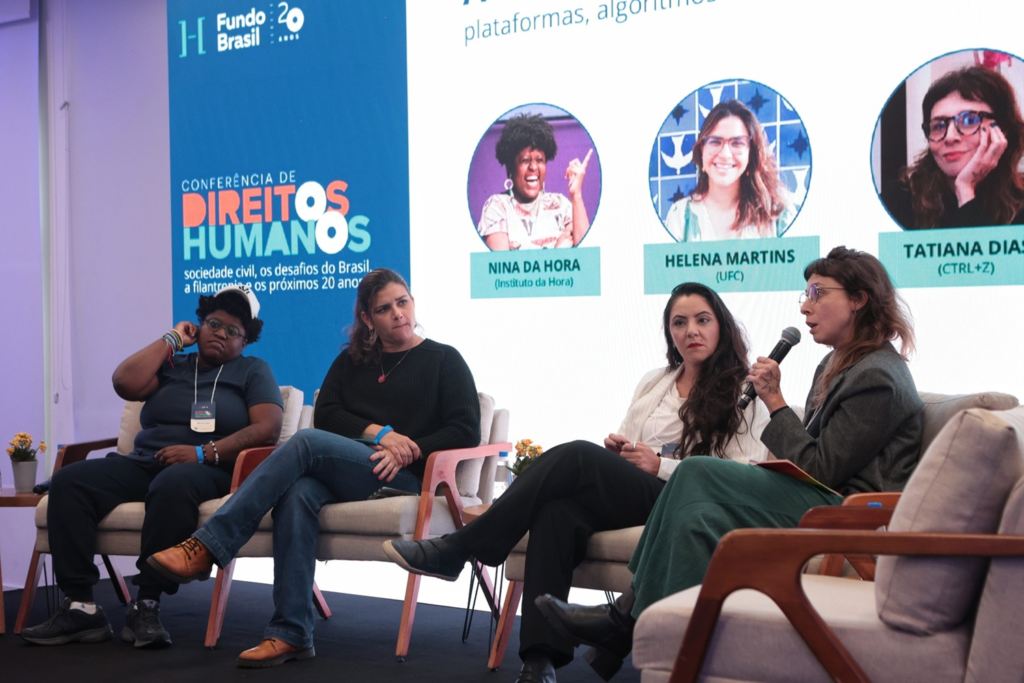
Nina da Hora, Helena Martins, Juliana Dal Piva e Tatiana Dias | Photo: Rebeca Figueiredo
The regulation of social media and artificial intelligence systems is increasingly taking center stage in the debate about democracy and rights. On the first day of the Human Rights Conference – Civil Society, Brazil’s Challenges, Philanthropy, and the Next 20 Years, hosted by Fundo Brasil, a panel on The Machine Against Democracy: Platforms, Algorithms, and the Fight for Rights discussed the impacts of digital platforms on how information circulates. Panelists included Helena Martins, a Social Communication professor at the Federal University of Ceará (UFC); Juliana dal Piva, a journalist at the Latin American Center for Investigative Journalism and a writer for ICL News; Nina da Hora, a computer scientist and antiracist hacker; and Tatiana Dias, program director at CTRLZ.
Technology as Political Dispute
The panelists addressed the concentration of power in the hands of large technology companies. For them, the discussion about the digital environment should not be limited to the products offered by the platforms. It must also encompass their infrastructure, their business models, and the power relations that underpin them.
Talking about the disputes over who controls meaning, language, and the interpretation of facts, Nina da Hora argued that political movements cannot rely exclusively on platforms such as WhatsApp, Instagram, and Facebook. This is because these companies use systems that are subject to their own rules and interests.
The dissemination of false information and the manipulation of speeches, especially those delivered by authorities, were also addressed. Tatiana Dias criticized the tendency to focus the discussions on what is published or shared on social media. She said we should pay more attention to the architecture that produces certain results: “The product itself is flawed.”
She argued that the harm caused by posts spreading lies on digital platforms should be understood, both by the public and by regulators, as a consequence of decisions made by the companies themselves—since their algorithms value this type of content—and not simply as errors committed by users, or isolated cases reported as inappropriate content. According to her, one of the strategies to confront the power of big techs—technology companies with a strong influence on the global economy—is to produce evidence about how their systems work and to hold companies accountable for the decisions they make.
Helena Martins also pointed out that the power of these companies is directly related to a prevailing economic model based on the collection and processing of data. She argued that data protection must be strengthened and contended that proposals that facilitate the commercialization of this data could further expand the power of corporations.
She explained that the issue is not only economic, but also political. The ability to manipulate and control behaviors through data collected from users (including suggesting ads on social media that are tailored to an individual’s interests) helps to explain the reach achieved by these platforms.
Digital Sovereignty
Another point highlighted was the need to develop a digital sovereignty policy, ensuring autonomy over one’s data and internet infrastructure. Panelists argued that Brazil should not only react to decisions made by large corporations: it should develop its own capacity to define which technologies it wants to use and which problems it intends to solve with them.
Furthermore, they argued that discussions about technology should be linked to concrete problems in the country. Instead of adopting certain technologies simply because they are seen as modern, we ought to ask what purpose they serve and what real social needs they meet. “Sovereignty means having the ability to define what we want first and foremost,” said Helena.
In the end, she rejected a pessimistic view of the future of technology, stating that there are proposals to address the problems discussed. She provided examples that could guide policy and the work of civil society, such as the National Forum for the Democratization of Communication (FNDC), a civil society organization that works to defend the democratization of the media; and the Network for Digital Sovereignty, a group of organizations that work in the areas of technology and digital rights.
The speakers concluded that confronting the power of platforms requires a combination of regulation, social organization, knowledge production, and the development of technological alternatives.
*Lucas Miranda, a member of the Junior Journalism program at the USP School of Communication and Arts, under the supervision of journalist Mônica C. Ribeiro.