





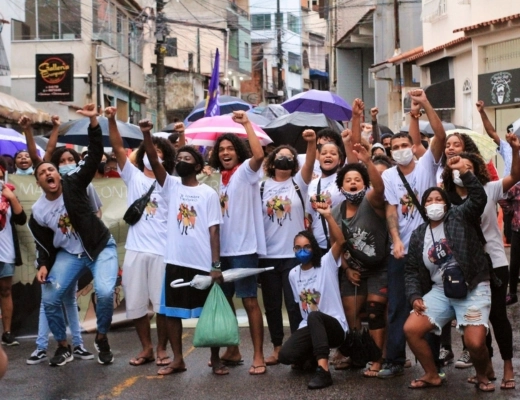
Six months after the massacre caused by the Rio de Janeiro civilian and military polices during the Contenção operation, on the communities of Penha and Alemão, at least three people remain missing. The data was raised by the Right to Memory and Racial Justice Initiative (Idmjr), a fluminense organization that, since last October, closely follows the relatives of people killed by the security forces. “Those three missing persons don’t appear in official statistics. Since their bodies haven’t been found, it’s as if they don’t exist “, affirms historian Fransérgio Goulart, director of Idmjr.
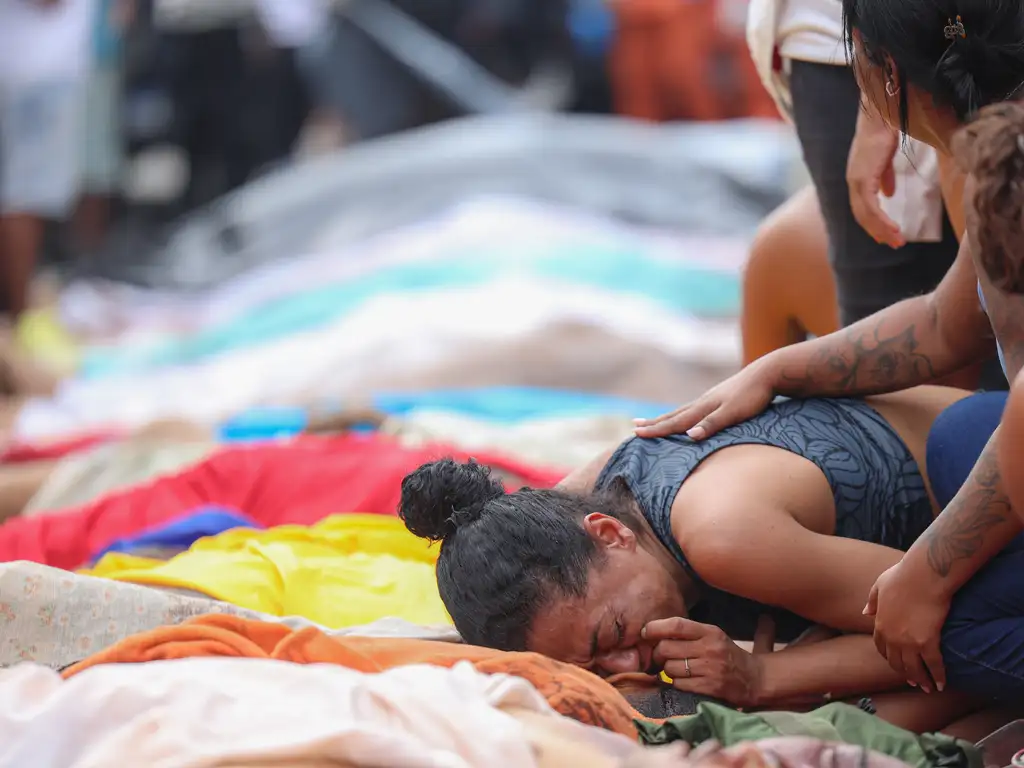
Conteção took place on October 27th 2025. Its goal was, according to the Rio de Janeiro government, to disarticulate the actions of Comando Vermelho in the region. It has resulted in 122 dead. Among them, five policemen. It was the most lethal police operation in Brazilian history. At the time, it horrified through a picture showing hundreds of corpses piled up in the middle of the street. “What happened in Rio de Janeiro was unprecedented”, claims Goulart. “That’s why we call it a ‘massacre’”.
With support from the Brazil Fund, Idmjr gave assistance to the families affected in the hours after the incident. The foundation granted R$50 thousand (circa 10,000 USD) to support Idmjr’s actions. It also released a digital campaign in which it invited society to do the same.
In the same night in which the massacre took place, Idmjr created a Whatsapp group through which it received reports of people in search of missing relatives. It also received cases of people who were trying to identify the corpses in the Institute of Legal Medicine (IML) of Rio de Janeiro, but complained of the treatment given to the relatives of the victims.
The activist says that, through the Brazil Fund’s grant, the group managed to offer legal assistance to 15 relatives. It fed at least 50 of the people who went to IML. The resources also took the form of food vouchers distributed to 100 motorcycle taxi drivers from Alemão and Penha. The measure was important given that all of the region’s economy was affected: small businesses, for instance, stopped working for around a month after the operation.
In the end, the groups focused on supporting local collectives and promoting ludic activities with children and teenagers of the region. The goal was to reduce the effects of those traumatic episodes on the mental health of youths. 30 children were supported.
Today, six months after the operation, Goulart complains about the sluggishness of the investigations. Residents of the region demand clarification of deaths with signs of execution.
The demand is the same done by international organisms. In the end of March, the Inter-American Commission on Human Rights (CIDH) concluded that “Contenção Operation must be investigated under hypothesis of a massacre, in the context of security policy”. The organ, tied to the Organization of American States (OEA), also affirms that “such investigation must ascertain penal and disciplinary responsibilities both of the material perpetrators as well as the chain of command involved in the planning and supervision of the operation, especially in the face of evidence of possible extrajudicial executions”.
The conclusions are the result of a three-day visitation done by the Commission to Rio de Janeiro in December of last year. The notice is available in the institution’s website.
Discussions on reparations
Goulart also points out what he calls the “process of criminalization of relatives”. On the day after the operation, the then secretary of the Civilian Police in Rio de Janeiro, Felipe Curi, said the state would sue relatives who had moved corpses found in the woods, between the complexes of Penha and Alemão. On the occasion, he affirmed that relatives of the victims tampered with the circumstances in which the bodies were found, hindering forensics. “The relatives simply wanted to give a dignified burial to their dead. They weren’t thinking of the accountability mechanisms anymore”, says Goulart.
Shortly after the operation, Idmjr and other groups acting in the region requested an audience with justice Alexandre de Moraes, from the Supreme Federal Court (STF). The idea was to report the horror lived during the operation, and the hardships faced by the population in the following days. “As a result of this hearing, STF prevented the opening of investigative procedures against the relatives that sought their dead in the woods”. The justice’s decision was divulged on November 10th.
On that same note, Goulart points out the urgency of stimulating a talk about reparations to victims of violence provoked by the State’s security forces. A debate, in his assessment, still prevented in the country by the tendency to stigmatization – or criminalization – of those relatives.
ADPF of the favelas
The Contenção operation took place a few months after the Supreme Federal Court concluded deliberations on the Claim of Non-Compliance of Fundamental Precept (ADPF) 635. Nicknamed ADPF of the favelas, the action demanded the end of militarized operations in favelas and peripheries. Idmjr acted as a friend of the court during the trial – that is, as an institution with knowledge about the subject debated, capable of offering information useful to the justices’ judgement.
The results, however, disappointed Goulart and other activists. Against a request of the movements acting in favelas, the Court understood it’s the responsibility of the civilian police to investigate death occurred during police operations. The third sector organizations demanded independent investigations. Among other measures, STF also determined the creation of a process of land recuperation of areas under the domain of criminal factions. “We request a plan for the reduction of police lethality. STF ordered a plan of territorial occupation for the favelas”, wrote Idmjr on Instagram on the occasion.