




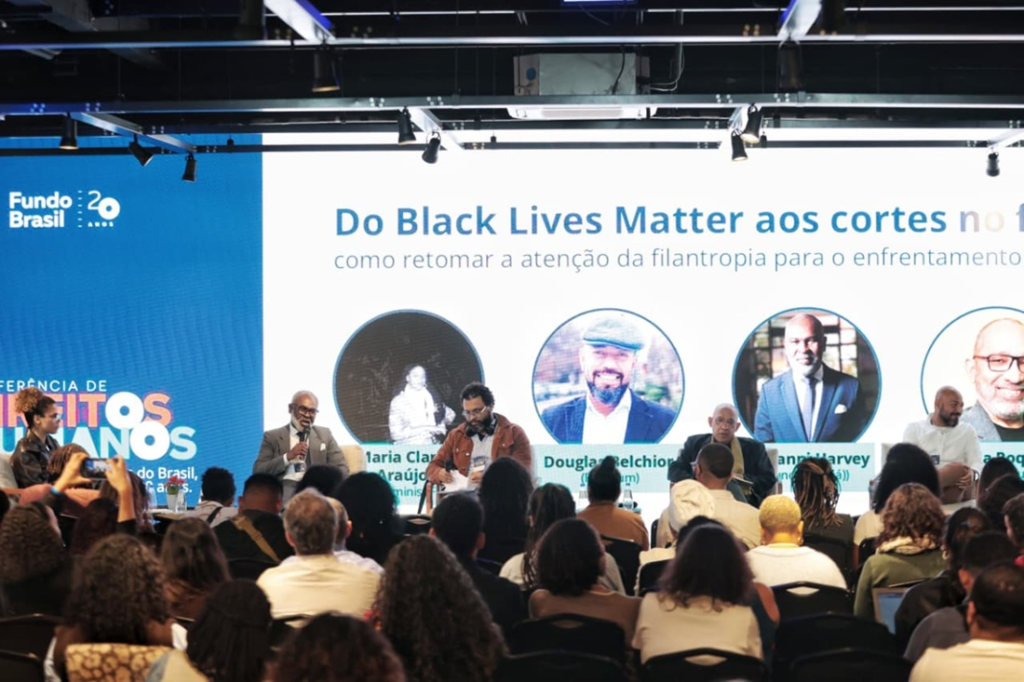
Maria Clara Araújo, Giovanni Harvey, Flávio Costa, Átila Roque e Douglas Belchior | Photo: Rebeca Figueiredo
With the rise of the far right in the world political scene, the decline in funding for antiracist organizations has affected the field of philanthropy. On Wednesday September 9, during the first day of the Human Rights Conference – Civil Society, Brazil’s Challenges, Philanthropy, and the Next 20 Years, hosted by Fundo Brasil, this discussion was the main focus of a panel titled From Black Lives Matter to Funding Cuts: How to Refocus Philanthropy’s Attention on Fighting Racism?
The discussion was moderated by Flávio Costa, an investigative journalist from The Intercept Brazil, and brought together different perspectives on the challenges faced by Black movements. Participants include Giovanni Harvey, executive director of the Baobá Fund; Átila Roque, a historian and political scientist; Maria Clara Araújo, an Afrofeminist from the Black Feminist Fund; and Douglas Belchior, a consultant at the Peregum Black Reference Institute.
According to Giovanni, despite the rise of the far right and the decline in support for the racial agenda, the current situation cannot be understood based on present events alone; instead, it should take a historical perspective. Ultimately, the antiracist agenda has more tools and institutions to fight racism today than it did 50 years ago. “I think we’re not as bad off as it seems, or as people say we are,” he stated, and argued that the movement should seek to expand, and not just defend the rights it has already secured.
The discussion about the term and nature of the funding allocated to fighting racism was further explored by Maria Clara Araújo, who spoke about the experience of the Black Feminist Fund (BFF), an organization focused on funding Black feminist movements. For her, the reduction in financial support highlights the historical underfunding of these institutions.
Created in March 2021, the BFF adopted long-term financing as one of its main strategies, with resources allocated to supported groups for up to eight years. According to Maria Clara, in five years, more than US$50 million was allocated to Black feminist groups in the Americas, Africa, Europe, and the Middle East. The BFF also began working to connect Black feminists working in various philanthropic institutions, at a time when organizations were under pressure to remove terms related to race and gender from their documents and projects.
Maria Clara argued that Black feminist movements should not be reduced solely to organizations focused on gender issues, as these groups are also active in the areas of climate change, health, and education, among others, and therefore need to be recognized as political agents capable of responding to different crises.
Átila Roque broadened the discussion to add a historical perspective. As former director of the Ford Foundation in Brazil, he recalled that the inclusion of the racial justice agenda at the center of Brazilian philanthropy did not occur spontaneously, but rather as a result of pressure from social movements.
For him, the debate about racial quotas was one of the moments that most provoked the Brazilian philanthropic sector. The mobilization around this policy brought the discussion about racial inequality to the center of society even before the murder of George Floyd in 2020. The US case, however, gave new momentum to the agenda, especially on the international stage.
“We won’t be so easily forgotten. We had a tremendous moment in Brazil, which was the fight for quotas,” Roque stated. Not surprisingly, he argued that the current decline should not be interpreted as the end of the racial agenda, but as part of an ongoing struggle for space and representation for Black people.
Structures That Last Beyond Project Funding
Douglas Belchior highlighted the need to transform one-off funding into ongoing support. He agrees that Black organizations cannot rely on funds earmarked exclusively for projects with a beginning, middle, and end. Philanthropic funds are temporary and should be used to build structures that will remain in place long after the funding ends. Among the priorities for this, he cited political strengthening, asset building, and leadership development.
Furthermore, Douglas criticized the traditional grant application structure, in which funders define the problems, strategies, and evaluation criteria to which Black organizations must adapt. For him, we must reverse this logic and provide greater autonomy to those who work in the territories.
The discussion converged on criticism of the funding model based on short-term projects, subject to changes according to the interests of funders. Instead of relying on moments of commotion or fleeting changes, participants advocated a model of philanthropy that is capable of sustaining organizations in the long term and recognizing their political autonomy.
For Douglas, the challenge lies not only in securing funds, but in leveraging funding periods to strengthen the political organization of the movements. This involves training, building relationships, and territorial organization so that institutions would not have to depend on the existence of a grant or a funded project.
Regarding the clash of ideas occurring in the current political landscape, Átila Roque argued that the antiracist movement needs to capture the imagination and affections of society, bringing its agenda closer to culture, art, and everyday experiences. For him, talking about racial equality should not only mean reacting to setbacks, but also presenting a project capable of mobilizing different sectors of the population. “Our fight is universal, and we are majority in Brazil”.
*Renata Paes, a member of the Junior Journalism program at the USP School of Communication and Arts, under the supervision of journalist Mônica C. Ribeiro.