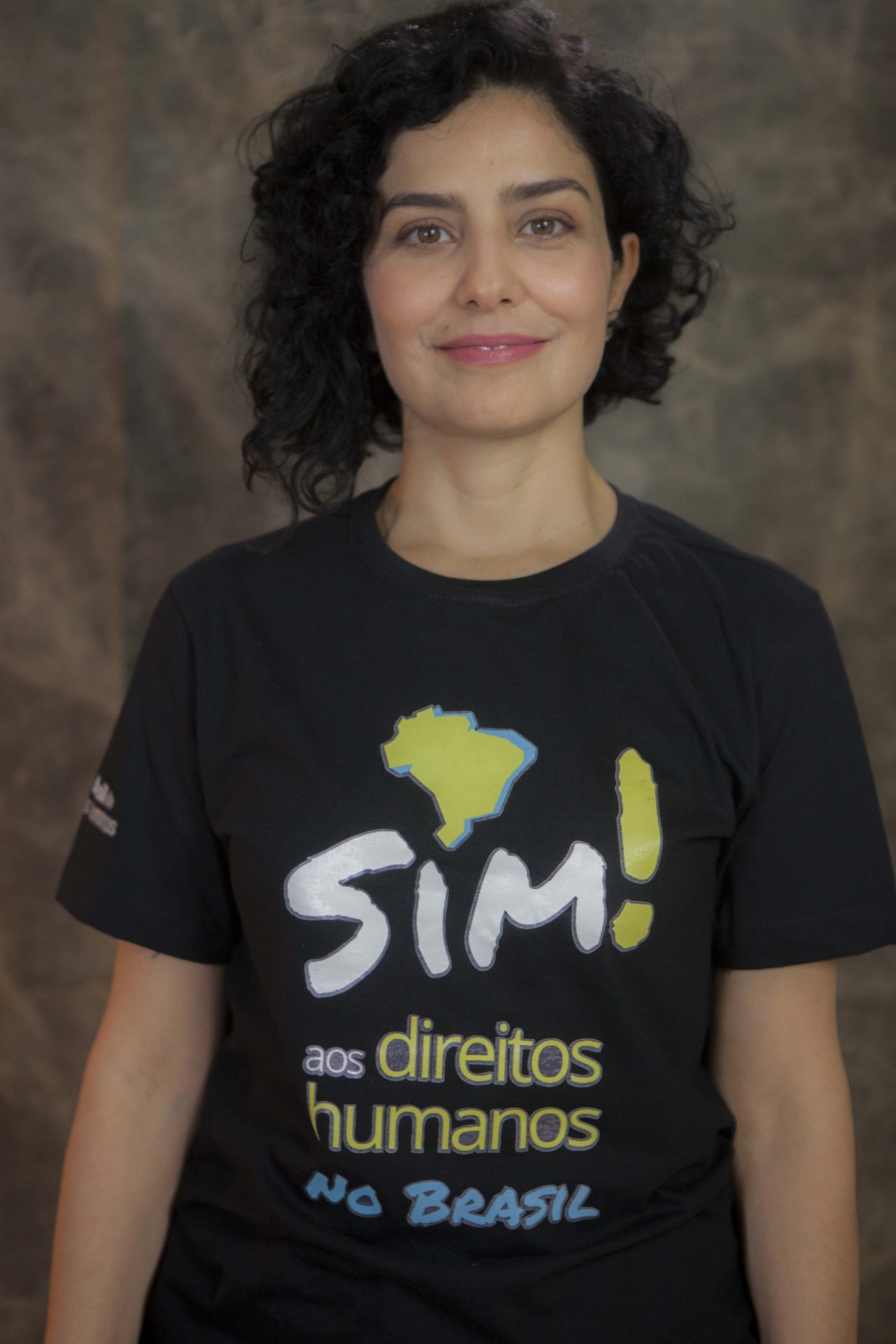




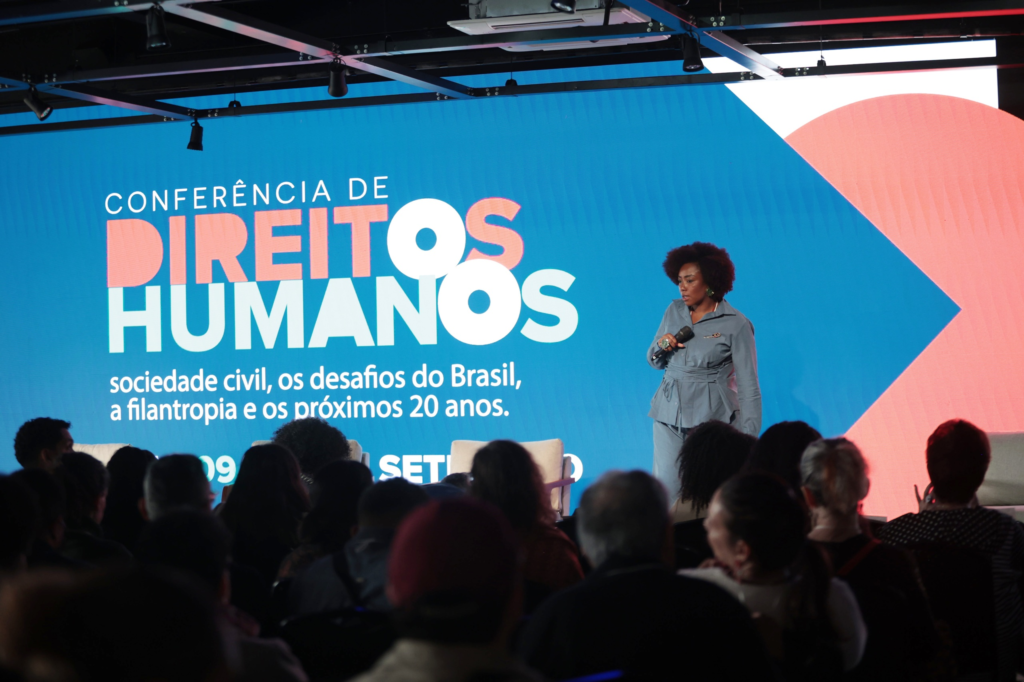
Allyne Andrade, Executive Director of Brazil Human Rights Fund, at the opening of the conference | Photo: Rebeca Figueiredo
The Brazil Human Rights Fund is celebrating its two decades of activity in 2026 with the Human Rights Conference—Civil Society, Brazil’s Challenges, Philanthropy, and the Next 20 Years.
Held on September 9 and 10, the event brought together different civil society actors to discuss Brazil’s current challenges on this agenda and potential pathways toward building a society that defends fundamental rights in the face of today’s challenges.
The conference was opened by current executive director Allyne Andrade e Silva and marked the farewell of Ana Valéria Araújo, who has left the position after 20 years at the hel

Ana Valéria Araújo | Photo: Rebeca Figueiredo
m of the Brazil Fund. Ana described the trajectory of the organization, conceived by Sueli Carneiro, Sérgio Haddad, Darci Frigo, and Oscar Vilhena, with the support of Denise Dora, highlighting its work in raising funds across the country to strengthen local voices and strategies. The event also paid tribute to other men and women who played a historic role in the fight for justice and democracy in our country: Abdias Nascimento, Margarida Genevois, Rose-Marie Muraro and Dom Pedro Casaldáliga, all founders of the Brazil Fund.
In December 2006, the first public call for proposals was launched aiming to support 20 projects in one year. Since then, the Brazil Fund has supported more than 550 initiatives every year, exceeding the mark of 2,500 projects in the whole period, and totaling more than R$140 million in grants to human rights groups, collectives, and organizations across the country.
“We have advanced on many things during this period. Achievements that have profoundly transformed our country, such as racial quotas and the Maria da Penha Law, to cite just two examples where civil society played a key role. The Brazil Fund supported many of the organizations that enabled these and other changes throughout this period. But it is a fact that we are going through a very complex moment, both nationally and globally: extreme climate events and emergencies, wars, the rise of extremism and hatred, racism, misogyny and xenophobia, the erosion of fundamental guarantees, and the emergence of new forms of human rights violations. We need to address these challenges and the competition for people’s hearts and minds in times of uncertainty for the protection of human rights,” she pointed out.
Building on the understanding that there is no real democracy without an autonomous, vibrant, and strengthened civil society capable of defending its own rights, the Human Rights Conference sought to reflect on the progress achieved on this agenda and on the challenges facing Brazil, as well as the role of civil society and philanthropy for the next 20 years, inviting people to imagine the future we want for human rights and for our country.
Human Rights Under Attack: Why Do We Still Insist?
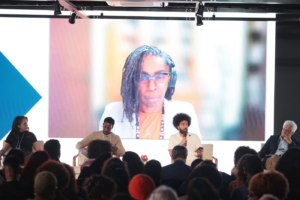
Opening plenary of Fundo Brasil’s 20th anniversary conference: Tatiana Vargas Maia, Ronilso Pacheco, Pedro Borges, Oscar Vilhena and, in the background, Jurema Werneck | Photo: Rebeca Figueiredo
“It is impossible to talk about human rights in Brazil without placing social movements at the center. We are celebrating the structure that has sustained this fight. The Brazil Fund chose to be here,” said Mafoane Odara, chairperson of the Brazil Fund’s Board of Directors. She further pointed out that the human rights under attack have color, gender, class, CPF (Brazilian taxpayer ID), zip code, and territory: “Violence does not affect all bodies in the same way, and the State does not reach all places in the same way. We need to look at what the Brazilian reality has been demanding of each of us. The centrality of movements and grassroots organizations lies in the construction of a national project in which we believe. You cannot discuss race without considering territory, and you cannot discuss democracy without addressing inequality.”
She also highlighted the crosscutting nature of the climate emergency in relation to the rights agendas, and how the current funding situation—resulting from budget cuts and the shifting of resources caused by global and national contexts—affects the support received by those fighting for rights: abuses that go undocumented, or networks that can no longer support what the State cannot sustain.
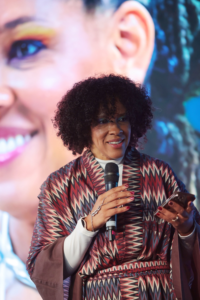
Mafoane Odara
Mafoane’s speech preceded the plenary session on Human Rights Under Attack: Why We Still Insist, and What Is at Stake Now, which featured the participation of Jurema Werneck (Amnesty International), Oscar Vilhena (FGV), Ronilso Pacheco (ISER), Tatiana Vargas Maia (UFRGS), and Pedro Borges (Alma Preta) as moderator.
As we examine the Brazil Fund’s 20 years in operation, we are faced with distinct historical moments: achievements in the field of human rights, followed by a reaction from ultraconservative actors in the country and around the world.
Ronilso Pacheco, a theologian and executive director of the Institute for Religious Studies (ISER), identified these moments. The first one, concentrated between 2006 and 2013, was marked by the rise of left-wing governments, the election of a Black president in the United States, the Arab Spring, the pontificate of Pope Francis, the Black Lives Matter movement, and the approval of civil partnerships for same-sex couples in different countries. That was followed, however, by the reorganization of the far right around the world, leading to additional pressure on the field of human rights, which, according to Ronilso, is also undergoing a change in meaning.
“A dispute arose not only over the agenda, but also over the meaning of human rights, and we need to start explaining what these rights are that we are defending. The conservatives took to the streets, but not with the same intensity that we see today; however, 20 years have been enough for a change in context that demands new strategies from us,” he states.
He highlighted the need for us to understand how to overcome this seclusion of the human rights debate and move toward ensuring that people understand this agenda. He also stressed the importance of understanding the role of religion in this equation, which has become increasingly prominent over the past 20 years.
Tatiana Vargas Maia, an assistant professor at UFRGS’s Department of Economics and International Relations, has been devoting much of her time to researching central themes that may help us understand the global landscape. For her, “human rights have acquired a centrality in political discourse that we did not see before. The far right proposes a new way of talking about freedom and equality, from a different perspective. The fight for human rights must be understood as a field of permanent dispute, constantly under tension. We are not arguing about being for or against it, but rather about the meaning of these rights. They are colonizing and redefining what these rights are. We need to think about how to disseminate and affirm wider meanings of freedom, equality, and human rights—so as to translate all this content into political practices, beyond abstractions.”
Democracy at Stake
For an attack on human rights to be effective, it must be directly linked to an attack on democracy. According to Oscar Vilhena, founding professor and director of the Law School at the Getúlio Vargas Foundation, we must place democracy at the center of the fight because “it is through the erosion of democracy that all progress in the area of human rights is dismantled. Although we always fully recognized the progress that democracy brought to Brazil and other countries around the world, perhaps we didn’t have a clear perception, 20 years ago, of the magnitude of the reaction to our work.”
Oscar also highlighted that this reaction to the achievements in the protection of rights was linked to a disruption in the way that we got used to doing politics throughout the 20th century. There was a profound change in the world’s production model, affecting the structure of unions and leading to losses in their social bargaining power. In addition, the way in which public debate is structured was also affected, with social networks rising, and the mainstream media losing their leading role. As a result, political parties, media outlets, trade unions, and civil society organizations lost their central role and the ability to effectively disseminate their messages.
“Reinventing the possibilities of defending human rights is, in fact, about reinventing ways of defending democracy. Our fight needs to be connected to the defense of democracy at this moment.”
Ability to Seek Convergence in the Face of Diversity
Jurema Werneck, executive director of Amnesty International Brazil, pointed out that “We must remember that we won before because we fought before. The trajectory of our fight for human rights points to our victory”.
Citing Amnesty International’s work with the LGBTQIAPN+ community in Hungary, which was harshly criminalized during the country’s 16-year autocratic regime, Jurema stressed the ability to seek convergence in the face of diversity among individuals. By supporting the Pride Parade through media mobilization, Amnesty International helped civil society realize that it was possible to confront adversity and authoritarianism, inspiring other segments to mobilize their efforts for a new vision of the future.
“Some segments are not necessarily in our field, but we share common problems. The Black Women’s Movement, for example, brought a point of convergence to our mobilization: living well. Everyone is looking for that. A good life means education, health, and it can mean so many things. This process starts with us getting together. We need to apply this every day, in a concrete manner. Planning for the future is also part of living well, and this involves our choices, including those made during elections. Voting for what we have, but also for what we don’t have yet.”
Finding common ground among different perspectives, recognizing the trajectories of our fights and achievements so far in the face of adversity, and imagining new futures are fundamental steps to enable the rights agenda to continue advancing amidst the disputes for meaning. After all, as Mafoane Odara pointed out at the opening session of the first day of the Brazil Fund conference, “even in the face of threats, we cannot lose our capacity to imagine, because every achievement in the area of rights began with a utopia sustained by someone who refused to believe that our future had to be limited by our present”.
*Maju Pinheiro, a member of the Junior Journalism program at the USP School of Communication and Arts, under the supervision of journalist Mônica C. Ribeiro.