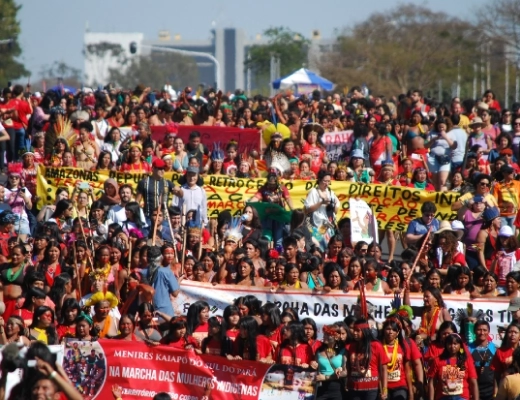



Photo: Alex Borja/ Brazil Fund Archive
Many of the open veins of Latin America still remain. Forests cut down and burned. Toxic smoke turning blue skies a dull beige-gray and staining lungs with dark patches. Mercury causing what was once life in the rivers to float to the surface along their banks, while lengthening the lines at healthcare facilities. Illegal mining operations advancing into backyards where children play and women of all ages shell corn. Graves multiply where the Pindorama of the ancestors once stood.
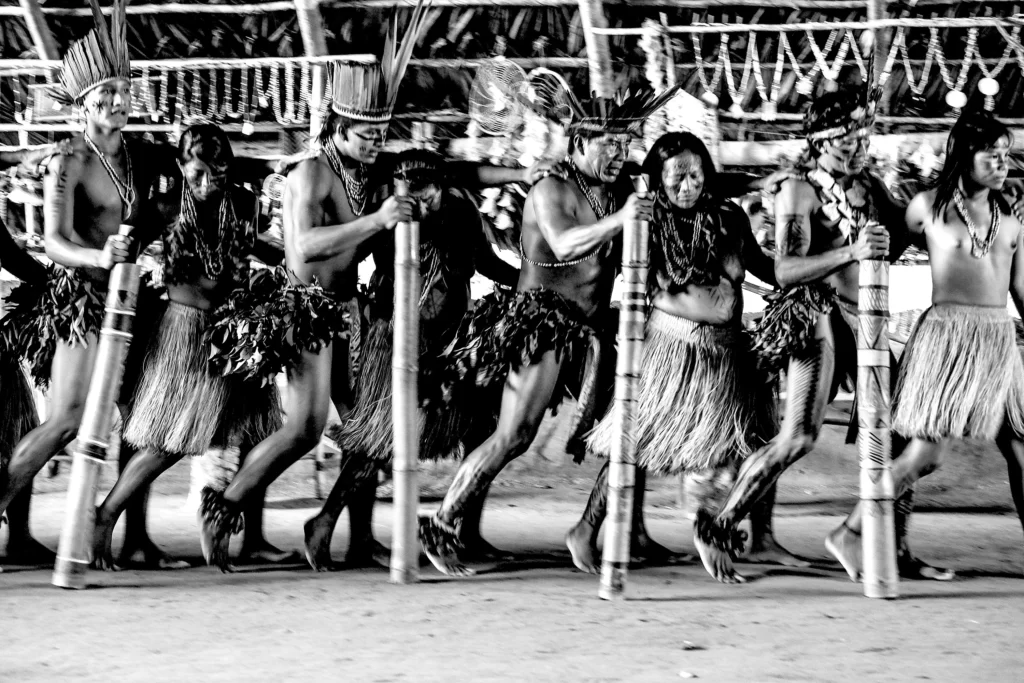
Today, the fundamental rights of Indigenous peoples in Brazil continue to be threatened by factors such as deforestation, wildfires, land grabbing, mining, the dismantling of public policies, and the marco temporal thesis. These pose immeasurable risks to indigenous survival and deepen the vulnerability of territories that should be protected.
These conflicts have intensified significantly, revealing a scenario of ongoing assaults on indigenous rights and lives. Beyond direct attacks, the failure to demarcate indigenous lands, with 62% of claimed territories still pending recognition, constitutes a form of structural violence, according to an article published by Greenpeace.
Therefore, the demarcation of indigenous lands represents much more to indigenous communities than simply defining their territories. This legal process, as established by the 1988 Federal Constitution, guarantees that indigenous peoples have their rights respected.
In addition to autonomy and protection, geographic definition provides communities with a safer and more stable territory where they can develop socially while preserving their cultures, managing their natural resources, and accessing specific public policies, such as healthcare and education tailored to indigenous needs, ensuring a dignified and respectful life within their communities.
But what changes immediately when indigenous land is demarcated?
Beyond safeguarding fundamental human rights, including healthcare, education, ethnic preservation, security, the right to development, housing, and other social rights, demarcation also brings another important benefit: environmental protection.
According to a feature article published by Revista Fórum, indigenous lands also play a central role in preserving biodiversity and combating climate change. “However, the approval of the Marco Temporal Law could potentially result in the loss of indigenous peoples’ rights to the lands they need for their subsistence and continued existence,” researchers from the Federal University of Goiás point out. Data show that 85.7% of endangered species are protected in indigenous lands. Of these, 35.5% are found in lands officially recognized by 1988, while 80.27% are found in lands recognized after the Constitution was enacted and 74.8% in areas that have not yet been officially recognized.
The delay in the demarcation process has led to serious conflicts in these territories, marked by the criminal actions of land grabbers, logging companies, illegal large-scale farming and ranching, and other extractive activities. This is the case of the Guarani Kaiowá indigenous people in Douradinha, in the state of Mato Grosso do Sul. On July 13, 2024, the indigenous people reclaimed part of the territory they consider ancestral to the Panambi-Lagoa Rica Indigenous Land (IL). The IL has already been officially recognized and its boundaries defined, but the demarcation process has been stalled since 2011, according to an article published by Brasil de Fato.
What is the marco temporal?
The marco temporal (time frame) thesis is a proposal to change the current rules governing the demarcation of indigenous lands. Under this proposal, indigenous peoples would only be able to claim lands they occupied or were actively contesting as of the enactment of Brazil’s current Constitution in 1988. In 2023, the Federal Supreme Court (STF) ruled that the thesis was unconstitutional, sparking intense debate and leading to the approval by the Senate of Bill No. 2,903/2023, which gave rise to the Marco Temporal Law.
In other words, indigenous peoples would lose the right to have lands demarcated that were historically theirs but were invaded, occupied, and improperly exploited throughout the centuries of colonization and up to the present day.
As a result, indigenous peoples have faced a series of challenges that threaten the social and cultural survival of their communities. In an interview with G1, philosopher, activist, and writer Ailton Krenak described the debate over the marco temporal as a legal aberration that should not be treated as a constitutional matter. He emphasized that the Federal Supreme Court (STF) has already ruled on the issue and found the proposal unconstitutional.
In an increasingly polarized political environment, marked by growing pressure from the agricultural sector and the oppression of indigenous representatives, the situation is delicate. The future of indigenous lands is being shaped by political decisions made by non-indigenous groups, with Indigenous Peoples lacking adequate representation within the judiciary. The issue has repeatedly returned to the STF for consideration, with no definitive resolution.
The demarcation of indigenous lands is directly connected to issues of justice, human rights, and sustainability in Brazil. That is why it is essential that the voices of indigenous peoples be heard and respected, and that their historical and cultural rights be recognized.
If you want to support this cause, join Brazil Fund in defending the rights of indigenous peoples. Only by doing so can we build a more just and democratic country where the diversity of indigenous peoples is valued and preserved.