



Photo credit: Marcos Jadir de Souza/Brazil Fund Archive
Many people think that if they cannot afford to make a large donation, they might as well not contribute at all. After all, what difference can a donation of BRL 20, BRL 30, or BRL 50 make when an organization is facing such complex challenges?
On its own, perhaps not much. But that changes when many people contribute on a regular basis.
A small monthly contribution, combined with those of hundreds of other people, can become an important resource for keeping an organization running. Beyond funding a specific activity, recurring donations help provide financial predictability, allowing organizations to retain their teams, maintain their structures and activities, and have greater security when planning their work.
The math is simple: An individual contribution may be small, but together, those contributions can make a significant difference.
If 100 people donate BRL 20 a month, that adds up to BRL 2,000 every month. Over the course of a year, that becomes BRL 24,000. The same applies to larger or smaller amounts. What matters is not only how much each person can give, but the ability to bring different contributions together in support of a cause.
What does a donation help maintain?
When we think of a civil society organization, we often associate its funding with a visible activity: a workshop, a service, a campaign, or the distribution of food. But for these activities to happen, there is an entire structure behind them.
There are professionals who need to be paid, spaces that need to be maintained, bills that need to be paid, as well as equipment, communications, transportation, accounting, and a range of other costs that are not always visible when we talk about the work being carried out.
Having their own predictable resources helps organizations maintain this structure and avoid relying exclusively on one-off projects or new funding to continue operating.
This can also mean greater autonomy. An organization with a base of supporters can count on a source of funding that is not necessarily tied to a specific grant call or a particular activity.
This capacity makes a difference, especially when unexpected situations arise. In times of crisis or emergency, organizations that already have the necessary structure and resources can respond more quickly to the needs of their communities and territories.
Small contributions help build a headquarters
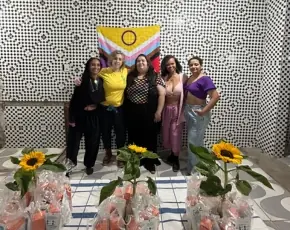
Photo: Coletiva Resistência Lésbica da Maré Archive
The story of Coletiva Resistência Lésbica da Maré (Maré Lesbian Resistance Collective), in Rio de Janeiro, shows how resource mobilization can help strengthen an organization.
Founded in 2017 in the Complexo da Maré by five lesbians, four of them Black women, the Collective works to organize lesbians around the struggle for access to human rights in Rio’s favelas. Its work focuses on combating racism, sexism, lesbophobia and transphobia, while creating a space dedicated to diverse forms of womanhood.
Between 2022 and 2025, the organization provided more than 180 in-person psychological support sessions, 80% of which were accessed by Black women. In addition to psychological support, offered both in person and online, the Collective also distributed food baskets.
It was during this period that a dream began to take shape: to have a headquarters of their own, a space to welcome and strengthen lesbian, bisexual, and trans women.
It was during a fundraising workshop organized by Brazil Fund as part of a Project Gathering that the Collective learned about different resource mobilization strategies. One of them was direct mail, which involves sending letters soliciting voluntary donations, with suggested amounts that can be adjusted according to each person’s means.
The strategy helped the organization raise funds to purchase furniture and set up the new space. With donations and support from the Brazil Fund, the Collective was able to pay off Casa Resistências in 2025, which has since become its headquarters.
Having a space of its own was not the result of a single major donation. Rather, it grew out of a process of resource mobilization and building organizational autonomy, allowing the collective to expand and sustain its work.
How to donate?
At Brazil Fund, it is possible to make recurring donations and help ensure the continuity of other projects like this one.
One way for individuals to support human rights is through the Nota Fiscal Paulista Program. Registration is done only once and turns you into a recurring donor without requiring you to spend anything beyond what you normally would. The amount comes from a portion of the ICMS tax paid on the purchased product, and any purchase can generate a donation.
When donated, the amount can be worth up to 20 times what the system would otherwise generate as a return for the consumer. In 2021, Brazil Fund reached BRL 1 million raised through Nota Fiscal Paulista. This amount is enough to support 25 projects.
In addition to the Nota Fiscal Paulista, it is also possible to contribute directly through the donation form, where you can choose how much to donate each month or make a one-time donation.
Learn more >> How to Support