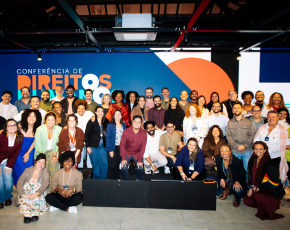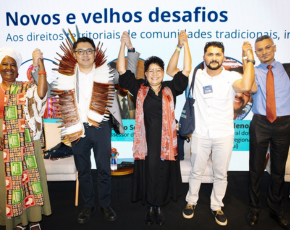






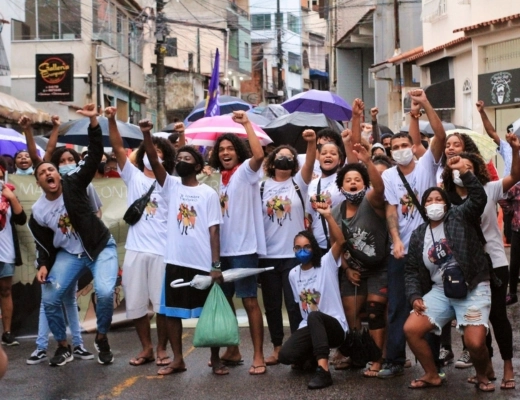

Mateus Araújo, Caê Vatiero, Rafaelly Wiest e Rildo Veras | Foto: Rebeca Figueiredo
It has been fifteen years since Brazil’s Federal Supreme Court (STF) first recognized same-sex couples’ rights to civil partnerships. However, the LGBTQIA+ community is now facing new barriers to securing their rights and developing policies to protect them.
The first day of the Human Rights Conference – Civil Society, Brazil’s Challenges, Philanthropy, and the Next 20 Years, hosted by Fundo Brasil, ended with a panel discussion titled From Court to Congress: Obstacles to LGBTQIA+ Rights in the Legislature, which discussed the new difficulties faced by this group. Moderated by journalist Caê Vatiero, the discussion brought together Rafaelly Wiest, from the Dignity Group; Mateus Araújo, from the Diadorim Agency; and Rildo Veras, from the Lions of the North Movement.
Yuri Cantizano, a trans man and an activist, opened the discussion by recounting his journey and work in producing data on violence against the LGBTQIA+ population. As a researcher at NGO Conexão G, he participates in annual surveys on the topic, and shared how his work has brought him closer to stories similar to his own.
He pointed out that, in 2026, a report produced by the Observatory of LGBTI+ Deaths and Violence recorded 230 deaths of LGBTQIA+ people in Brazil. “This is the official number that has been reported. How many others are there that we don’t know about?”, he asked. For Yuri, producing data means putting pressure on public authorities; indeed, civil society organizations have been performing a function that should be institutional.
Caê Vatiero summarized one of the dilemmas found in this discussion: despite the progress achieved by the movement, many of them took place at the Judicial level, while the Legislative branch remains an arena of dispute, without as much progress.
Mateus Araújo presented data from Observatória, an initiative created in 2024 to monitor bills of law related to LGBTQIA+ rights at the National Congress and at state legislative assemblies. The survey compiles proposals created since 2019 and points toward a change in the landscape. Between 2019 and 2025, projects favorable to the LGBTQIA+ population were more numerous than those opposed. Around May 2026, there was a reversal in that trend.
Mateus also highlighted a change regarding the themes of the proposals: gender-neutral language had been at the heart of initiatives against the LGBTQIA+ population for years, but schools have now become one of the main targets. In the Senate, six proposals were presented against LGBTQIA+ rights in 2025, compared to none the previous year.
Territory Also Defines Access
Rildo Veras took the discussion to the inner state of Pernambuco. According to him, although the recognition of LGBTphobia as a crime represented progress, laws and judicial decisions alone are not enough to guarantee its enforcement.
The Lions of the North Movement worked to expand the production of data on violence in Pernambuco and created an app called Rugido (Roar, in Portuguese), which allows users to register complaints with location, photos and videos and track their progress.
For Rildo, the gap between law and reality becomes evident when public policies remain concentrated in the capital. “Depending on your life’s circumstances and zip code, you may have more access, some access, or no access to public policies to benefit the LGBTQIA+ population,” he said.
The mobilization also reached the Pernambuco Legislative Assembly. This year, following coordination with local organizations, a Parliamentary Front for Community Civic Rights was created. He also pointed out that public hearings were held in smaller towns in inner Pernambuco to bring parliamentarians closer to the different realities found in the state.
Representativeness and Electoral Dispute
For Rafaelly Wiest, having a presence in the Legislative branch is key to ensuring that rights will be protected—as presidents, governors, and mayors require legislators’ approval of their policies. She defended the presence of more LGBTQIA+ people in positions of power, but stressed that their actions should not be limited to identity politics.
Communication was also identified as a tool for this fight. The Diadorim Agency makes news reports available for republication and has created a tool to monitor the government programs of candidates running for president and state governors, identifying proposals targeting sexual and gender minorities.
According to Rildo Veras, speeches that incite violence or discrimination cannot be protected by freedom of expression; and Rafaelly advocated a strategic approach: where it is not possible to directly address transphobia, defending human rights more widely can expand the reach of the agenda.
Given the current electoral landscape, participants emphasized the importance of organization and mobilization. Initiatives such as Vote with Pride, promoted by the National LGBTQIA+ Alliance, cited by Rafaelly, promote support and exposure for candidates committed to this agenda.