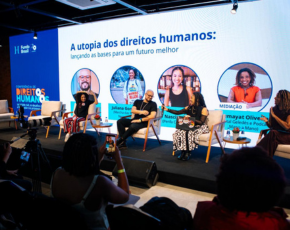




Fábio Pontes, Andréia Coutinho, Maryellen Crisóstomo, Sineia Wapixana e Maureen Santos | Photo: Rebeca Figueiredo
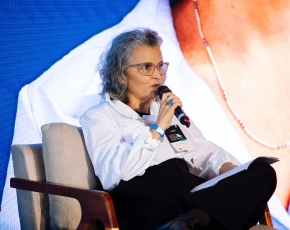
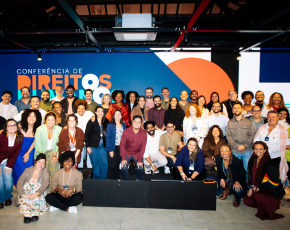
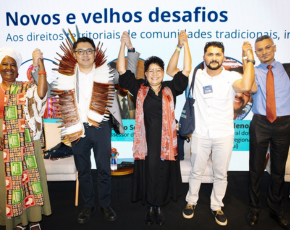
The role of Indigenous peoples, local communities, and social movements in decisions regarding the climate crisis was addressed at the Human Rights Conference – Civil Society, Brazil’s Challenges, Philanthropy, and the Next 20 Years, hosted by Fundo Brasil. Panelists included Andréia Coutinho, executive director of the Brazilian Center for Climate Justice; Maryellen Crisóstomo, a journalist and Quilombola from the Baião territory; Maureen Santos, a leader in climate justice efforts and political scientist; and Sineia do Vale, COP’s Special Envoy for Indigenous Peoples. They discussed progress and constraints affecting people’s participation at the Conferences of the Parties (COPs), with Fábio Pontes, executive editor of the Varadouro newspaper, acting as moderator.
Despite All Progress, Participation at COPs Still Presents Challenges
As a representative of the Wapichana people from the state of Roraima, Sineia stated that the presence of Indigenous peoples at the conferences results from decades of mobilization. COPs are annual events promoted by the United Nations that bring together nearly 200 countries to discuss and make decisions about climate change and the fate of the planet.
According to her, participation in these spaces was not granted by governments, but conquered by the peoples themselves. Since the United Nations Conference on Environment and Development, Rio-92, a precursor to the current COP model, organizations representing Indigenous communities have expanded their activities in international climate discussion forums.
According to Sineia, COP30, held in Brazil in 2025, was an important step forward in this process. The conference methodology expanded the spaces allocated to civil society, with more than 600 Indigenous leaders in attendance.
Maryellen Crisóstomo, a Quilombola herself (member of a community descended from escaped slaves) and a journalist, argued that, despite all progress, the very language used at COPs may impose a barrier to participation. The lack of proficiency in technical terms and in English—the predominant language for negotiations—makes it difficult to connect with representatives from the territories. “Using technical terms are also a form of exclusion,” she said.
She also emphasized the importance of recording the commitments made during the conferences in official documents. “Only what is written will become a commitment by the States.”
Actions Beyond the Conferences
Andréia Coutinho, executive director of the Brazilian Center for Climate Justice, pointed out that the debate about climate justice also involves communication. According to her, there is a degree of inequality in the coverage of climate events: events in São Paulo or Rio de Janeiro receive greater attention, while what happens in regions such as Acre may take days to reach national media. Expanding knowledge about the climate agenda, in her view, requires accessible language and journalistic production capable of bridging the gap between international discussions and local realities.
Local participation, however, should not be limited to attending conferences. Andréia highlighted the need to broaden access to information about the COPs and their main concepts, especially among social movements and organizations. Language is part of this dispute, since understanding the terms and processes of the conferences is necessary for different groups to follow the negotiations. “Communication is power, journalism is power, language is power,” she stressed.
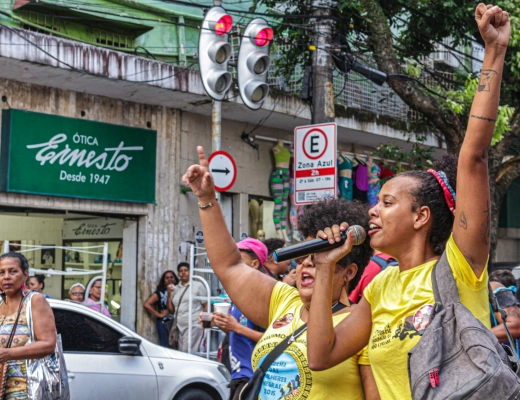
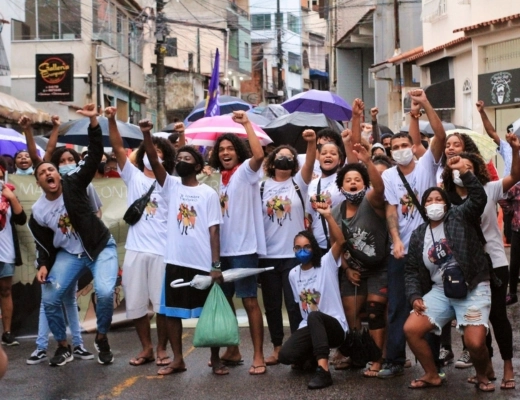
Maureen Santos, a political scientist, also drew attention to the processes that are developed outside the official spaces of the conferences. The People’s Summit, for example, functions as a space for resistance and for building alternative solutions in the face of the constraints that limit participation in formal negotiations.
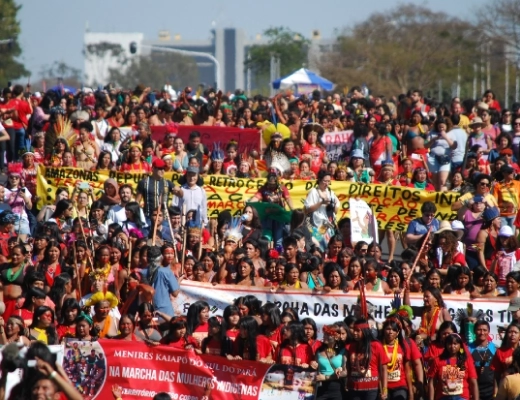
The People’s Summit in Belém was developed over two and a half years, and brought together social movements and Indigenous, Quilombola, Black, and women’s organizations, as well as unions and international networks. The process began with around 40 associations and grew to over 1,500, according to her. She added that one of the main legacies was the expansion of the climate agenda among movements that previously did not see it as one of their priorities.
At the end, the panelists and the moderator argued that people’s participation in COPs should not be seen as an isolated goal. Building climate justice depends on how we organize our work within communities, producing knowledge, communicating, securing funding, and exerting pressure on governments. Participation in the COPs would therefore be part of a broader mobilization effort that continues before, during, and after each conference.
*Lucas Miranda, member of Jornalismo Júnior at the School of Communications and Arts of the University of São Paulo (USP), under the supervision of journalist Mônica C. Ribeiro.