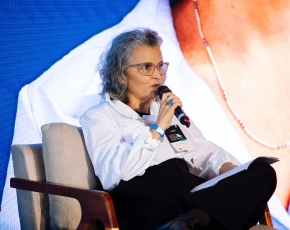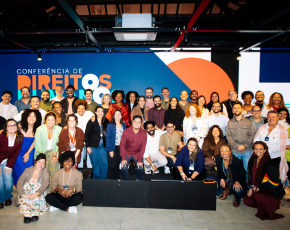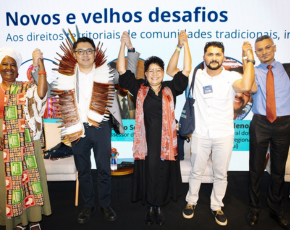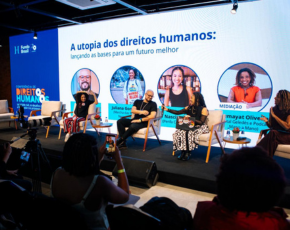




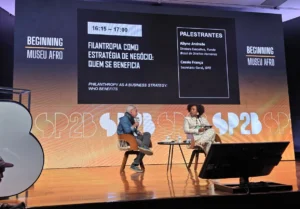
Allyne Andrade and Cássio França discussed how philanthropy can bring resources closer to those creating solutions in their territories. Photo: Mônica Nóbrega / Brazil Fund Archive
Corporate social responsibility has become a global agenda and a market imperative. In this context, philanthropy can be a strategic partner in driving the growth and strengthening of the very ecosystem in which businesses thrive.
This was the focus of the panel “Philanthropy as a business strategy: Who benefits?”, held on Tuesday, August 11, as part of the SP2B program, a major innovation and business event in the city of São Paulo. Featuring Allyne Andrade, Executive Director of Brazil Human Rights Fund, and Cássio França, Secretary General of the Group of Institutes, Foundations and Companies (GIFE), the discussion explored the role of philanthropy in ensuring that companies’ impact capital achieves its intended goals.
According to the speakers, moving from a model based on one-off investments toward structural outcomes requires more strategic partnerships. Long-term collaborations that draw on philanthropic organizations’ experience in supporting social causes can increase the impact of corporate investments in the ESG agenda.
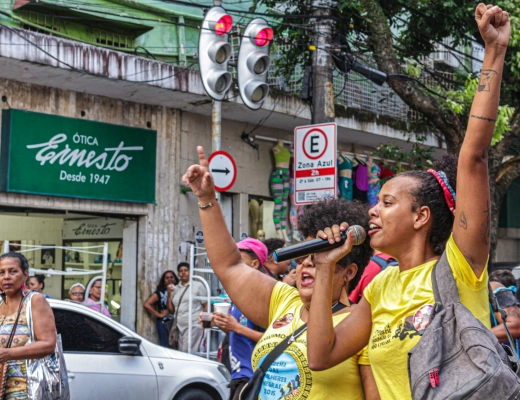
In explaining the role of social justice and socio-environmental philanthropy in this context, Allyne Andrade emphasized the paradigm shift as essential in ensuring that partnerships can benefit everyone involved. “The paradigm shift proposed by this form of philanthropy is based on recognizing that people, communities, and territories affected by material deprivation and a lack of rights also develop solutions to these problems,” said the Executive Director of Brazil Fund.
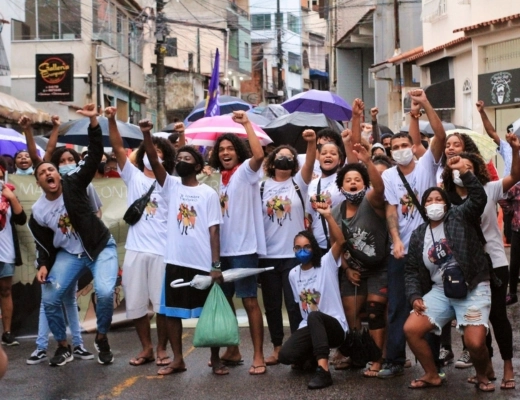
Because they engage with these challenges on a daily basis, grassroots communities develop practical adaptations and solutions of their own. These innovations emerge from lived experience and are tested in real-world contexts and often require little more than support to thrive and, in many cases, scale up.
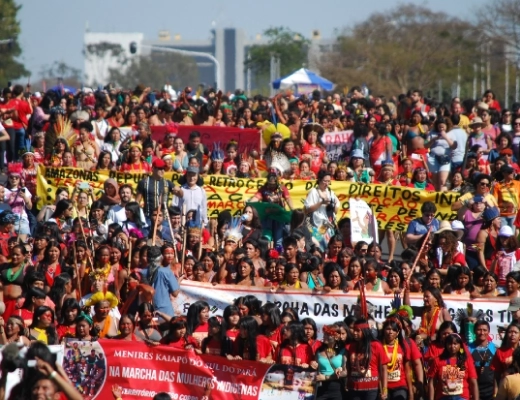
Allyne also pointed out that Brazil Fund is celebrating 20 years of work, during which it has mobilized BRL 140 million for more than 2,300 initiatives across every region, state, and territory in Brazil, including the most remote areas, where funding for social causes often fails to reach.
“This is the result of a solid track record of continuous dialogue with grassroots groups and collectives, as well as with medium-sized and large organizations that help connect these individual efforts into broader networks and multiply their impact,” Allyne Andrade said. “Building and sustaining relationships of trust in these territories is not easy. That is exactly what Brazil Fund knows how to do and has been doing for 20 years. It is why we are able to get resources to these grassroots groups and territories and ensure they fulfill their purpose.”
Donation culture

“Above all, it is a way of taking part in creating the future,” Allyne Andrade emphasized when discussing the role of philanthropy at an SP2B panel. Photo: Mônica Nóbrega / Brazil Fund Archive
Cássio França, Secretary General of the Group of Institutes, Foundations and Companies (GIFE), said that Brazil needs to strengthen its donation culture and foster a collective understanding that donating and continuously supporting social causes is a way of taking responsibility for finding solutions to the country’s challenges.
“[Brazilian companies] need to donate more and also talk about it to engage their peers,” he said, noting that research on donation culture in Brazil shows that a sense of collective responsibility is the main driver of individual donations. This is an approach that the business sector needs to embrace.
He also stressed that philanthropy is not “something only the wealthy can afford,” nor is it the sole responsibility of large corporations. As the panelists noted, participation is possible regardless of the resources available, because contributions of every size can make a difference.
Brazil Fund for Human Rights has partnership models that accommodate companies of different sizes. For small and medium-sized businesses, one option is to connect donations to sales, allocating a small portion of the amount consumers pay for a product or service to the cause.
“We know that supporting social causes and helping strengthen communities can enhance reputation and brand value, create more authentic connections with consumers, and strengthen relationships throughout the supply chain. But above all, it is a way of helping create the future, a commitment to solutions, innovation, and our country’s development,” Allyne Andrade said.
Impact infrastructure
Social justice and socio-environmental philanthropy are valuable assets for companies seeking to engage in civic participation.
“The main message is that the infrastructure to mobilize these resources already exists, helping ensure that impact capital reaches where companies want it to go. When these resources are well deployed, they can genuinely foster solutions for Brazil,” said Allyne.
“Brazil Fund wants to broaden this conversation with companies, individuals, and small and medium-sized business owners. We also want to learn and do this together,” she concluded.