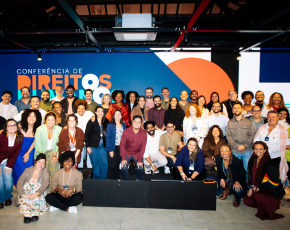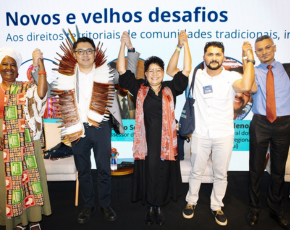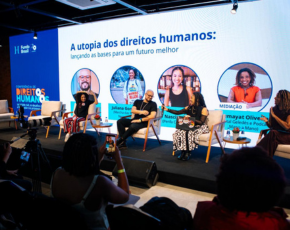






Flavia Scabin, Tamara Monzani, Gabriela Caseff, Cristina Orpheo, Natália Cerri and Cássio França I Picture: Rebeca Figueiredo
In the second day of the Human Rights Conference – Civil Society, Brazil’s Challenges, Philanthropy, and the Next 20 Years, hosted by Fundo Brasil, conducted in commemoration of the foundation’s twenty years, representatives from private initiatives and independent philanthropy discussed the contradictions that involve the financing of organizations that act in defense of rights. The “Companies and human rights: how to ensure the efficiency of financing for civil society organizations?” roundtable took place in the second day of the event and also brought to debate possible solutions for the problem.
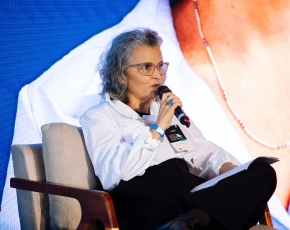
The need to transform philanthropy into a continuous practice, and not punctual or restricted to crisis periods, was one of the main topics of debate. Gabriela Cassef, a reporter from Folha de S.Paulo and mediator of the roundtable, alongside Cristina Orpheu, executive director of the Casa Socioambiental Fund; Tamara Monzani, from the BNP Paribas Cardif insurance; Cássio França, secretary-general of the Group of Institutes Foundations and Companies (GIFE); Flavia Scabin, director of the center of Human Rights and Companies of FGV; and Natália Cerri, manager of Itaúsa, brought to the discussion the current scenario of underfunding to humanitarian causes.
Though there are different perspectives on the subject, speakers converged with regards to the private sector’s participation. Cristina, for instance, highlighted that the partnerships with the private sector are still recent and need to be strengthened in order to expand the access to resources in the territories. According to her, the presence of national philanthropy in the funding for rights is still small when compared to international funding, which proves concerning when faced with the reduction of foreign donations that has manifested from the demobilization of USAID – an agency by the United States government aimed towards international development.
For Tamara, the mediation between companies and supported communities undertaken by structured philanthropic organizations is essential to the continuity and results of the initiatives. In the meantime, Cássio not only agreed, but also complemented the quote with regards to the network that these entities form amongst themselves: “the Brazil Fund’s reach shows that this process doesn’t need to be bureaucratic. If it’s a problem for the company’s compliance, we take it up”.
Contradictory relationship
The relationship between private institutions and human rights causes may also prove quite tense. “Many of the conflicts tied to human rights are related to companies. The community needs to feel safe that it’s not threatened by its own backer”, observed Flávia about the contradiction present in philanthropy.
Natália for her part complemented that private funding can’t moderate the discourse of civil society organizations. Afterwards she questioned the limits between philanthropy and obligation, especially by companies. The matter reverberated up to the end of the session, since, as put by herself, all economic activity generates effects on human rights.
“Supporting civil society is a choice by companies, but respecting and promoting human rights is an obligation”, affirmed Natália. That affirmation was partially contested by Cássio França, secretary-general of GIFE. According to him, in a country marked by social and economic inequalities, such as Brazil, it’s hard to consider corporate acting in social actions as purely voluntary actions. “I have many doubts about ‘being voluntary’, [after all] companies are co-responsible for inequality”.
The perspective was complemented by Cristina Orpheu, from the Casa Socioambiental Fund, who related Brazilian inequality as a historical debt, fruit of accumulation of wealth – such as financial, material, or valuable assets. For her, the support of companies to socioenvironmental causes is a reparation, not a favor. In practice, however, this commitment falls into limits of convenience, as happened during the fires in the Amazon in 2019. Cristina highlighted that, despite the critical nature of the event, the mobilization of private enterprises only took force when the smoke reached the great urban centers of the Southeast.
This logic of convenience has a structural face. Local communities, Indigenous peoples, and quilombolas contribute to the preservation of biomes that sustain entire sectors of the economy. Which makes philanthropy less a generous gesture and more a way of retribution for something from which the market already benefits.
For Flavia Scabin, from the Human Rights and Companies center of FGV, reparations aren’t enough. “Before donating, it’s necessary to do the homework and ensure that these companies aren’t causing even more impacts”, she affirmed.
As for the obligations of the private sector, Natália Cerri, from Itaúsa, highlighted that investing in actions of social impact is even more cost-effective than fulfilling the legal duties within a company’s value chain. From that, the speakers debated how to balance these contradictions and agreed that, first, it’s necessary to acknowledge that there are different interests between the parts in order to, later, focus on that which is similar between the purposes of companies and organizations.
Democracy as a condition to philanthropy
Beyond the discussion about obligations, mediator Gabriela Cassef questioned the roundtable members about the future of human rights in electoral periods. For Cristina, it’s a recurring challenge, exemplified by the advancement of climate denialism and episodes of violence against local communities registered in previous electoral years. She also pointed out that the financing to causes is usually used as a political instrument by elites and governments, as per the moment’s convenience. The funds of socioenvironmental justice philanthropy, on the other hand, keep the firm commitment with communities and territories.
Still, apprehension about the following years – since the presidential election takes place in October next month – has been constant. That uncertainty goes through the relationship with the private sector in a different manner. Maintaining the ongoing investments regardless of the election’s results was pointed out by Tamara Monzani, from BNP Paribas Cardif, as one of the greatest challenges. That’s because, for companies, the difficulty is in sustaining that flow in moments of instability for their own businesses.
Even in critical moments, Cássio recalled that no company has ever gone broke for doing philanthropy, which brought him to question if taking a stand in defense of democracy represents, in fact, a risk to reputation or if that’s just a perception that has never been tested. To him, defending democracy is not taking a stand for parties or candidates, but defending agendas such as tackling racism and sexism. And not taking a stand for that is, to him, the true problem.
*Alicia Dias, member of Junio Journalism in the School of Communications and Arts of the University of São Paulo, under supervision of journalist Mônica C.Ribeiro.