





Rosane Borges, Guacira de Oliveira, Betânia Ávila, and Lola Ferreira | Photo: Rebeca Figueiredo
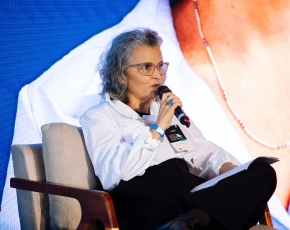
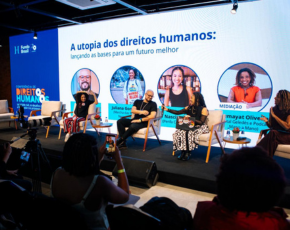
Statistics and news reports clearly show an increase in the number of cases and new forms of violence against women. With a view to addressing this problem, new protection mechanisms and strategies are constantly being developed. The second day of the Human Rights Conference – Civil Society, Brazil’s Challenges, Philanthropy, and the Next 20 Years, hosted by Fundo Brasil, featured a session titled Infodemic of Violence Against Women: How to Address the New Challenges in Gender-Based Violence?, mediated by journalist Lola Ferreira. Panelists included Betânia Ávila, a researcher and cofounder of SOS Corpo—Feminist Institute for Democracy; Guacira de Oliveira, a sociologist and cofounder of the Feminist Center for Studies and Consulting (CFemea); and Rosane Borges, a journalist and professor at PUC-SP.
Decades of Fighting for Rights
In 2025, 1,571 women were victims of femicide in Brazil, according to the 20th Brazilian Yearbook of Public Security. This record number highlights the persistence of violence against women and reinforces the need for policies and actions aimed at stopping it.
Gender-based violence is a historical reality in Brazil. Thanks to decades of mobilization by feminist movements claiming for women’s rights and representation, we now have a space where to address it publicly, as pointed out by sociologist Guacira.
The 1988 Federal Constitution represented a milestone along this journey, establishing—for the first time in the history of Brazil—equal rights and obligations for men and women. However, the fact that this recognition came so late confirms that the path toward formal equality is very long.
Another milestone was the Maria da Penha Law, enacted in August 2006, which represented an important step forward by establishing mechanisms for physical, psychological, financial, sexual, and moral protection for women in situations of violence. Nevertheless, available data show that there is still much to fight for.
Challenges in Combating Violence
Guacira explained that the State lacks policies to protect women—in particular, to prevent violence from happening. This gap is filled by community organizations and social movements, which offer support to victims, she explains.
Researcher Betânia Ávila stated that the high number of negative news reports to which people are exposed day after day, whether related to gender violence or not, does not allow time for awareness-raising and outrage. “With so much violence, we end up being exposed to a process of social desensitization,” Guacira added. Journalist and professor Rosane Borges agreed with the other speakers and asked how it is possible to promote justice if there is no outrage or indignation in the face of violence.
She pointed out that such violence primarily affects Black women. Last year, 65.1 percent of all femicide victims were Black. She also revealed another alarming fact: Brazil is the fifth country that kills the most women in the world, according to the World Health Organization (WHO).
The sexist and patriarchal mentality that governs the country is another obstacle to fighting gender violence, highlighted Guacira. “Preventing the barbarity that women suffer is a process we need to build together to transform hearts and minds in this violent country,” she stated.
Public Policies and Collective Action
Guacira stressed the importance of more effective policies to protect women: “The State needs to take action regarding this.” The speakers also emphasized the importance of working together in fighting the current situation. “There is no way forward without organization and collective action,” explained Betânia.
As a way to overcome this sexist and patriarchal culture, Betânia argued for the need of a feminist, antiracist education for all. She ended the discussions stressing the importance of collective action to address the current situation: “Suffering doesn’t change the world. Only rebellion against suffering may change the world, and rebellion against suffering will only change the world if it is collective rebellion.”
*Lucas Miranda, member of Jornalismo Júnior at the School of Communications and Arts of the University of São Paulo (USP), under the supervision of journalist Mônica C. Ribeiro.