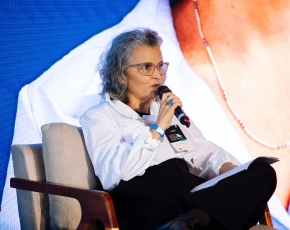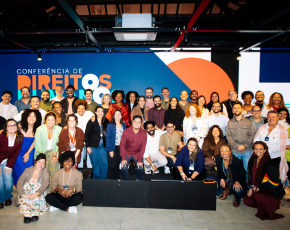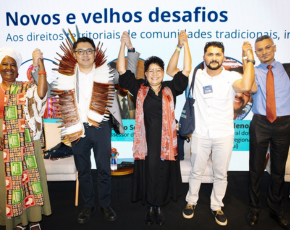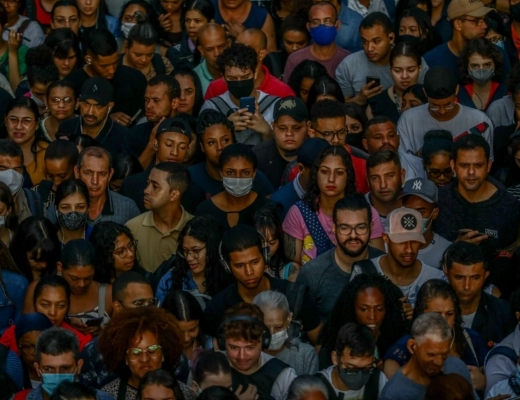
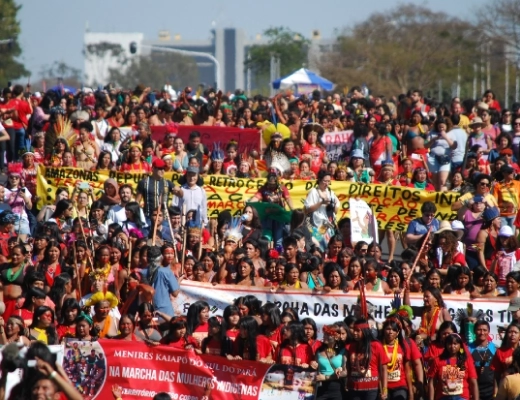





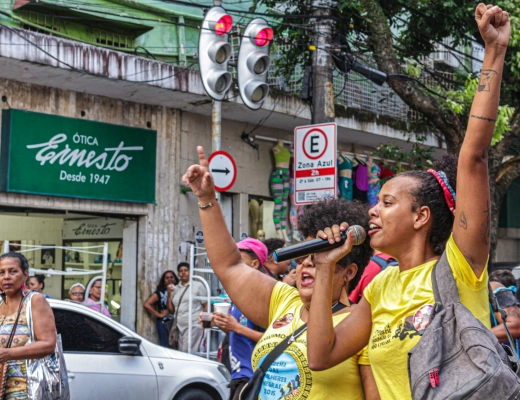
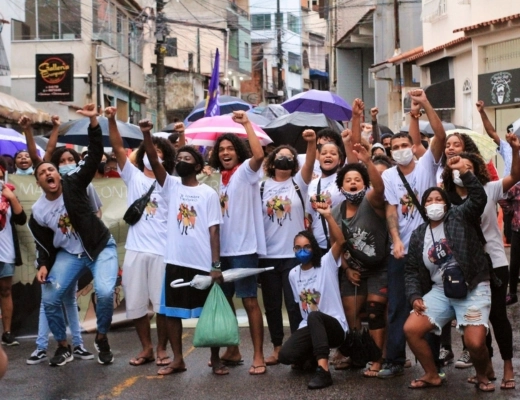
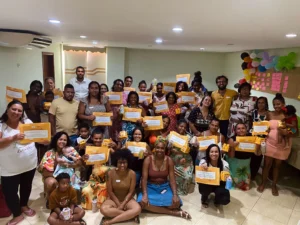
Warriors for Decarceration. Photos: ISER
When family members of people deprived of their liberty are confronted with misinformation, rights violations, and stigmatization, legal and political education initiatives can mean the difference between isolation and collective action. This is the premise behind Warriors for Decarceration, a project developed by the Institute of Religious Studies (ISER) with support from the Brazil Human Rights Fund.
Since 2022, the initiative has trained more than 100 participants across different territories in the state of Rio de Janeiro. The vast majority are women — mothers, wives, daughters, and sisters of people deprived of their liberty or subject to the socio-educational system. During the training sessions, participants gain knowledge about their rights, the workings of the justice system, police approaches, socio-educational measures, and strategies for demanding guarantees that are often denied to them.
Support from the Brazil Fund enabled the initiative to expand. According to Ane Clarissa dos Santos Rocha, an advisor with ISER’s Rights and Justice System team, the funding made it possible to bring the training to new territories and strengthen its structure.
“Reaching Três Rios, Rio de Janeiro, and Campos dos Goytacazes was possible thanks to the funding from the Brazil Human Rights Fund. It was from that point on that we were able to increase the size of the group, improve the stipends, carry out all the work we do, and take the initiative to another city. We were able to expand so much because of the support from the Brazil Fund,” she says.
The funding also covers expenses that may be invisible to those outside this reality but are essential to ensuring that participants can remain in the program. Transportation costs, food, and stipends are all part of the training’s structure.
“We need funding for everything. People need to get to the training. Many of them do not have jobs. We don’t think it’s fair to expect someone to spend BRL 30 or BRL 40 out of their own pocket just to participate in a training program. Food is a basic necessity for us; it’s a matter of dignity,” Ane sums up.
Information that strengthens
Warriors for Decarceration was born from an often-overlooked reality: women are, for the most part, the ones who maintain family ties with incarcerated people, standing in visiting lines, traveling long distances, and navigating a daily routine marked by a lack of information about their rights.
“These are the women standing in the visiting lines. They are usually the ones seeking to secure the rights of their children, husbands, and siblings who are deprived of their liberty,” Ane explains.
The choice of the project’s name also speaks directly to this experience.
“What do you call a woman who gets up at three in the morning, faces rain and scorching sun, and spends hours in line just to visit a family member, if not a warrior?”, she asks.
In the training sessions, participants discuss topics ranging from what constitutes an arrest in flagrante delicto to the rights of adolescents undergoing socio-educational measures. The aim is to provide them with information that rarely reaches the communities most affected by incarceration.
According to Ane, knowing their rights brings about concrete changes in the lives of participants and their communities.
“When we tell them that they have the right to attend an adolescent’s hearing, or that adolescents cannot be held in a police station alongside adults, it can be surprising and even infuriating—but it also leads to political organization.”
The initiative has had an impact well beyond the training sessions. Many participants go on to support other families, set up support groups, and coordinate collective efforts in their communities.
“The impact of Warriors for Decarceration is immeasurable. We plant a seed. When they come back, they tell us that they’ve helped another mother, organized a group, or managed to secure rights for someone in their community. There’s no way to quantify that.”
A book written by those who live the reality of incarceration
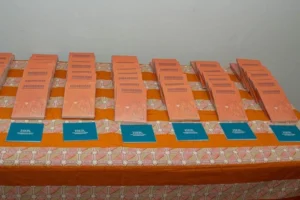
Warriors for Decarceration book. Photo: ISER
In 2025, ISER published the book Warriors for Decarceration, drawing on the experiences of participants in the program’s first training cycles.
The publication brings together testimonies, reflections, and analyses of the impact of incarceration on families, particularly on women who take on the responsibility of caring for their loved ones and advocating for their rights.
The writing process sought to preserve the participants’ leading role. Some of the texts emerged from evaluations conducted at the end of each training cycle, while others were written or collectively organized by the women themselves.
“It is a book with a great deal of collective writing. Some of the testimonies came from the evaluations, while others were written and sent to us. It was something we built together with them,” Ane says.
The book also challenges narratives that often reduce these women to their status as relatives of incarcerated people. Throughout the chapters, they emerge as the authors of their own stories, producers of knowledge, and protagonists in the struggle for rights.
The publication has already reached audiences beyond Brazil. Recently, copies were distributed at an international human rights seminar in Angola.
What comes next
After four training cycles and more than 100 participants, the challenge now is to ensure that the initiative continues and reaches even more people.
ISER hopes to strengthen the network built by the participants, bring the training to new territories, and expand political advocacy efforts focused on the rights of families of people deprived of their liberty.
The recent approval of Resolution No. 2/25 by the Inter-American Commission on Human Rights — which recognizes the impact of incarceration on family members and people with close emotional ties to those deprived of their liberty — opens up new possibilities for this work.
For the ISER team, training continues to be a key tool for ensuring that women directly affected by the prison system can access information, expand their ability to demand their rights, and occupy spaces of political participation.
At the same time, there is still the challenge of engaging society on an issue that continues to face resistance and prejudice. “No one is exempt from being arrested. Anyone could be deprived of their liberty tomorrow. And, as we often say, what is taken away is freedom, not rights,” Ane emphasizes.
She believes that any discussion about justice must begin with recognizing the humanity of people affected by incarceration. “People need to be seen. It’s not just about looking. It’s about seeing. Because anyone could find themselves in that place one day.”
In a field long marked by limited resources and the stigma imposed on families of people deprived of their liberty, initiatives like Warriors for Decarceration help bring information, collective action, and rights advocacy to those who are so often left out of public policies.
Strengthening those facing the violence of incarceration
ISER’s support is part of the Brazil Fund’s Criminal Justice Program, which provides funding to organizations, collectives, and movements committed to defending rights amid mass incarceration, police violence, and other forms of State violence.
Over the last decade, the Brazil Fund has allocated more than BRL 38 million to criminal justice initiatives. This funding has helped strengthen civil society organizations, increase the participation of groups historically excluded from decision-making processes, and support important achievements, such as the consolidation of custody hearings and civil society organizations’ involvement in shaping and monitoring criminal justice policies, including the Pena Justa (Fair Sentencing) Plan.